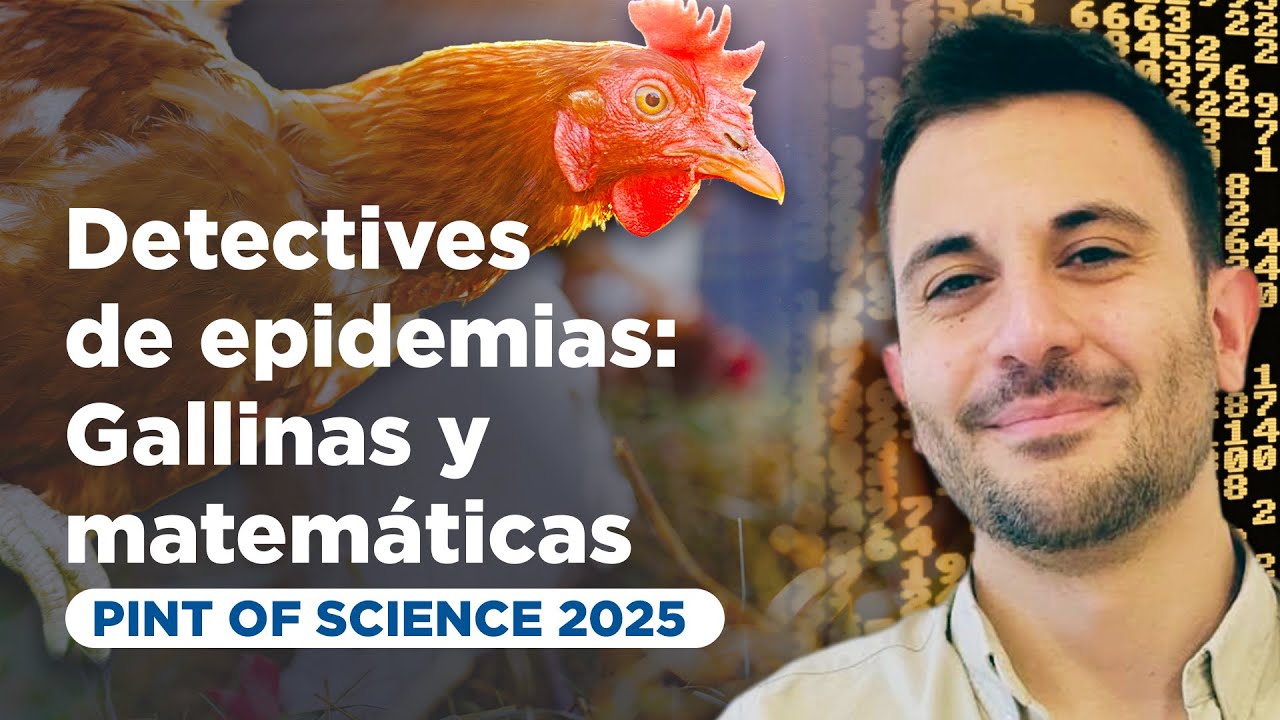
Detectives de epidemias: Gallinas y matemáticas
Keywords
Summary
164 words
Critical Evaluation
The talk is an excellent example of science communication, effectively making epidemiological concepts accessible to a general audience. The speaker, Pablo Ibáñez Porras, demonstrates a strong command of the subject matter, drawing on his background in physics and mathematics to explain complex systems in a relatable way. The use of a detective metaphor is engaging and helps structure the narrative, making the investigative process clear and memorable.
The scientific content is accurate and up-to-date, with references to recent trends in avian influenza outbreaks, including the shift from Asia to Europe and the increasing involvement of wild birds. The speaker correctly notes the implications for public health and the economy, such as rising egg prices in the United States. He also touches on the challenges of disease surveillance, including false reports and the need for multiple confirmatory tests.
The argumentation is solid, with a logical progression from the basics of the virus to the complexities of disease spread. The speaker avoids overwhelming the audience with technical jargon, instead using analogies and visual aids to illustrate key points. However, the talk is relatively brief and does not delve deeply into the mathematical models that underpin epidemiological predictions, which might be a limitation for those seeking a more quantitative understanding.
The sources cited are not explicitly mentioned in the talk, but the speaker references his affiliation with the Centro de Investigación en Sanidad Animal and mentions the use of data from disease notification systems. The description provides a link to the university’s blog, which may contain additional resources.
Overall, the talk is a valuable educational resource that successfully demystifies epidemiology and highlights the importance of complex systems thinking. It is well-paced, engaging, and scientifically sound, making it suitable for a broad audience interested in understanding how diseases spread and how scientists work to control them.
302 words
Title / Content Match
The title accurately reflects the content: the talk uses a detective metaphor to explain how epidemiologists investigate outbreaks, using chickens and avian influenza as a case study, and mentions mathematics in the context of complex systems.
Quality & Reliability
8/10
The talk is given by a researcher in animal health, presenting epidemiological concepts and data on avian influenza in an accessible manner. The content is scientifically sound, though simplified for a general audience. The speaker uses a narrative approach to explain complex systems and disease spread, and mentions real-world examples and trends. The presentation is clear and well-structured, with a focus on education rather than original research.
Key Moments
Markers derived by PSI from the transcript: the creator did not define chapters.
- Introduction to the talk and the detective metaphor for epidemiology.
- Overview of avian influenza virus characteristics and its impact.
- Presentation of data on outbreak trends and geographic shifts.
- Introduction of the characters: the chicken Catalina and the storks.
- The detective investigation: tracing the source of the outbreak.
- Discussion of the complexity of real-world outbreaks and the role of complex systems.
- Conclusion and emphasis on the importance of epidemiological research.
Cited Sources
- UBUInvestiga Blog — The speaker's university research blog, mentioned in the video description as a source for more scientific outreach content.
Concurring Sources
- WHO Avian Influenza Fact Sheet — The World Health Organization provides up-to-date information on avian influenza, which aligns with the talk's discussion of the disease's impact.
Contribution & Novelties
The talk provides an engaging and accessible introduction to epidemiology, using a detective narrative to explain how outbreaks are investigated. It highlights recent trends in avian influenza, such as the shift in geographic focus and the increasing role of wild birds, which are relevant for public health and veterinary science.
Pour aller plus loin :
- Epidemiology (Wikipedia) — Provides a comprehensive overview of the field, including methods and applications.
- Avian influenza (WHO) — Official information on avian influenza, including current outbreaks and public health guidance.
- Complex systems (Wikipedia) — Explains the concept of complex systems, which is central to the talk’s discussion of disease spread.
105 words
Radar Profile
The radar profile shows a balanced performance across all dimensions, with particularly high scores in quality of information and reliability, reflecting the speaker's expertise and the accurate presentation of epidemiological data. The lower score in technical level is appropriate for a general audience talk, as it avoids complex mathematical formulas while still conveying scientific concepts.
💬 No comments were provided for analysis.