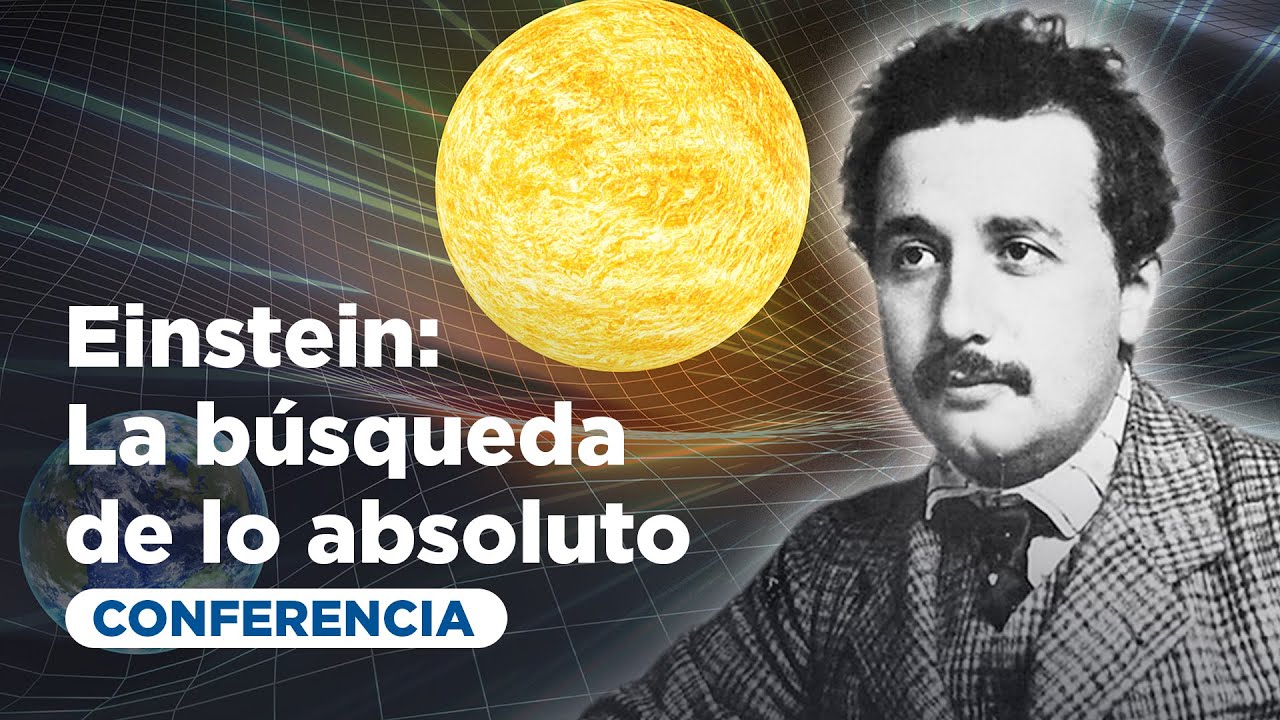
Einstein: la búsqueda de lo absoluto | Teoría de la relatividad | Conferencia de Alfonso Hernando
Keywords
Summary
169 words
Critical Evaluation
The lecture provides a solid and engaging introduction to Einstein’s relativity theories, grounded in historical context. Alfonso Hernando, with his background in physics and history of science, delivers accurate information and clarifies common misconceptions, such as the idea that relativity implies everything is relative. He correctly emphasizes Einstein’s search for absolutes, like the constancy of the speed of light, and his drive toward unification. The argumentation is coherent, and the scientific content is reliable, though it remains at a popular science level without deep mathematical derivations. The sources cited are not explicitly referenced during the talk, but the speaker’s expertise and the institutional affiliation (University of Burgos) lend credibility. The title accurately reflects the content, focusing on Einstein’s quest for absolute truths. The lecture is well-structured, with clear sections, and the speaker’s enthusiasm makes it accessible. However, it lacks critical engagement with alternative interpretations or controversies, and the discussion of Einstein’s later unified field theory is brief. Overall, it is a valuable educational resource for those interested in the history and concepts of relativity.
174 words
Title / Content Match
The title accurately reflects the content, focusing on Einstein's quest for absolute truths through relativity theory.
Quality & Reliability
8/10
The lecture is given by a physicist and historian of science with academic credentials, providing a historically accurate and conceptually sound overview of Einstein's work. The content is well-structured and aligns with established scientific knowledge, though it is a popular science talk without peer review.
Chapters
Cited Sources
- UBUinvestiga — Official website of the University of Burgos research dissemination platform, where the lecture was hosted.
Concurring Sources
- Einstein's Theory of Special Relativity — Space.com article explaining special relativity, consistent with the lecture's content.
- General Relativity Explained — Encyclopaedia Britannica entry on general relativity, aligning with the lecture's explanations.
Dissenting Sources
- Alternative interpretations of relativity — Some fringe theories challenge Einstein's relativity, but they lack scientific consensus and are not considered in mainstream physics.
Contribution & Novelties
The lecture offers a clear historical narrative of Einstein’s relativity theories, emphasizing his quest for absolutes and unification. It provides a valuable perspective for a general audience, connecting scientific developments with philosophical motivations.
Pour aller plus loin :
- Special relativity — Overview of the theory and its postulates.
- General relativity — Comprehensive introduction to Einstein’s theory of gravitation.
- Unified field theory — Discussion of Einstein’s later attempts and the broader quest for unification.
73 words
Radar Profile
The radar profile shows high scores in information quantity and quality, indicating a content-rich and accurate presentation. The technical level is moderate, suitable for a general audience, while reliability is strong due to the speaker's expertise.