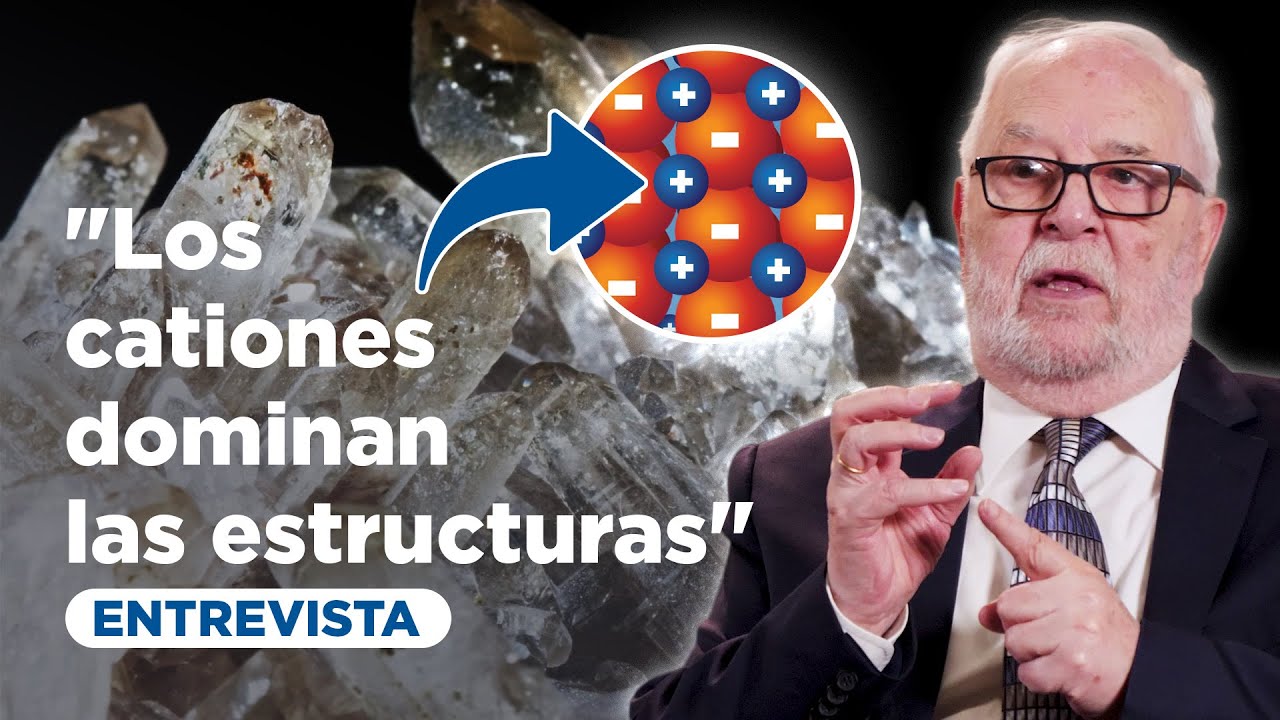
Un nuevo enfoque para explicar las estructuras cristalinas inorgánicas | Entrevista a Ángel Vegas
Keywords
Summary
134 words
Critical Evaluation
The interview presents a compelling and well-articulated alternative perspective on inorganic crystal structures, grounded in decades of crystallographic research. Dr. Vegas’s argument is built on extensive observational evidence, as he emphasizes the importance of examining intercationic distances and recognizing elemental fragments within compounds. His claim that oxidation is equivalent to high pressure is a provocative and potentially transformative idea, supported by specific examples like the perovskite barium stannate. However, the presentation is primarily an expert opinion rather than a systematic review or meta-analysis, and the scientific community’s reception is not deeply explored. The video does not include counterarguments or a balanced discussion of the model’s limitations, which could be seen as a weakness. Nevertheless, the content is rigorous in its reasoning and offers a valuable contribution to the field. The inclusion of editorial notes and references to an open-access book enhances credibility. The title accurately reflects the content, and the video’s production quality is adequate for an academic interview. Overall, the interview provides a thought-provoking and scientifically grounded perspective, though viewers should be aware that it represents a minority viewpoint within the field.
183 words
Title / Content Match
The title accurately reflects the content: an interview presenting a new approach to explaining inorganic crystal structures.
Quality & Reliability
8/10
The interview features a recognized expert in crystallography, with a long research career and peer-reviewed publications. The claims are based on extensive observations of crystal structures and are presented with nuance, acknowledging the scientific debate. The video includes editorial notes and references to an open-access book, enhancing credibility. However, the content is largely opinion and personal interpretation, not a systematic review or meta-analysis.
Chapters
Cited Sources
- Modelos estructurales de cristales inorgánicos. De los elementos a los compuestos — Open-access book by Dr. Ángel Vegas detailing his structural models for inorganic crystals.
- UBUInvestiga website — Official website of the research dissemination channel, providing additional resources and information.
Concurring Sources
- O'Keeffe, M., & Hyde, B. G. (1985). An alternative approach to non-molecular crystal structures with emphasis on the arrangements of cations. — The video references the work of O'Keeffe and Hyde, which supports the idea that cations play a dominant role in determining crystal structures.
Dissenting Sources
- Traditional ionic model (e.g., Pauling's rules) — The classical ionic model, as taught in most textbooks, emphasizes the role of anions in determining crystal structures, which is directly challenged by Vegas's proposal.
Contribution & Novelties
The video presents a novel perspective on inorganic crystal structures, challenging the traditional ionic model by proposing that cations, rather than anions, determine the overall structure. This is based on the observation that cations often retain the structural motifs of their elemental forms, and that oxidation is equivalent to applying high pressure. This idea could have implications for materials design and understanding phase transitions.
Pour aller plus loin :
- Ionic bonding — Provides background on the traditional ionic model.
- Crystal structure — General overview of crystal structures and their determination.
- Perovskite (structure) — Relevant to the example of barium stannate discussed in the video.
- High-pressure chemistry — Context for the equivalence between oxidation and pressure.
115 words
Radar Profile
The radar profile shows high scores in information quantity, quality, and reliability, with a slightly lower technical level, indicating that the content is dense and well-supported but may require some background knowledge to fully appreciate.