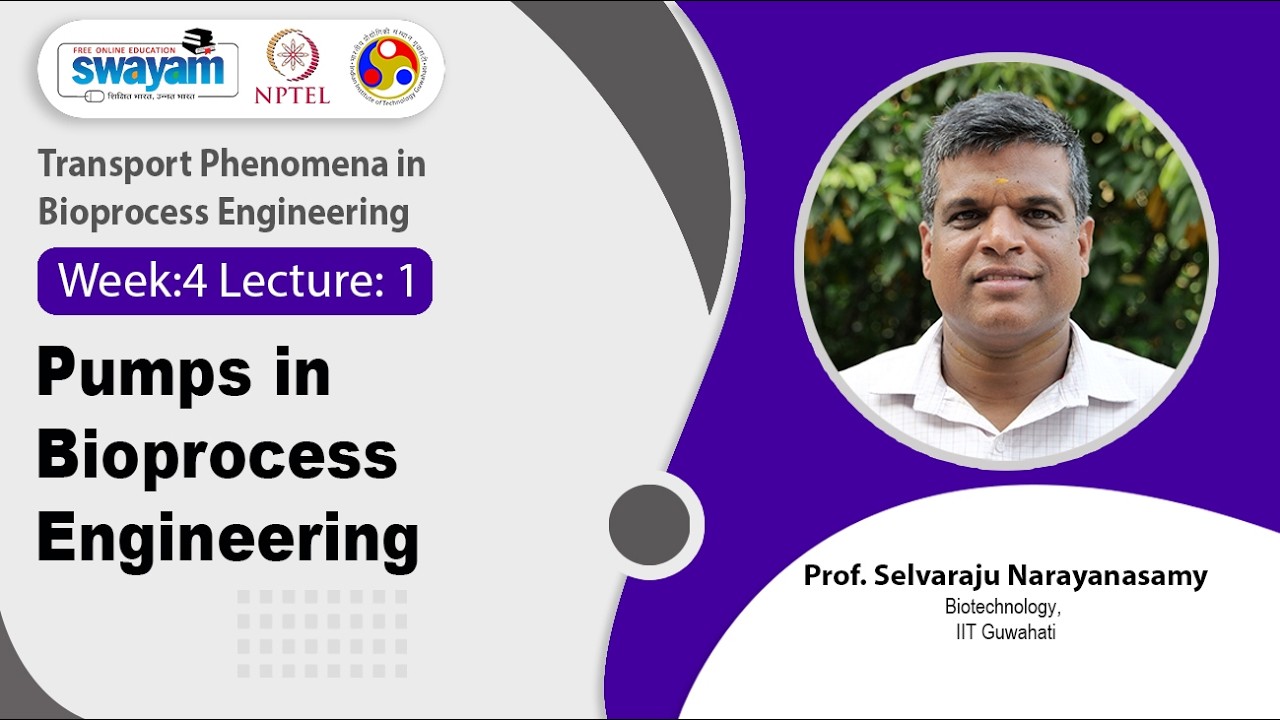
Lec 16: Pumps in Bioprocess Engineering
Keywords
Summary
171 words
Critical Evaluation
The lecture provides a solid introduction to pumps in bioprocess engineering, covering the main types and their applications. The professor, an expert in the field, delivers the content in a clear and structured manner, starting with the basic energy principles and progressing to specific pump types. The classification into positive displacement and dynamic pumps is standard and well-explained. The discussion on peristaltic pumps is particularly detailed, including their working mechanism, types, and tube selection criteria, which is valuable for practical applications. However, the lecture lacks depth in certain areas, such as quantitative performance curves, efficiency calculations, and specific selection criteria for different bioprocess scenarios. The presentation is somewhat repetitive, with the professor restating points multiple times, which may reduce clarity. Additionally, no external sources or references are cited, limiting the ability to verify the information independently. The content is accurate but does not delve into advanced topics like pump sizing, cavitation, or energy consumption, which are crucial for engineering design. The adéquation between title and content is good, as the lecture focuses specifically on pumps. Overall, the lecture serves as a useful educational resource for students, but it could benefit from more rigorous technical details and references to enhance its scientific value.
202 words
Title / Content Match
The title accurately reflects the content, which focuses on pumps used in bioprocess engineering.
Quality & Reliability
7/10
The lecture is delivered by a professor from IIT Guwahati, a reputable institution, and covers fundamental concepts of pumps in bioprocess engineering. The content is technically accurate but lacks depth in some areas and does not provide citations or references to external sources. The presentation is clear but has some verbal repetitions and minor inaccuracies in terminology.
Key Moments
Markers derived by PSI from the transcript: the creator did not define chapters.
- Introduction to pumps and their role in bioprocess engineering
- Explanation of three types of energy: pressure, kinetic, and potential
- Importance of pumps in bioprocess applications
- Classification of pumps: positive displacement and dynamic
- Working principle and characteristics of positive displacement pumps
- Working principle and characteristics of dynamic pumps
- Introduction to peristaltic pumps and their working mechanism
- Types of peristaltic pumps: hose, tube, and 360° eccentric
- Factors for tube selection and materials used
- Advantages and limitations of peristaltic pumps
- Introduction to diaphragm pumps and their components
- Working principle of diaphragm pumps: suction and discharge strokes
Cited Sources
- Course page: Transport Phenomena in Bioprocess Engineering — Official course page providing details about the course and its content.
- Playlist: Transport Phenomena in Bioprocess Engineering — YouTube playlist containing all lectures of the course.
Concurring Sources
- Peristaltic pump - Wikipedia — Confirms the working principle and applications of peristaltic pumps.
- Diaphragm pump - Wikipedia — Confirms the components and operation of diaphragm pumps.
Contribution & Novelties
The lecture provides a comprehensive overview of pumps used in bioprocess engineering, focusing on peristaltic and diaphragm pumps. It explains their working principles, advantages, and limitations, which is valuable for students and practitioners. The content is presented in a structured manner, making it accessible for beginners.
Pour aller plus loin :
- Peristaltic pump - Wikipedia — Provides detailed information on peristaltic pump types and applications.
- Diaphragm pump - Wikipedia — Explains the working principle and uses of diaphragm pumps.
- Centrifugal pump - Wikipedia — Offers insights into dynamic pumps and their characteristics.
92 words
Radar Profile
The radar profile shows a balanced performance across all dimensions, with slightly higher scores in information quantity and quality, reflecting the lecture's comprehensive coverage. The technical level is moderate, suitable for an introductory audience, while reliability is good due to the instructor's expertise.