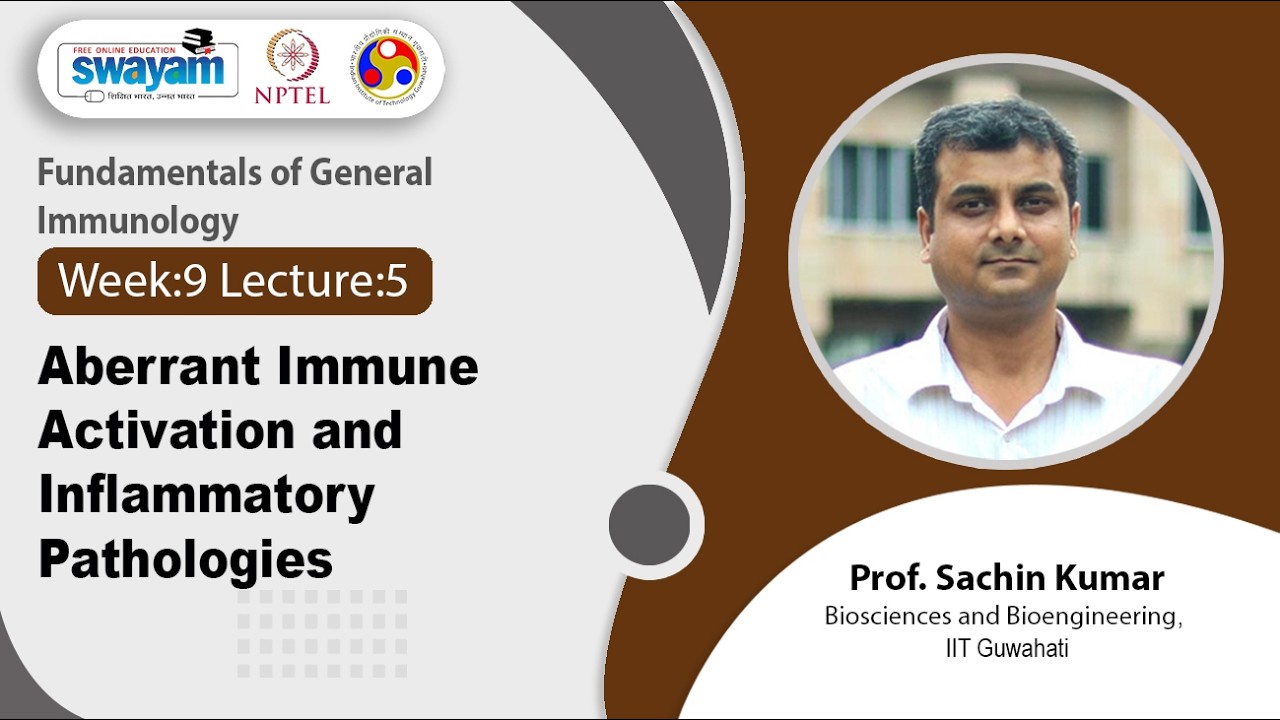
Lec 39: Aberrant Immune Activation and Inflammatory Pathologies
Keywords
Summary
181 words
Critical Evaluation
Value of the Information & Strength of the Argument
The lecture provides a solid overview of the key mechanisms of immune dysregulation in two major respiratory viral infections. It clearly explains the viral tropism and the resulting immune responses, including the concept of cytokine storm and its pathological consequences. The argumentation is logical and builds from viral entry to cellular and molecular effects. However, the presentation is somewhat descriptive and lacks depth in certain areas, such as the specific signaling pathways involved. The discussion of aging is superficial and could be expanded. Overall, the value lies in its educational clarity for students, but it does not offer novel insights for experts.
Scientific Rigor, Source Quality, Title Accuracy
The content is scientifically accurate and aligns with established knowledge in immunology. The professor is an academic expert, and the lecture is part of a formal course, lending credibility. However, no specific scientific sources are cited within the lecture, and the description only provides links to the course and playlist. The title accurately reflects the content, focusing on aberrant immune activation and inflammatory pathologies. The lecture is well-structured but could benefit from referencing specific studies to support the claims made.
197 words
Title / Content Match
The title accurately reflects the content, which focuses on aberrant immune activation and inflammatory pathologies in influenza and COVID-19.
Quality & Reliability
7/10
Lecture from an academic course by a professor at IIT Guwahati, based on established immunology concepts. The content is accurate but lacks citations to specific studies, and the presentation is somewhat unstructured.
Key Moments
Markers derived by PSI from the transcript: the creator did not define chapters.
- Introduction to immune dysregulation and lecture overview
- Comparison of influenza and SARS-CoV-2 genome and receptor binding
- Influenza virus tropism and replication in respiratory epithelium
- Influenza immunopathology: cytokine storm, fibrosis, and respiratory distress
- COVID-19 disease overview and long COVID
- SARS-CoV-2 immunopathology: lymphopenia, lymphocyte dysfunction, and neutrophilia
- Mechanisms of SARS-CoV-2 induced immunopathology: T cell exhaustion, cytokine storm, and ADE
- Age-related immune dysregulation and conclusion
Cited Sources
- Course: Fundamentals of General Immunology — Course page for the NPTEL course this lecture is part of.
- Playlist: Fundamentals of General Immunology — Playlist containing this lecture and other course videos.
Concurring Sources
- WHO: Coronavirus disease (COVID-19) — General information on COVID-19, consistent with the lecture's description of the disease.
- CDC: Influenza (Flu) — Information on influenza, consistent with the lecture's description of the virus and its effects.
Contribution & Novelties
The lecture provides a structured educational overview of immune dysregulation in influenza and COVID-19, synthesizing known concepts into a coherent narrative. It highlights key differences in viral tropism and immune responses, which is useful for students. However, it does not present novel research findings.
Pour aller plus loin :
- Cytokine storm — Overview of the phenomenon discussed in the lecture.
- Antibody-dependent enhancement — Explanation of ADE, a key concept mentioned.
- TMPRSS2 — Protease essential for SARS-CoV-2 entry, discussed in the lecture.
- Influenza hemagglutinin — Details on the viral protein and its receptor binding.
93 words
Radar Profile
The radar profile shows a balanced performance across all dimensions, with scores around 7. This indicates a solid educational lecture that is informative and technically sound, though not exceptional in any single area. The lecture is well-suited for its target audience of students.