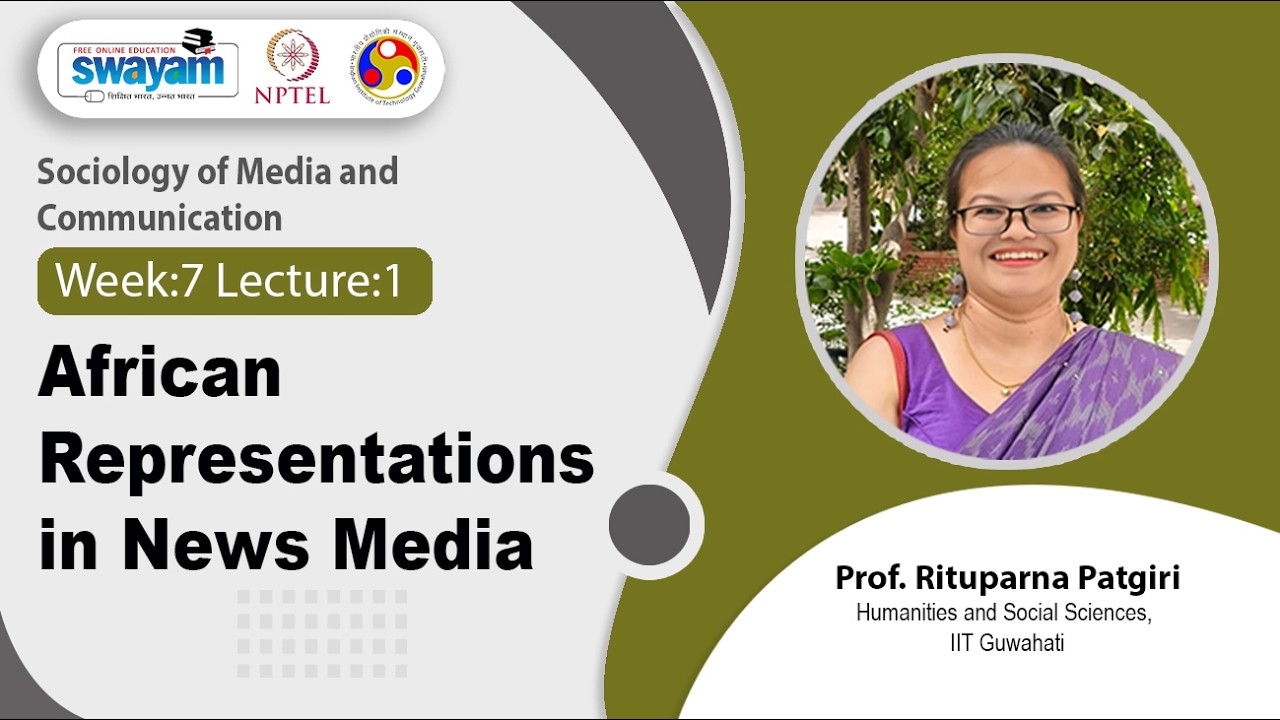
Lec 31: African representations in news media
Keywords
Summary
151 words
Critical Evaluation
Value of the Information & Strength of the Argument
The lecture provides valuable insights into media representation theory, using a concrete case study to illustrate how news is constructed. It effectively argues that media coverage is not objective but serves ideological and economic purposes. The argumentation is solid, drawing on established scholars and providing a critical framework. However, it is one-sided, focusing solely on the negative aspects of Western media without acknowledging any potential positive roles or alternative perspectives.
Scientific Rigor, Source Quality, Title Accuracy
The lecture is academically rigorous, referencing key theorists like Stuart Hall, Noam Chomsky, and Edward Herman, and specifically John Sorenson’s analysis. The sources are credible and relevant. The title accurately reflects the content. The lecture is well-structured and clear, though it could benefit from more diverse sources or counterarguments to enhance its balance.
138 words
Title / Content Match
The title accurately reflects the content, which focuses on how African representations are constructed in news media.
Quality & Reliability
8/10
The lecture is based on established academic work (John Sorenson, Stuart Hall, Chomsky & Herman) and provides a coherent critical analysis. It is a university lecture, thus reliable, though it presents a specific perspective rather than a balanced overview.
Key Moments
Markers derived by PSI from the transcript: the creator did not define chapters.
- Introduction to the lecture on African representations in mass media.
- Discussion of the 1984 BBC report on Ethiopian famine and its global impact.
- Analysis of how the famine was portrayed as a spectacle, ignoring historical context.
- Introduction of John Sorenson's work and the concept of media discourse.
- Explanation of how media corporations prioritize profit and sensationalism.
- Discussion of how the famine was blamed on African incompetence and communist policies.
- Examination of the role of visual imagery and shock value in shaping public perception.
- Analysis of the moral parable constructed around the famine, ignoring colonial history.
- Discussion of how media representations perpetuate racist stereotypes and dehumanize Africans.
- Conclusion summarizing the key points and implications for media literacy.
Cited Sources
- Sociology of Media and Communication - Course Page — Course homepage providing context for the lecture series.
- Playlist: Sociology of Media and Communication — Playlist containing all lectures of the course.
Concurring Sources
- Manufacturing Consent: The Political Economy of the Mass Media — Noam Chomsky and Edward Herman's book, referenced in the lecture, supports the argument about media propaganda.
Contribution & Novelties
The lecture offers a critical analysis of media representation, applying theoretical frameworks to a specific case study. It highlights the importance of deconstructing media narratives and understanding the ideological underpinnings of news coverage. For further exploration, consider the following:
Pour aller plus loin :
- Propaganda model — Explains the five filters shaping media content.
- Orientalism — Edward Said’s concept of Western representations of the East, applicable to Africa.
- Stuart Hall’s encoding/decoding model — Framework for understanding media messages.
78 words
Radar Profile
The radar profile shows high scores in information quantity, quality, and reliability, with a moderate technical level. This indicates a well-researched and credible lecture that is accessible to a general audience, though it requires some background in media studies.