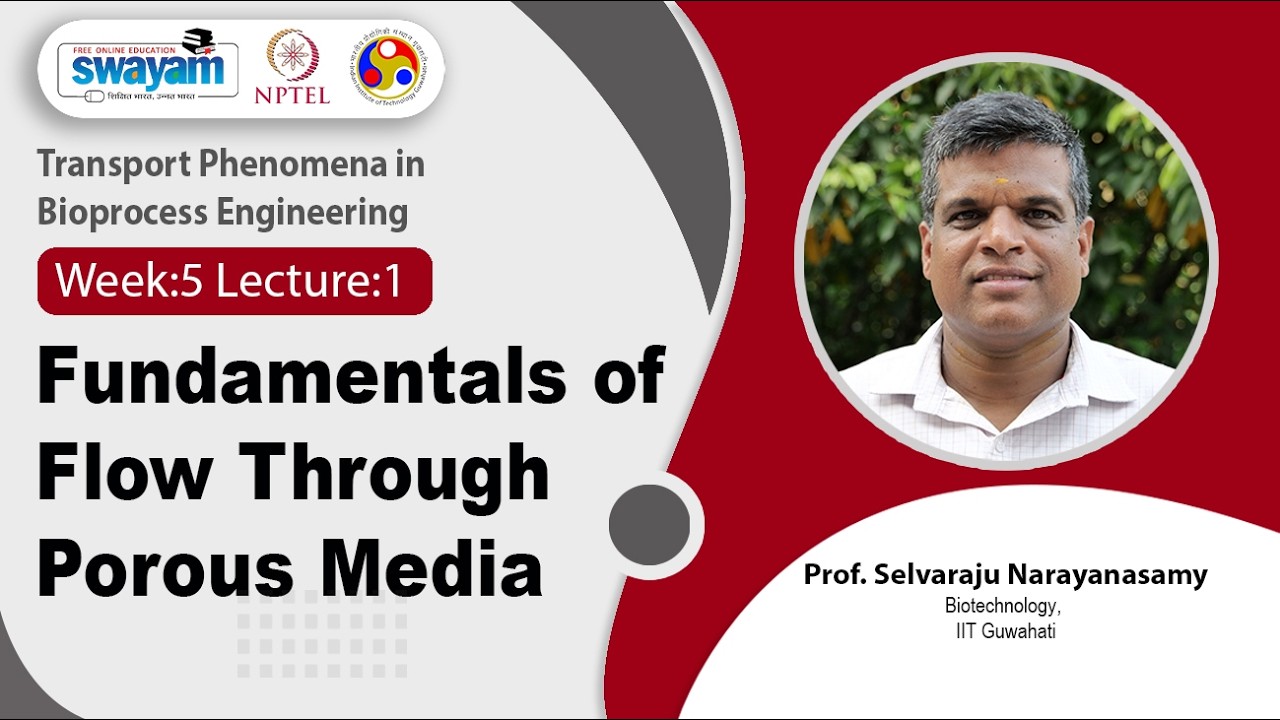
Lec 21: Fundamentals of Flow Through Porous Media
Keywords
Summary
132 words
Critical Evaluation
The lecture provides a clear and accessible introduction to flow through porous media, a topic central to many bioprocess engineering applications. The instructor, Prof. Selvaraju Narayanasamy, is a faculty member at IIT Guwahati, lending credibility to the content. The presentation is well-structured, starting with definitions and importance, then moving to structural properties and applications. The use of examples such as packed bed bioreactors, chromatography, and filtration effectively illustrates the practical relevance. However, the lecture is introductory and lacks mathematical depth; for instance, Darcy’s law is mentioned but not derived or explained in detail. The discussion of porosity is brief and does not include typical ranges or measurement methods. The distinction between superficial and interstitial velocity is promised but not fully elaborated, leaving the viewer with an incomplete understanding. The content is accurate and aligns with standard textbooks on transport phenomena, but the delivery is somewhat repetitive, with phrases like ’this one’ and ‘so’ used frequently, which may distract some viewers. The video is part of a formal NPTEL course, so the target audience is likely undergraduate engineering students, but the analysis here focuses on the content’s merits. The title accurately reflects the content, and the lecture fulfills its promise of covering fundamentals. Overall, it serves as a good starting point for learners, but those seeking deeper quantitative treatment may need supplementary resources.
222 words
Title / Content Match
The title accurately reflects the content, which covers fundamentals of flow through porous media.
Quality & Reliability
7/10
Lecture by a professor from IIT Guwahati, part of an NPTEL course, providing a structured introduction to flow through porous media. Content is accurate but introductory, with some verbal repetitions and lack of detailed derivations.
Key Moments
Markers derived by PSI from the transcript: the creator did not define chapters.
- Introduction to the lecture and course context.
- Definition of porous media and its importance in bioprocess engineering.
- Examples of porous media in bioprocesses: packed bed bioreactor, chromatography, biofilm, soil bioremediation.
- Classification of porous media: natural vs. engineered, homogeneous vs. heterogeneous.
- Structural properties: pore size, connectivity, shape, surface roughness.
- Introduction to porosity as a fundamental parameter.
- Discussion on applications: packed bed bioreactors, chromatography, filtration.
- Preview of upcoming topics: superficial vs. interstitial velocity, Darcy's law.
Cited Sources
- NPTEL Course: Transport Phenomena in Bioprocess Engineering — Course page for the lecture series, providing context and additional materials.
- Playlist: Transport Phenomena in Bioprocess Engineering — YouTube playlist containing all lectures of the course.
Concurring Sources
- NPTEL Course: Transport Phenomena in Bioprocess Engineering — Official course page, consistent with the lecture content.
Contribution & Novelties
This lecture provides a foundational overview of flow through porous media, emphasizing its relevance to bioprocess engineering. It clearly explains the distinction between porous media and simple pipe flow, and introduces key structural properties. The lecture is part of a structured NPTEL course, offering a systematic introduction for students.
Pour aller plus loin :
- Darcy’s law - Wikipedia — Provides the fundamental equation for flow through porous media, mentioned in the lecture.
- Porosity - Wikipedia — Detailed explanation of porosity, a key parameter discussed.
- Packed bed reactor - Wikipedia — Application example of porous media in bioreactors.
97 words
Radar Profile
The radar profile shows moderate scores across all dimensions, with quality and reliability slightly higher than quantity and technical depth. This indicates a solid introductory lecture but with limited depth and detail.