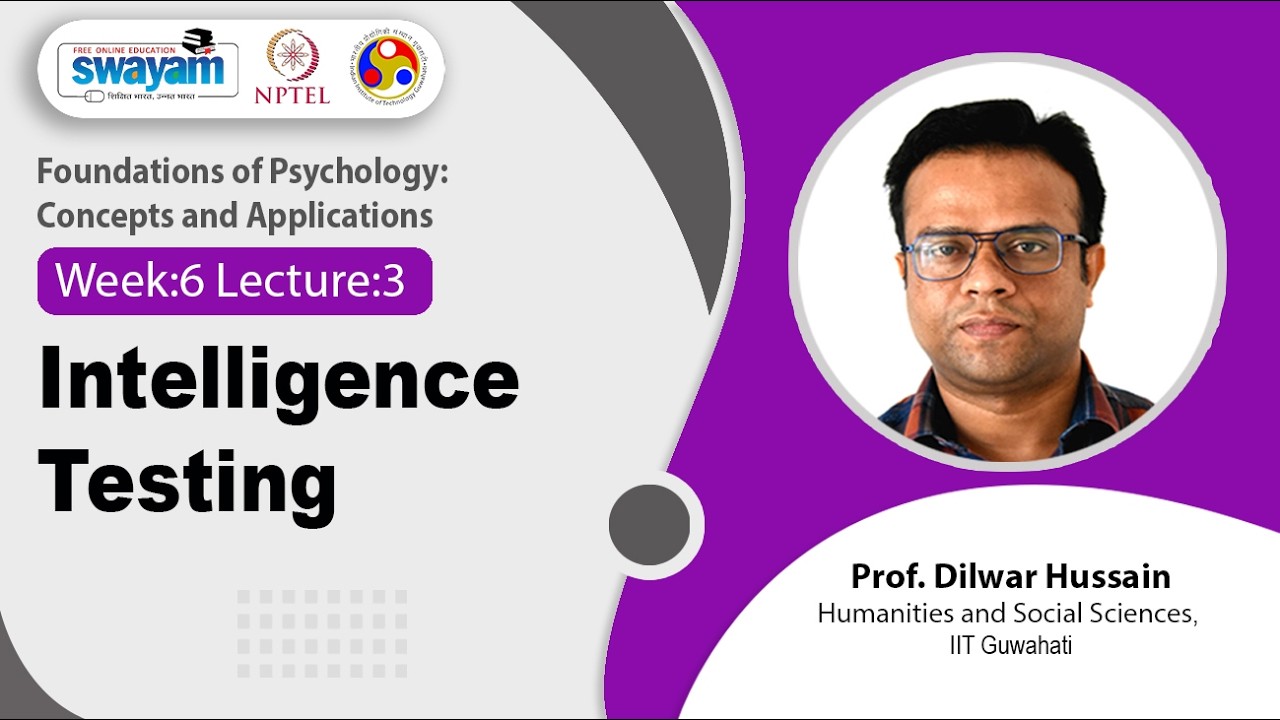
Lec 16: Intelligence Testing
Keywords
Summary
99 words
Critical Evaluation
The lecture provides a solid introduction to intelligence testing, covering key historical developments and concepts. The discussion of self-report limitations, including the Dunning-Kruger effect, is relevant and well-explained. The explanation of mental age and its limitations is clear, and the transition to IQ scores is logical. However, the lecture lacks critical depth: it does not delve into the controversies surrounding IQ testing, such as cultural bias, the nature vs. nurture debate (only briefly mentioned in the previous lecture), or the ethical implications of testing. The presentation is largely descriptive, with little evaluation of the validity and reliability of the tests discussed. The sources cited are limited to the course page and playlist, with no direct references to primary research. The lecture is appropriate for an introductory audience but would benefit from a more critical perspective. The title accurately reflects the content, and the lecture is well-structured, though the pace is slow and some concepts could be explained more concisely.
159 words
Title / Content Match
The title accurately reflects the content, which focuses on intelligence testing, including historical development, types of tests, and related concepts.
Quality & Reliability
7/10
Lecture from a recognized academic institution (IIT Guwahati) by a professor in psychology. Content is structured and based on established theories and historical facts. However, no citations or references are provided in the video itself, and the presentation is primarily descriptive without critical evaluation of the tests discussed.
Key Moments
Markers derived by PSI from the transcript: the creator did not define chapters.
- Introduction to the lecture and recap of previous lecture on intelligence theories.
- Discussion on the limitations of self-report measures in intelligence testing.
- Explanation of the Dunning-Kruger effect and metacognition.
- Introduction of the Binet-Simon test and its purpose.
- Explanation of the concept of mental age and its limitations.
- Development of IQ scores and deviation IQ.
- Discussion on contemporary IQ tests and the difference between aptitude and intelligence tests.
- Validity of IQ tests and extreme forms of intelligence.
- Misuses of IQ tests and concluding remarks.
Cited Sources
- Course page: Foundations of Psychology: Concepts and Applications — Official course page for the lecture series.
- Playlist: Foundations of Psychology — Playlist containing all lectures of the course.
Concurring Sources
- Intelligence quotient - Wikipedia — Provides background on IQ and its measurement.
- Binet-Simon scale - Wikipedia — Historical context for the first intelligence test.
Contribution & Novelties
The lecture provides a clear and structured overview of intelligence testing, particularly the historical development from mental age to IQ scores. It effectively explains the limitations of self-report measures and introduces the Dunning-Kruger effect in this context. However, it does not offer novel insights beyond standard textbook content.
Pour aller plus loin :
- Intelligence quotient - Wikipedia — Provides a comprehensive overview of IQ, its history, and controversies.
- Binet-Simon scale - Wikipedia — Details the first intelligence test and its evolution.
- Dunning-Kruger effect - Wikipedia — Explains the cognitive bias discussed in the lecture.
- Stanford-Binet Intelligence Scales - Wikipedia — A modern version of the Binet-Simon test.
- Wechsler Adult Intelligence Scale - Wikipedia — Another major contemporary IQ test.
119 words
Radar Profile
The radar profile shows moderate scores across all dimensions, indicating a balanced but not exceptional lecture. The highest score is in information quantity and reliability, while technical level is slightly lower, reflecting the introductory nature of the content.