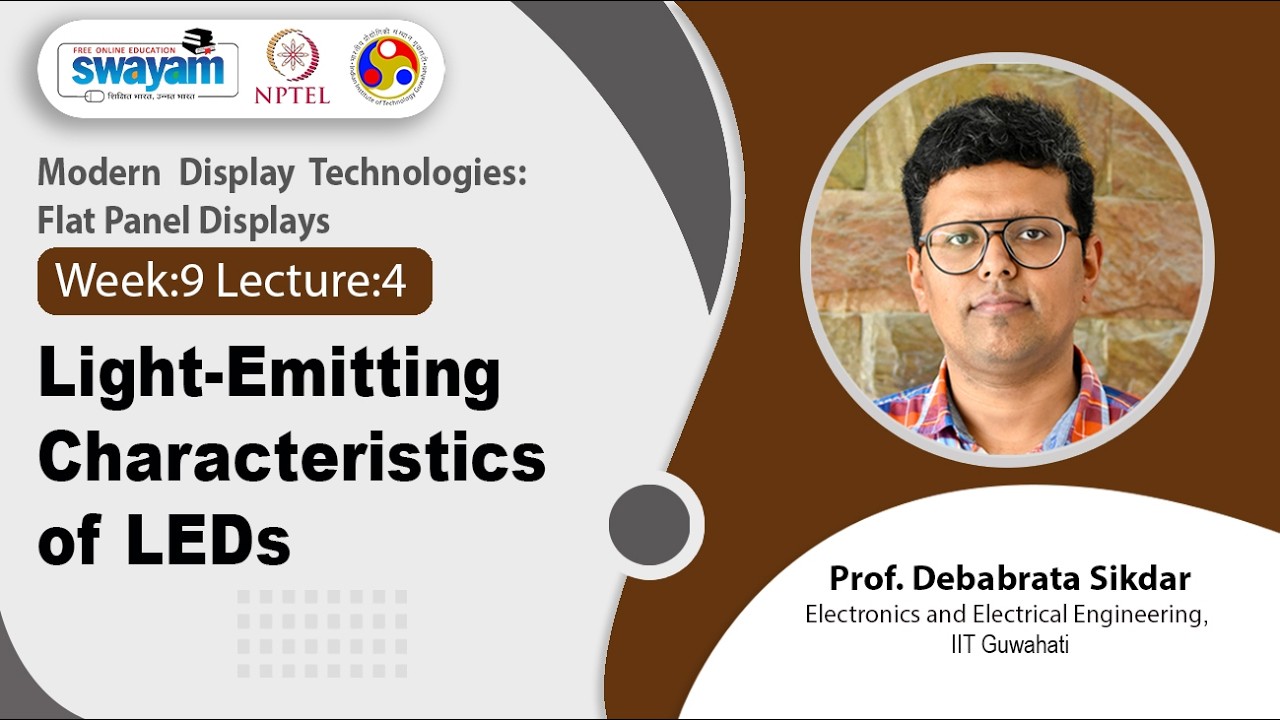
Lec 44: Light-Emitting Characteristics of LEDs
Keywords
Summary
203 words
Critical Evaluation
Value of the Information & Strength of the Argument
The lecture provides a comprehensive and well-structured overview of LED performance metrics, systematically moving from fundamental physics to practical engineering considerations. The argumentation is solid, built on established semiconductor physics and standard models like the ABC recombination model. The instructor clearly explains the relationships between parameters, such as how series resistance affects the IV curve and how the escape cone limits extraction efficiency. The use of equations and figures enhances the clarity and rigor of the presentation. The discussion of efficiency droop and its implications for mini-LED backlighting is particularly valuable, as it connects theoretical concepts to real-world display design choices.
Scientific Rigor, Source Quality, Title Accuracy
The lecture is scientifically rigorous, presenting standard models and equations from LED physics. The content aligns with established knowledge in the field, and the instructor’s expertise is evident. However, the video does not explicitly cite specific sources or references, which limits the ability to verify claims independently. The title accurately reflects the content, which is entirely focused on the light-emitting characteristics of LEDs. The lecture is part of a formal academic course, which adds to its credibility. The description provides links to the course and playlist, but no direct references to external literature.
209 words
Title / Content Match
The title accurately reflects the content, which focuses on the light-emitting characteristics of LEDs, including electrical, optical, and thermal properties.
Quality & Reliability
8/10
The lecture is part of a formal academic course by NPTEL IIT Guwahati, providing a structured and rigorous treatment of LED characteristics. The content is based on established physics and engineering principles, with clear definitions and equations. The presentation is consistent with standard textbooks and research literature, though it lacks explicit citations to specific sources within the video.
Key Moments
Markers derived by PSI from the transcript: the creator did not define chapters.
- Introduction and lecture outline
- Recap of light-emitting junction and introduction to measurable characteristics
- Discussion of IV characteristics, diode equation, and series resistance
- Explanation of LI curve and linear-to-sublinear transition
- Efficiency chain: injection, internal, extraction, and wall-plug efficiency
- Escape cone problem and light extraction limitations
- Efficiency droop and the ABC model
- Emission spectrum, linewidth, and peak wavelength behavior
- White light generation methods and color quality metrics (CCT, CRI)
- Thermal behavior and junction temperature effects
- Reliability, degradation, and lifetime (L70/L90, Arrhenius factor)
- Summary and link to manufacturing considerations
Cited Sources
- Course page: Modern Display Technologies: Flat Panel Displays — Official course page for the NPTEL course, providing context for the lecture series.
- Playlist: Modern Display Technologies — YouTube playlist containing all lectures of the course, including this one.
Concurring Sources
- Light-emitting diode — General reference on LED operation and characteristics, consistent with the lecture's content.
- Internal quantum efficiency — Defines IQE, a key parameter discussed in the lecture.
- Total internal reflection — Explains the physical principle behind the escape cone problem.
Contribution & Novelties
This lecture provides a systematic and quantitative overview of LED light-emitting characteristics, bridging the gap between device physics and practical display engineering. It clearly explains the efficiency chain and the factors limiting LED performance, such as the escape cone and efficiency droop. The discussion of the ABC model and its implications for mini-LED backlighting is particularly insightful, as it connects fundamental recombination mechanisms to design strategies.
Pour aller plus loin :
- Light-emitting diode — General overview of LED technology and principles.
- Internal quantum efficiency — Definition and relevance to LED performance.
- Total internal reflection — Physical basis for the escape cone problem.
- Shockley–Read–Hall recombination — Mechanism behind SRH recombination mentioned in the ABC model.
- Auger recombination — Non-radiative recombination process contributing to efficiency droop.
- Color rendering index — Metric for color quality in lighting, discussed in the lecture.
138 words
Radar Profile
The radar profile shows high scores in quantity of information, technical level, and reliability, reflecting the lecture's comprehensive and rigorous nature. The quality of information is also high, though slightly lower due to the lack of explicit citations. Overall, the lecture is a strong educational resource for understanding LED characteristics.