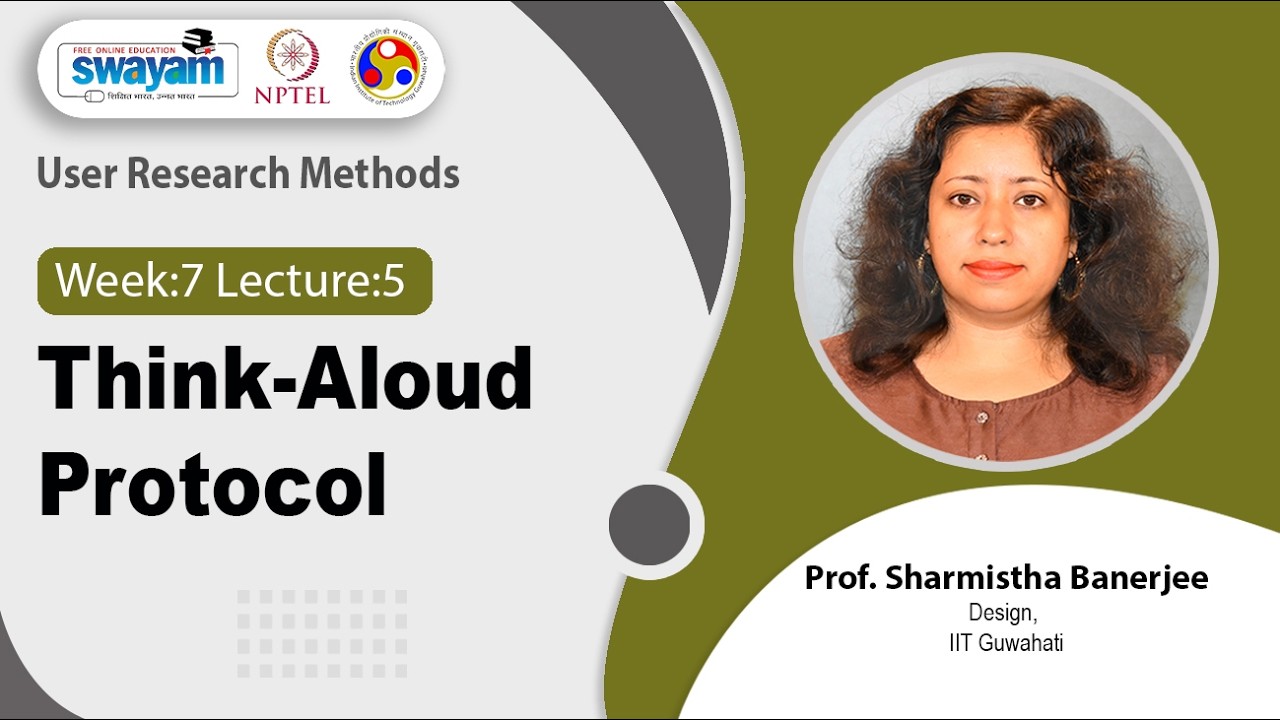
Lec 34: Heuristic Evaluation - Part 2: Process, Severity Rating & Case Study
Keywords
Summary
181 words
Critical Evaluation
Value of the Information & Strength of the Argument
The lecture provides substantial practical value, offering a clear, step-by-step guide to conducting think aloud sessions, complete with a realistic case study that illustrates the entire process from briefing to analysis. The argumentation is solid, grounded in established theory (Ericsson & Simon) and reinforced with concrete examples of user verbalizations and their interpretation. The professor effectively demonstrates how to code data and derive actionable design recommendations, making the method accessible and immediately applicable. The discussion of pitfalls and the emphasis on neutral moderation show a nuanced understanding of the method’s challenges, strengthening the overall credibility of the instruction.
Scientific Rigor, Source Quality, Title Accuracy
The lecture is scientifically rigorous, referencing the foundational work of Ericsson and Simon on protocol analysis, which is appropriate for the topic. The methodology presented aligns with standard HCI practices, and the case study is well-executed, providing a realistic demonstration. However, the title is misleading: it refers to ‘Heuristic Evaluation’ while the content is entirely about ‘Think Aloud Protocol’. This is a significant discrepancy that could confuse viewers seeking information on heuristic evaluation. The sources cited in the description are the course and playlist links, which are relevant but do not provide direct references to the specific literature mentioned. Overall, the content is reliable and well-presented, but the title-content mismatch is a notable flaw.
227 words
Title / Content Match
The title mentions 'Heuristic Evaluation' but the content is about 'Think Aloud Protocol', a different usability method. This mismatch is significant and could mislead viewers.
Quality & Reliability
8/10
The lecture is a well-structured academic tutorial by a professor at IIT Guwahati, grounded in established usability research (Ericsson & Simon's protocol analysis). It provides a clear methodology, practical examples, and acknowledges limitations. The content is consistent with standard HCI practices, though it lacks explicit citations to recent studies.
Key Moments
Markers derived by PSI from the transcript: the creator did not define chapters.
- Introduction to Think Aloud Protocol and its purpose.
- Explanation of concurrent vs. retrospective think aloud.
- Five steps to run a think aloud session.
- Briefing the participant and setting expectations.
- Case study begins: concurrent think aloud on a web app.
- Task 2: building a short list and encountering duplicates.
- Task 3: comparing methods side by side.
- Task 4: diary study search fails, revealing a usability issue.
- Analysis of verbalizations and deriving interface fixes.
Cited Sources
- Course: User Research Methods — Course page for the lecture series.
- Playlist: User Research Methods — Playlist containing this lecture.
Concurring Sources
- Think-aloud protocol - Wikipedia — Supports the description and variants of think aloud.
- Protocol analysis - Wikipedia — Confirms the theoretical basis in Ericsson and Simon's work.
Contribution & Novelties
The lecture offers a comprehensive, practical guide to the Think Aloud Protocol, with a detailed case study that demonstrates the entire process from briefing to analysis. It emphasizes the importance of neutral moderation and provides concrete examples of how to code verbalizations into actionable design insights. The discussion of common pitfalls and the distinction between concurrent and retrospective methods adds depth to the instruction.
Pour aller plus loin :
- Think-aloud protocol - Wikipedia — Provides an overview and history of the method.
- Protocol analysis - Wikipedia — Explains the theoretical foundation by Ericsson and Simon.
- Usability testing - Wikipedia — Contextualizes think aloud within broader usability methods.
107 words
Radar Profile
The radar profile shows high scores in information quantity, quality, and reliability, with a slightly lower technical level. This indicates a well-rounded, practical lecture that is accessible yet grounded in theory, making it suitable for students and practitioners.