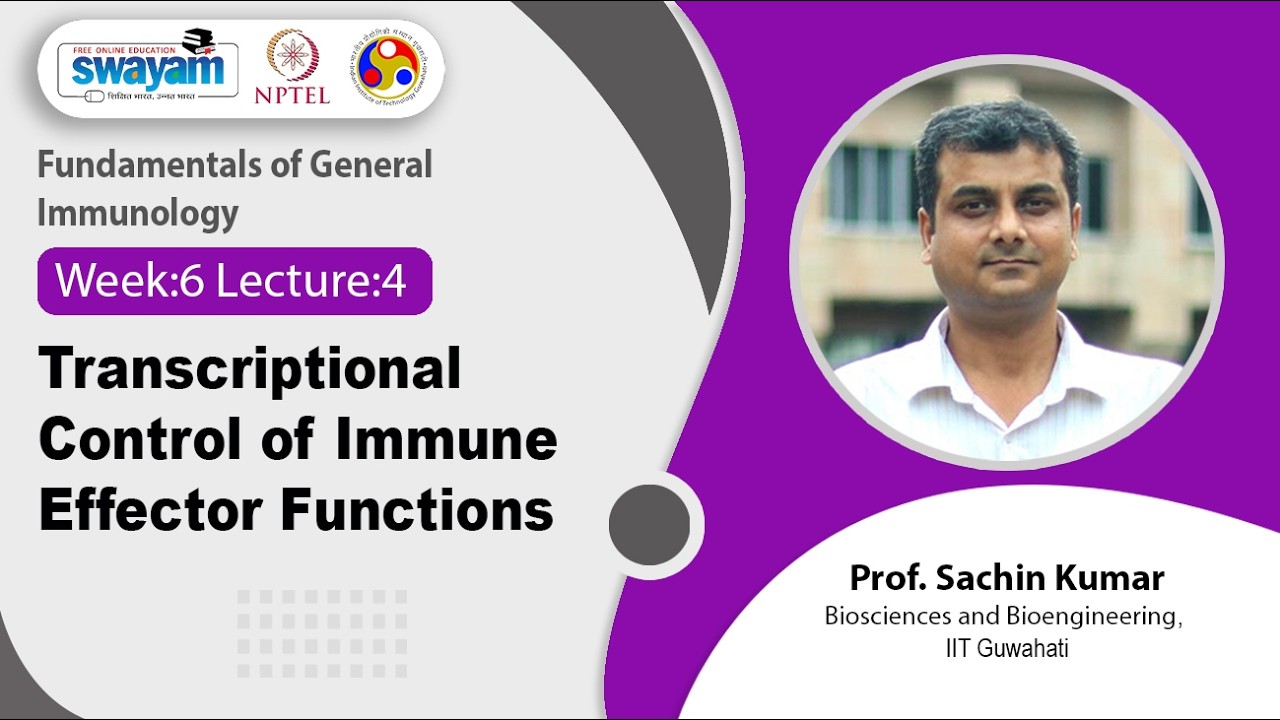
Lec 24: Transcriptional Control of Immune Effector Functions
Keywords
Summary
188 words
Critical Evaluation
The lecture provides a comprehensive and well-structured overview of transcriptional control in T cell immunity, suitable for advanced undergraduate or graduate students in immunology. The content is scientifically accurate and aligns with current textbook knowledge. The professor systematically walks through the key transcription factors and cytokines involved in T cell development and effector differentiation, making complex pathways accessible. The discussion of Treg suppressive mechanisms is particularly detailed and highlights the multifaceted nature of immune regulation. The inclusion of metabolic reprogramming adds a modern perspective on T cell activation. However, the lecture is primarily descriptive and lacks critical analysis of the evidence or discussion of controversies and nuances in the field. For instance, it does not address the plasticity of T helper subsets or the context-dependent roles of transcription factors. The presentation is also somewhat monotonous, and the transcription contains several errors (e.g., ‘T-helpper’, ‘iicaros’) that could confuse viewers. The sources cited are limited to the course and playlist, with no direct references to primary literature, which reduces the ability to verify specific claims. Overall, the lecture is a solid educational resource but could benefit from more depth and critical engagement with the material.
193 words
Title / Content Match
The title accurately reflects the content, which focuses on transcriptional regulation of T cell subsets and effector functions.
Quality & Reliability
8/10
Lecture from a reputable academic institution (IIT Guwahati) delivered by a professor in the field. Content is well-structured and aligns with established immunology knowledge. Minor transcription errors and occasional imprecisions in terminology (e.g., 'T-helpper' for 'T-helper') do not undermine the scientific accuracy.
Key Moments
Markers derived by PSI from the transcript: the creator did not define chapters.
- Introduction and recap of B cell transcription control
- Overview of T cell subsets and development in thymus
- Key transcription factors in thymic T cell development: Notch1, E-proteins, Ikaros
- TH1 differentiation: IL-12, IFN-γ, T-bet, effector cytokines
- TH2 differentiation: IL-4, GATA3, effector cytokines
- TH17 differentiation: TGF-β, IL-6, IL-23, RORγt, effector cytokines
- Cytotoxic T cell transcription control: T-bet, Eomes, perforin, granzymes
- T regulatory cell mechanisms of suppression
- Metabolic reprogramming in activated T cells and summary
Cited Sources
- NPTEL Course: Fundamentals of General Immunology — Course page for the lecture series
- YouTube Playlist: Fundamentals of General Immunology — Playlist containing the lecture
Concurring Sources
- Janeway's Immunobiology — Standard textbook covering T cell development and differentiation
Contribution & Novelties
The lecture provides a structured synthesis of transcriptional regulation in T cell immunity, integrating development, effector differentiation, and metabolic control. It offers a clear framework for understanding how transcription factors orchestrate immune responses, which is valuable for students and researchers. The discussion of Treg suppressive mechanisms is particularly comprehensive.
Pour aller plus loin :
- T-bet (TBX21) — Key transcription factor for TH1 differentiation.
- GATA3 — Master regulator of TH2 differentiation.
- RORγt — Transcription factor essential for TH17 cells.
- FOXP3 — Lineage-defining transcription factor for regulatory T cells.
- Eomesodermin — Transcription factor critical for cytotoxic T cell function.
- Metabolic reprogramming in T cells — Review on how metabolism shapes T cell responses.
111 words
Radar Profile
The radar profile shows high scores in quantity and quality of information, with a moderate level of technical depth. The fiabilite is high due to the academic source, but the lack of cited primary literature slightly reduces the overall score.