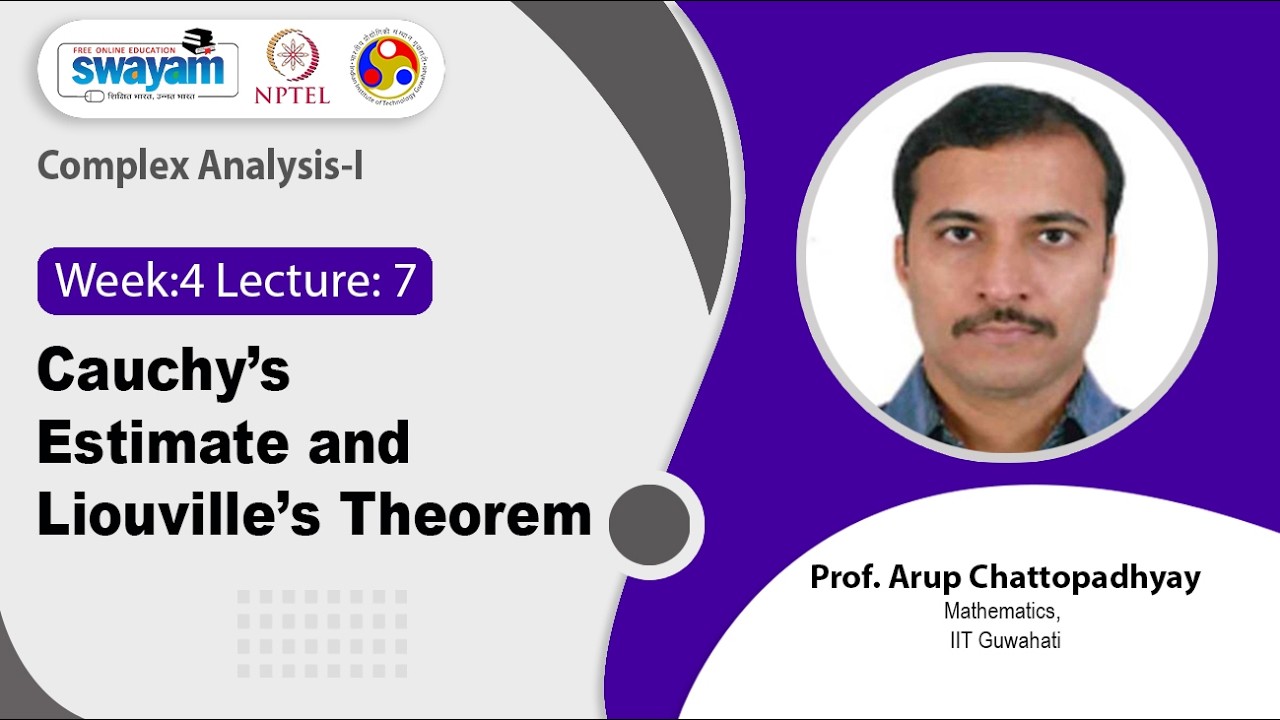
LEc 29: Cauchy’s Estimate and Liouville’s Theorem
Keywords
Summary
140 words
Critical Evaluation
The lecture provides a rigorous and clear exposition of two fundamental results in complex analysis: Cauchy’s estimate and Liouville’s theorem. The instructor, Prof. Arup Chattopadhyay, demonstrates a deep understanding of the subject and presents the material in a logical sequence, building on previously established results such as Cauchy’s integral formula and its derivative version. The proof of Cauchy’s estimate is detailed and uses standard techniques like the ML inequality, making it accessible to students. The discussion of Liouville’s theorem highlights the stark difference between real and complex analysis, which is pedagogically valuable. The lecture is part of a structured NPTEL course, ensuring a certain level of quality and reliability. However, the presentation is somewhat informal, with occasional verbal slips and repetitions, which might slightly detract from the clarity. The video has very few views and no comments, so there is no community feedback to consider. The content is accurate and aligns with standard textbooks on complex analysis. The sources cited are the course page and playlist, which are appropriate for further study. Overall, the lecture is a solid educational resource for students learning complex analysis.
185 words
Title / Content Match
The title accurately reflects the content: the lecture covers Cauchy's estimate and Liouville's theorem, with proofs and applications.
Quality & Reliability
8/10
Lecture by a professor from IIT Guwahati, part of an NPTEL course. The content is mathematically rigorous, with clear derivations and proofs. The presentation is somewhat informal and includes some verbal slips, but the mathematical reasoning is sound. The video is part of a structured course, and the instructor is an expert in the field.
Key Moments
Markers derived by PSI from the transcript: the creator did not define chapters.
- Introduction and recap of Cauchy's integral formula and its derivative version.
- Statement of the theorem: analyticity implies infinite differentiability.
- Corollary: component functions have continuous partial derivatives of all orders.
- Introduction to Cauchy's estimate and its statement.
- Proof of Cauchy's estimate using the integral formula and ML inequality.
- Discussion of Liouville's theorem and its statement.
- Comparison with real analysis: bounded smooth functions like sine and cosine are not constant.
Cited Sources
- NPTEL Course: Complex Analysis - I — Course page for the lecture series, providing additional resources and information.
- Playlist: Complex Analysis - I — Playlist containing all lectures of the course.
Concurring Sources
- NPTEL Course: Complex Analysis - I — Official course page, confirming the lecture is part of a structured curriculum.
Contribution & Novelties
This lecture provides a clear and rigorous exposition of Cauchy’s estimate and Liouville’s theorem, which are fundamental results in complex analysis. The instructor’s step-by-step proof of Cauchy’s estimate using the integral formula and the ML inequality is particularly instructive. The discussion of Liouville’s theorem highlights the contrast with real analysis, emphasizing the rigidity of analytic functions. The lecture is part of a structured NPTEL course, offering a reliable resource for students.
Pour aller plus loin :
- Cauchy’s integral formula — Provides background on the integral formula used in the proofs.
- Liouville’s theorem (complex analysis) — Further details on the theorem and its applications.
- Morera’s theorem — A related result mentioned in the lecture as a future topic.
117 words
Radar Profile
The radar profile shows high scores in information quantity, information quality, technical level, and reliability, indicating a well-structured and rigorous lecture. The low view count and lack of comments suggest limited community engagement, but the content is academically sound.