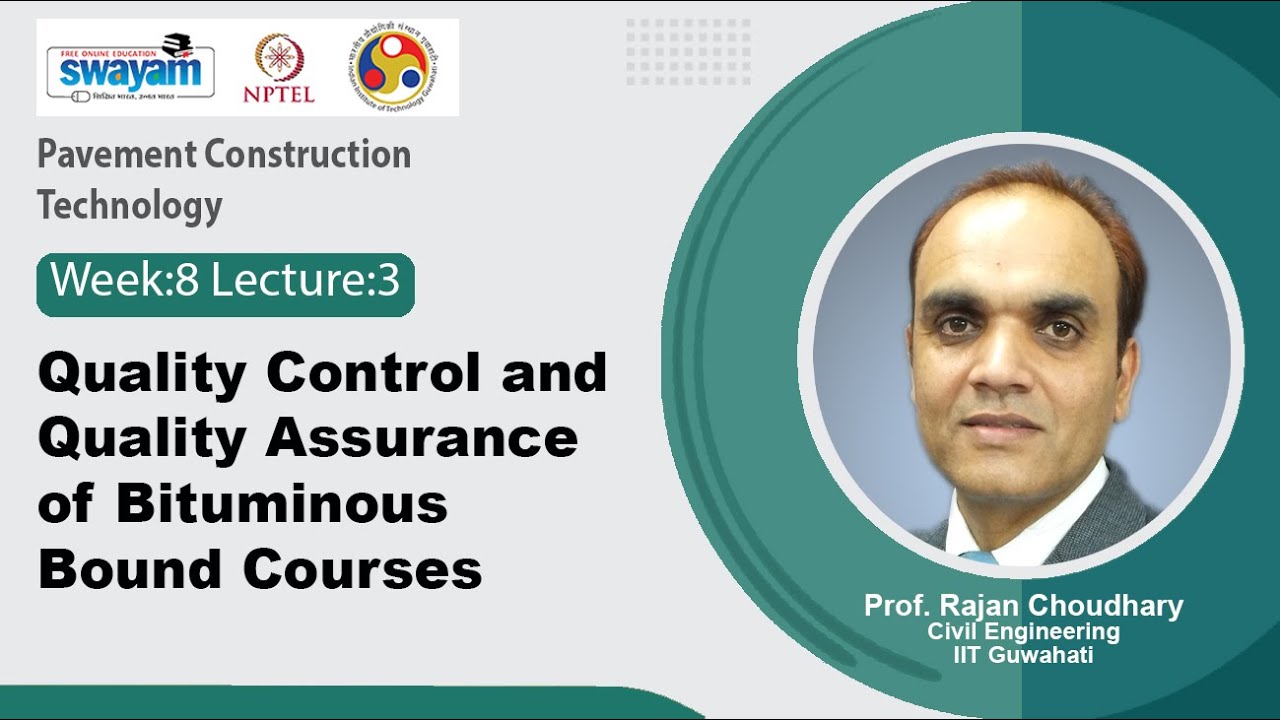
Lec 31: Quality control and quality assurance of bituminous bound courses
Keywords
Summary
139 words
Critical Evaluation
The lecture provides a solid introduction to quality control in bituminous pavement construction, focusing on the use of control charts. The content is technically accurate and aligns with established practices in civil engineering. The speaker, Prof. Rajan Choudhary, is a credible authority from IIT Guwahati, and the lecture is part of a recognized NPTEL MOOC, which adds to its reliability. The argumentation is logical, emphasizing the need to manage variability rather than reject entire lots based on single test results. The use of control charts is well-explained, with practical examples such as monitoring density and aggregate gradation. The lecture references relevant Indian standards (MORTH, IRC, IS), which are appropriate for the context. However, the lecture lacks depth in some areas; for instance, it does not delve into statistical process control theory or provide detailed case studies. The sources cited are primarily standards and course materials, which are credible but not peer-reviewed. The adéquation between title and content is excellent, as the lecture directly addresses quality control and assurance. Overall, the lecture is informative and useful for students and practitioners, but it could benefit from more concrete examples and a deeper exploration of statistical methods. The public comments, if any, were not provided, so no analysis of audience reception is possible.
210 words
Title / Content Match
The title accurately reflects the content, which focuses on quality control and assurance for bituminous bound courses.
Quality & Reliability
8/10
Lecture by a professor from IIT Guwahati, part of an NPTEL MOOC, referencing established standards (MORTH, IRC, IS). Content is technical and structured, but lacks peer-reviewed sources and is based on standard practice.
Key Moments
Markers derived by PSI from the transcript: the creator did not define chapters.
- Introduction to the lecture and course context.
- Discussion on variability in road construction and the need for quality control.
- Introduction to control charts and their benefits.
- Example of control chart for density of compacted bituminous core.
- Discussion on monitoring aggregate gradation and binder content.
- Explanation of key properties monitored through control charts.
- Importance of continuous monitoring and early detection of problems.
Cited Sources
- NPTEL Course: Pavement Construction Technology — Course page for the MOOC, providing context and additional materials.
Concurring Sources
- NPTEL Course: Pavement Construction Technology — The course itself is a source of concordance, as the lecture is part of a structured curriculum.
Contribution & Novelties
The lecture provides a clear and practical overview of quality control methods for bituminous bound courses, emphasizing the use of control charts. It is particularly valuable for its focus on Indian standards and practices, which may not be widely covered in international literature. The lecture’s contribution lies in its pedagogical approach, breaking down complex quality assurance concepts into understandable segments for engineering students.
Pour aller plus loin :
- Statistical Process Control — Relevant for understanding the theoretical basis of control charts.
- Asphalt Concrete — Provides background on bituminous mixtures and their properties.
- MORTH Specifications for Road and Bridge Works — Official Indian specifications for road construction, directly relevant to the lecture’s references.
112 words
Radar Profile
The radar profile shows high scores in quality of information and reliability, reflecting the authoritative source and technical accuracy. The quantity of information and technical level are moderate, indicating a focused but not exhaustive treatment. The overall profile suggests a reliable educational resource.