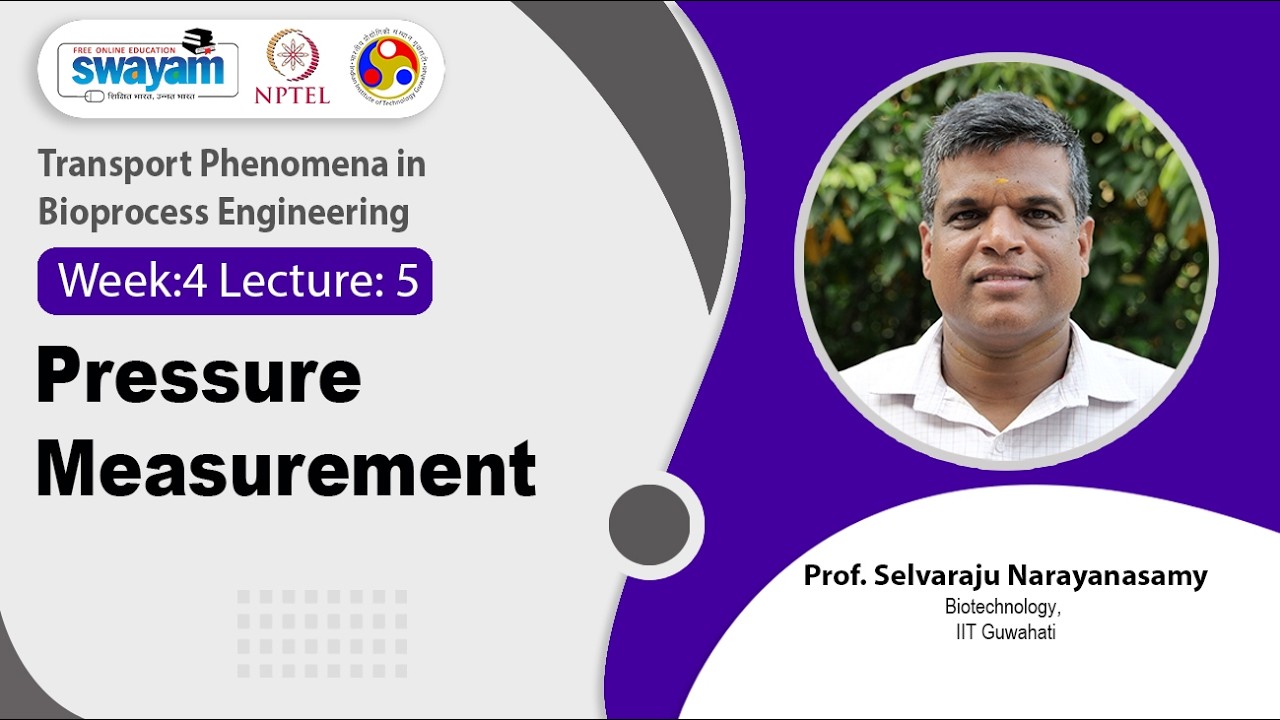
Lec 20: Pressure Measurement
Keywords
Summary
122 words
Critical Evaluation
The lecture provides a basic introduction to pressure measurement, focusing on manometers. The content is accurate and aligns with standard fluid mechanics principles. The instructor correctly defines pressure, derives the hydrostatic equation, and explains the operation of different manometer types. However, the presentation has several weaknesses. The verbal delivery is often unclear, with numerous grammatical errors and mispronunciations that may hinder comprehension. The visual aids are not visible in the transcript, and the instructor frequently refers to figures and equations without clear explanation, making it difficult for viewers to follow. The lecture lacks a structured outline and seems to jump between topics. No external sources are cited, and the content is presented as established knowledge. The adéquation between title and content is good, as the lecture indeed covers pressure measurement. The overall scientific rigor is moderate; the concepts are correct but the delivery is suboptimal. The lecture would benefit from clearer visuals, better organization, and more precise language. Despite these issues, it serves as a useful review for students already familiar with the subject.
174 words
Title / Content Match
The title accurately reflects the content, which focuses on pressure measurement techniques.
Quality & Reliability
6/10
The lecture is part of a formal academic course by a recognized institution (NPTEL, IIT Guwahati), and the instructor is a professor in biotechnology. The content is technically accurate but contains several verbal slips and lacks visual clarity. No external sources are cited beyond the course materials.
Key Moments
Markers derived by PSI from the transcript: the creator did not define chapters.
- Introduction to the lecture and recap of previous topics (rotameters, orifice meter).
- Definition of pressure and its units (Pascal, PSI, etc.).
- Derivation of hydrostatic pressure equation P = ρgh.
- Explanation of head and its relation to pressure.
- Introduction to manometers and their principle of operation.
- Detailed explanation of simple U-tube manometer.
- Discussion on two-fluid U-tube manometer for small pressure differences.
- Explanation of inverted U-tube manometer and its advantages.
- Brief mention of piezometer as a simple pressure measuring device.
Cited Sources
- NPTEL Course: Transport Phenomena in Bioprocess Engineering — Official course page for the lecture series.
- Playlist: Transport Phenomena in Bioprocess Engineering — Playlist containing all lectures of the course.
Concurring Sources
- NPTEL Course: Transport Phenomena in Bioprocess Engineering — Official course page for the lecture series.
Contribution & Novelties
The lecture provides a concise overview of pressure measurement techniques, specifically manometers, within the context of bioprocess engineering. It reinforces fundamental concepts and offers practical insights into selecting appropriate manometer types based on pressure ranges. The content is not novel but serves as a didactic resource.
Pour aller plus loin :
- Manometer - Wikipedia — General overview of pressure measurement devices.
- Hydrostatic Pressure - Wikipedia — Background on hydrostatic pressure principles.
- Fluid Mechanics - NPTEL — Related NPTEL course on fluid mechanics for deeper study.
85 words
Radar Profile
The radar profile shows moderate scores across all dimensions, indicating a balanced but not exceptional lecture. The technical level is relatively high, but the quality and quantity of information are average, and the reliability is moderate due to the informal presentation.