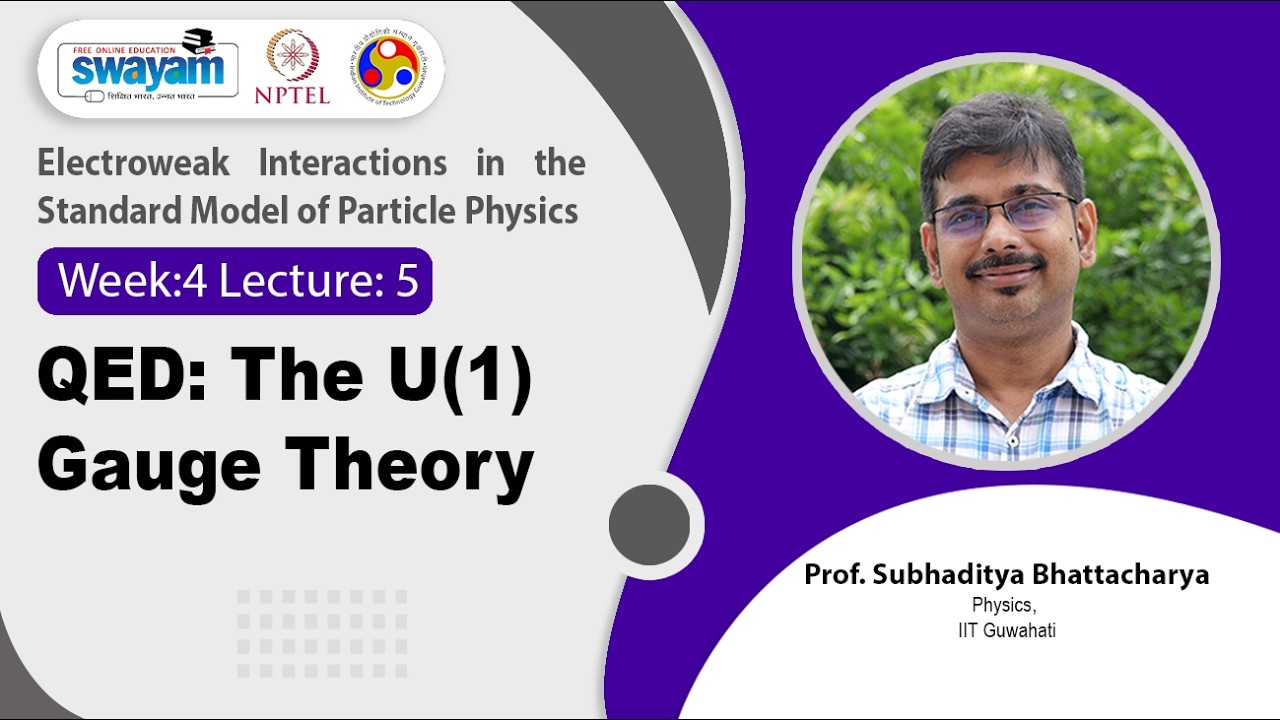
Lec 21: QED: The U(1) Gauge Theory
Keywords
Summary
197 words
Critical Evaluation
The lecture provides a solid introduction to the U(1) gauge theory and its role in QED. The instructor’s approach is methodical: he starts with the known Dirac and Maxwell Lagrangians, then demonstrates the need for a covariant derivative to maintain local gauge invariance. The derivation is clear and follows standard textbook treatments. The mathematical steps are well-explained, and the physical motivation is emphasized. The content is accurate and aligns with established physics. The lecture is part of a formal course by NPTEL, a reputable educational platform, and the instructor is a professor at IIT Guwahati, lending credibility. The presentation is didactic, with the instructor writing out equations and explaining each step. However, the lecture is relatively basic for a graduate-level course, focusing on the foundational aspects without delving into more advanced topics like renormalization or the full QED Lagrangian. The video quality is typical of a recorded lecture, with the instructor writing on a digital board. The audio is clear. The lecture does not include any visual aids beyond the equations, which might make it less engaging for some viewers. The title accurately reflects the content. The main strength is the clarity of the derivation and the pedagogical approach. A potential weakness is that the lecture assumes prior knowledge of the Dirac equation and Lagrangian mechanics, which might be challenging for beginners. Overall, this is a valuable resource for students learning quantum field theory, providing a clear and correct exposition of a fundamental concept.
244 words
Title / Content Match
The title accurately reflects the content: the lecture introduces the U(1) gauge theory and its connection to quantum electrodynamics.
Quality & Reliability
8/10
Lecture from a recognized academic institution (NPTEL IIT Guwahati), delivered by a physics professor. The content is mathematically rigorous and follows standard derivations in quantum field theory. The presentation is clear and pedagogically structured, though it is a lecture rather than peer-reviewed research.
Key Moments
Markers derived by PSI from the transcript: the creator did not define chapters.
- Introduction to the lecture and the goal of connecting electrons and photons via gauge theory.
- Review of the Dirac Lagrangian and the electromagnetic Lagrangian.
- Explanation of global U(1) symmetry and the Noether current.
- Introduction of local U(1) gauge transformation and its effect on the Dirac Lagrangian.
- Derivation showing that the kinetic term is not invariant under local transformation.
- Introduction of the covariant derivative and the gauge field (photon).
- Transformation law for the gauge field under U(1) gauge transformation.
- Verification that the covariant derivative restores gauge invariance.
- Conclusion and summary of the lecture.
Cited Sources
- Course page: Electroweak Interactions in the Standard Model of Particle Physics — Official course page for the NPTEL course, providing syllabus and materials.
- Playlist: Electroweak Interactions in the Standard Model — YouTube playlist containing all lectures of the course.
Concurring Sources
- Quantum Field Theory (book) by Mark Srednicki — Standard textbook covering gauge theories and QED.
- An Introduction to Quantum Field Theory (book) by Peskin and Schroeder — Classic textbook with detailed treatment of QED and gauge invariance.
Contribution & Novelties
This lecture provides a clear and systematic introduction to the U(1) gauge theory, demonstrating how local gauge invariance leads to the interaction between electrons and photons. The pedagogical approach is effective for students learning quantum field theory. The lecture does not present new research but serves as an educational resource.
Pour aller plus loin :
- Quantum electrodynamics — Overview of QED, its history, and key concepts.
- Gauge theory — General introduction to gauge theories, including the U(1) case.
- Dirac equation — Background on the Dirac equation and its role in quantum mechanics.
- Noether’s theorem — The theorem linking symmetries to conservation laws, relevant to the Noether current mentioned.
108 words
Radar Profile
The radar profile shows high scores in quantity and quality of information, technical level, and reliability, indicating a well-structured and accurate lecture. The balance across dimensions suggests a comprehensive educational resource.