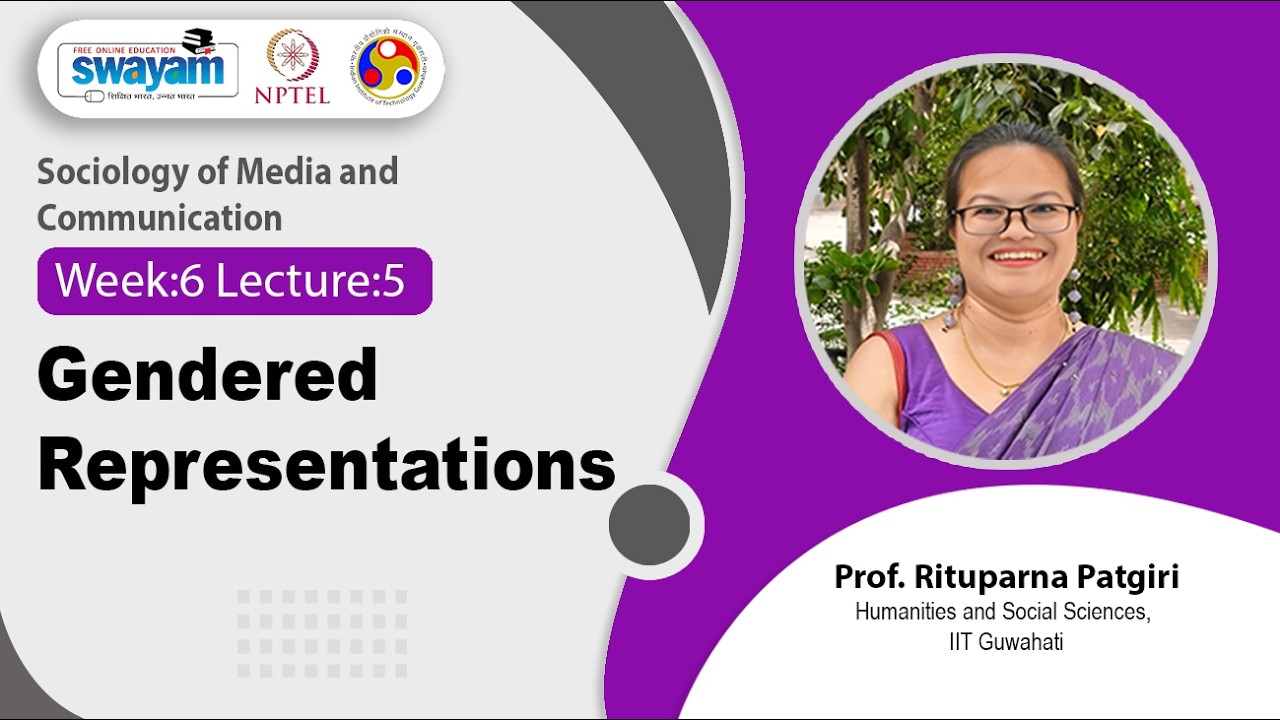
Lec 30: Gendered representations
Keywords
Summary
171 words
Critical Evaluation
Value of the Information & Strength of the Argument
The lecture provides a comprehensive overview of feminist media analysis, synthesizing key theories and case studies. It effectively argues that media representations are not neutral but shaped by patriarchal and neoliberal structures. The argumentation is solid, drawing on established scholars like Gallagher, Abu-Lughod, and Choudhuri, and uses concrete examples to illustrate theoretical points. However, it could benefit from more direct engagement with counterarguments or alternative perspectives.
Scientific Rigor, Source Quality, Title Accuracy
The lecture demonstrates academic rigor by referencing multiple scholarly works and situating them within broader debates. The sources are credible, though not all are explicitly cited in the video description. The title accurately reflects the content, and the lecture maintains a clear focus on gendered representations. The presentation is well-structured, moving from global to Indian contexts, and consistently ties back to the core concepts of representation and stereotyping.
149 words
Title / Content Match
The title accurately reflects the content, which focuses on gendered representations in media, particularly in the context of feminist perspectives and Indian print media.
Quality & Reliability
8/10
The lecture is an academic presentation by a professor, grounded in established feminist media theories (e.g., Gallagher, Dyer, Hall) and specific case studies. It provides a structured overview with citations to scholarly works, though it lacks direct references to primary sources in the video description.
Key Moments
Markers derived by PSI from the transcript: the creator did not define chapters.
- Introduction to gendered representations and feminist media perspectives.
- Discussion of Betty Friedan's 'The Feminine Mystique' and UN Decade for Women.
- Analysis of symbolic annihilation and two central axes of feminist critique.
- Intersectionality and critiques from black, Latina, and third-world feminists.
- Examples from Algeria, Egypt, Iran, and Afghanistan on women as markers of culture.
- Introduction to Indian context: feminism in print media and commercialization.
- Analysis of Femina, Cosmopolitan, and the 'feminism of choice'.
- Critique of International Women's Day representations and beauty pageants.
- Discussion on the erasure of structural inequalities in media representations.
- Conclusion: need for critical and nuanced representations.
Cited Sources
- Course page: Sociology of Media and Communication — Official course page for the lecture series.
- Playlist: Sociology of Media and Communication — Playlist containing this lecture and others in the course.
Concurring Sources
- Gaye Tuchman, 'The Symbolic Annihilation of Women by the Mass Media' — Foundational work on symbolic annihilation, aligning with the lecture's discussion.
- Lila Abu-Lughod, 'The Romance of Resistance: Tracing Transformations of Power Through Bedouin Women' — Relevant to the lecture's discussion on women as markers of culture in Middle Eastern contexts.
Dissenting Sources
- Christina Hoff Sommers, 'Who Stole Feminism?' — Provides a contrasting perspective on feminism, potentially challenging the lecture's critical stance on media representations.
Contribution & Novelties
This lecture provides a structured synthesis of feminist media theories and applies them to the Indian context, highlighting the commercialization of feminism in print media. It offers a critical perspective on how media representations often erase intersectional inequalities. The lecture is valuable for students and researchers seeking a concise overview of gendered representations.
Pour aller plus loin :
- Symbolic annihilation — Concept central to the lecture’s discussion of media representation.
- Intersectionality — Key framework for understanding overlapping identities and oppressions.
- Feminist media studies — Academic field that examines media through feminist perspectives.
92 words
Radar Profile
The radar profile shows high scores in quantity and quality of information, with moderate technical level, indicating a well-structured academic lecture. The fiabilite is high, reflecting the credibility of the presenter and sources.