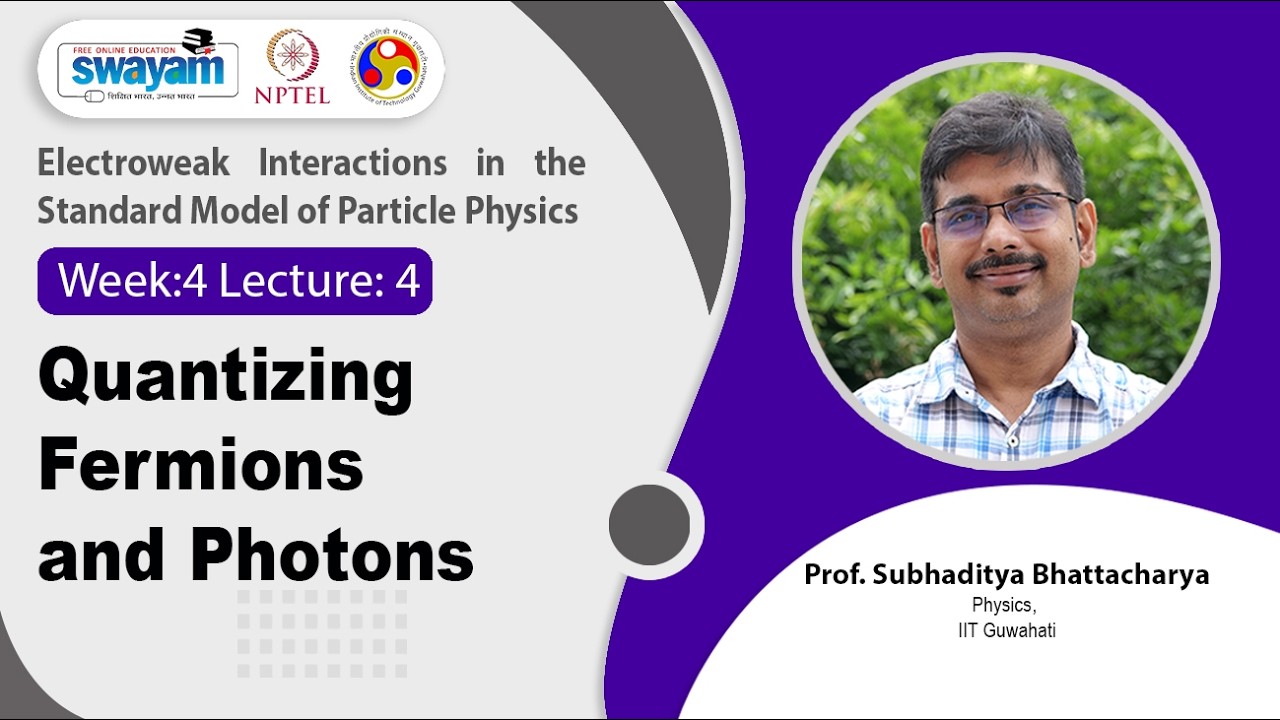
Lec 20: Quantizing Fermions and Photons
Keywords
Summary
174 words
Critical Evaluation
The lecture provides a rigorous and systematic introduction to canonical quantization of fermionic and bosonic fields, a cornerstone of quantum field theory. The instructor clearly explains the steps: writing the Lagrangian, deriving conjugate momenta, constructing the Hamiltonian, imposing (anti-)commutation relations, and performing mode expansions. The mathematical derivations are presented with sufficient detail, though some steps are left as exercises, which is appropriate for an advanced course. The argumentation is logically sound and consistent with standard textbooks such as Peskin & Schroeder or Srednicki. The sources are not explicitly cited, but the content is well-established physics. The lecture is technically dense and assumes prior knowledge of special relativity, classical field theory, and quantum mechanics. The title accurately reflects the content. The main strength is the clear pedagogical structure, guiding the student from classical fields to quantum particles. A minor weakness is the lack of explicit references, but this is typical for lecture videos. Overall, the lecture is highly valuable for students learning quantum field theory, providing a solid foundation for understanding the particle interpretation of fields.
175 words
Title / Content Match
The title accurately reflects the content: the lecture focuses on quantizing fermionic (Dirac) and bosonic (photon) fields.
Quality & Reliability
8/10
Lecture from a recognized academic institution (NPTEL IIT Guwahati), delivered by a physics professor. Content is standard quantum field theory, mathematically rigorous, and consistent with established textbooks. Minor caveats: no citations provided, and some derivations are left as exercises.
Key Moments
Markers derived by PSI from the transcript: the creator did not define chapters.
- Introduction and recap of scalar field quantization
- Start of Dirac field quantization: conjugate momenta and Hamiltonian
- Imposing anti-commutation relations and mode expansion for Dirac field
- Deriving the Hamiltonian for Dirac field and interpretation as particles/antiparticles
- Discussion of conserved charge and its interpretation
- Introduction to photon quantization: Proca Lagrangian and equation of motion
- Conjugate momenta and Hamiltonian for electromagnetic field
- Imposing commutation relations and mode expansion with polarization vectors
- Summary and outlook for interactions
Cited Sources
- Course page on NPTEL — Official course page for 'Electroweak Interactions in the Standard Model of Particle Physics'
- Playlist of lectures — YouTube playlist containing all lectures of the course
Concurring Sources
- Peskin & Schroeder, An Introduction to Quantum Field Theory — Standard textbook covering canonical quantization of fields, including Dirac and photon fields.
- Srednicki, Quantum Field Theory — Another standard textbook with detailed treatment of quantization.
Contribution & Novelties
The lecture provides a clear and structured exposition of canonical quantization for fermionic and bosonic fields, bridging the gap between classical field theory and particle interpretation. It emphasizes the physical meaning of creation and annihilation operators and the role of spin and polarization. The lecture is particularly useful for students transitioning to quantum field theory.
Pour aller plus loin :
- Canonical quantization — Overview of the procedure used in the lecture.
- Dirac equation — Background on the Dirac field and its solutions.
- Photon polarization — Explanation of polarization degrees of freedom for photons.
93 words
Radar Profile
The radar profile shows high scores in technical level and information quality, indicating a mathematically rigorous and well-structured lecture. The lower score in information quantity reflects the focused scope, while the fiabilite score is high due to the academic context.