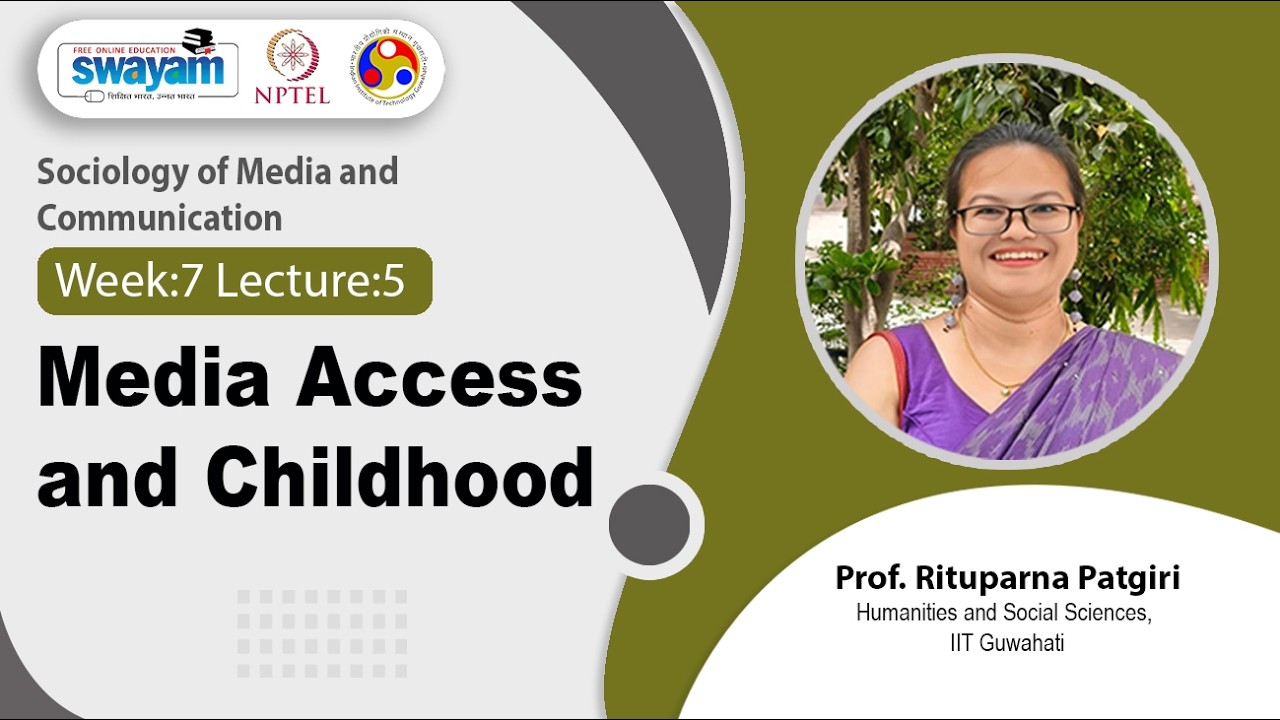
Lec 35: Media access and childhood
Keywords
Summary
172 words
Critical Evaluation
Value of the Information & Strength of the Argument
The lecture provides valuable insights into the intersection of media, childhood, and social change, drawing on established research by Sonia Livingstone and others. It effectively argues that while digital literacy is important, it is insufficient to protect vulnerable youth from platform risks, highlighting the need for systemic support. The argumentation is coherent and well-supported by references to specific studies and concepts, such as ‘risky affordances’ and ‘platformization’. The lecture also offers a nuanced view of parenting, acknowledging the complexities and lack of guidance for parents. However, it could have provided more concrete examples or data to strengthen the empirical grounding.
Scientific Rigor, Source Quality, Title Accuracy
The lecture demonstrates scientific rigor by referencing academic works, particularly Sonia Livingstone’s research, and by discussing empirical studies. The sources mentioned are credible, though specific citations are not provided in the video description. The title accurately reflects the content, focusing on media access and childhood. The lecture is well-structured and maintains a clear focus on the topic, with appropriate depth for an academic audience.
179 words
Title / Content Match
The title accurately reflects the content, focusing on media access and its impact on childhood.
Quality & Reliability
8/10
Lecture by a professor from IIT Guwahati, based on academic work by Sonia Livingstone and others, with clear theoretical grounding and references to empirical studies. The content is well-structured and credible, though it is a lecture rather than peer-reviewed research.
Key Moments
Markers derived by PSI from the transcript: the creator did not define chapters.
- Introduction to the lecture and the unit on media and social change.
- Discussion of Sonia Livingstone's work on children and the internet.
- Explanation of the digital divide and its implications for young people.
- Introduction of the concept of platform literacy and its limitations.
- Presentation of the study on vulnerable youth and mental health difficulties.
- Discussion of risky affordances and how platforms amplify vulnerabilities.
- Exploration of how young people develop coping strategies and hypervigilance.
- Examination of parenting in the digital age, referencing Livingstone and Blum-Ross.
- Discussion of the need for better support and regulation for families.
- Conclusion summarizing the impact of mediatization on childhood.
Cited Sources
- Sociology of Media and Communication - Course Page — Course page for the lecture series, providing context and additional resources.
- Playlist: Sociology of Media and Communication — Full playlist of the course lectures, allowing viewers to access related content.
Concurring Sources
- Sonia Livingstone's research on children and the internet — Her work is central to the lecture's arguments about children's online experiences.
- Digital divide - Wikipedia — Provides background on the digital divide concept discussed in the lecture.
Contribution & Novelties
The lecture provides a comprehensive overview of how media access shapes childhood, synthesizing existing research and highlighting the specific vulnerabilities of young people with mental health difficulties. It emphasizes the inadequacy of current digital literacy approaches and calls for systemic changes. The discussion of parenting in the digital age offers a nuanced perspective on the challenges faced by families.
Pour aller plus loin :
- Sonia Livingstone’s research on children and the internet — Overview of her work and publications.
- Digital divide - Wikipedia — Background on the concept of digital divide.
- Platformization - Wikipedia — Explanation of the concept of platformization.
- Parenting for a Digital Future - Book page — Information about the book by Livingstone and Blum-Ross.
118 words
Radar Profile
The radar profile shows high scores in quantity and quality of information, indicating a content-rich lecture. The technical level is moderate, suitable for a general academic audience. The overall reliability is high due to the academic credentials of the speaker and the use of established research.
💬 No comments were provided for analysis.