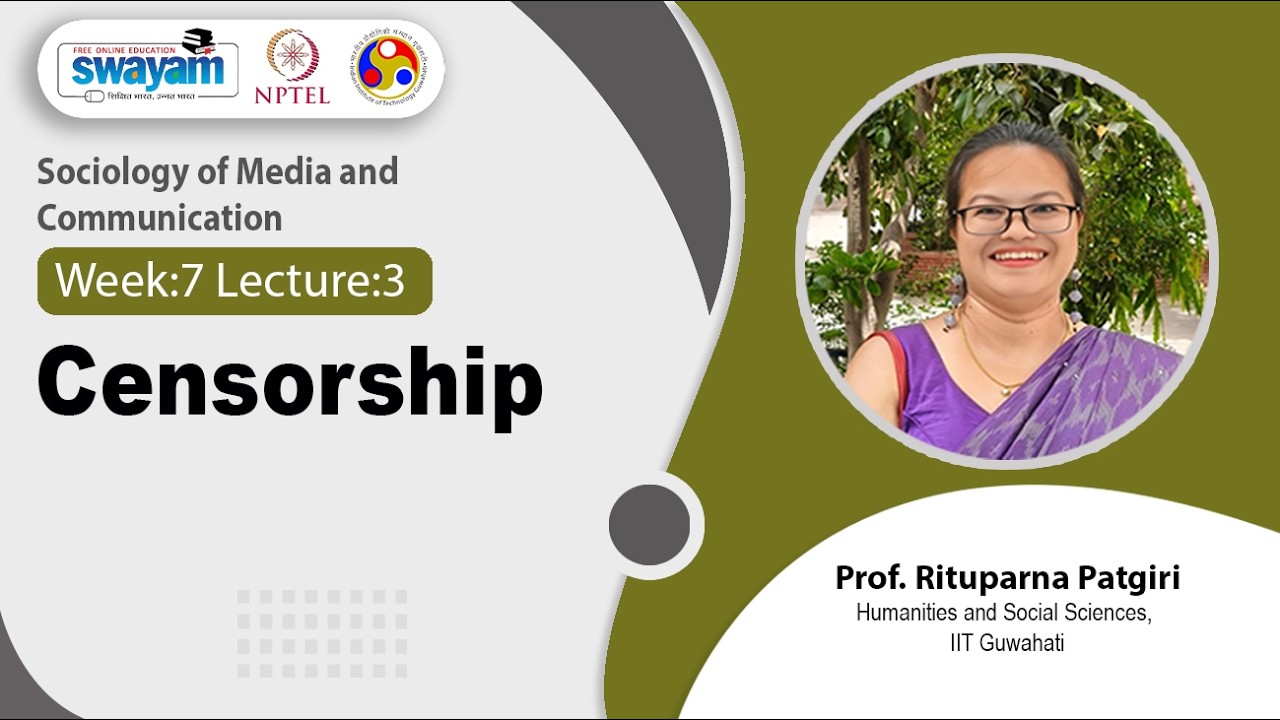
Lec 33: Censorship
Keywords
Summary
126 words
Critical Evaluation
Value of the Information & Strength of the Argument
The lecture provides a comprehensive overview of censorship, emphasizing its role as cultural regulation rather than mere control. It effectively uses historical examples to illustrate the evolution of censorship in India, and argues that censorship is intertwined with public sentiment and state power. The argumentation is logical and well-supported by references to specific laws and events, though it could benefit from more critical analysis of contemporary debates.
Scientific Rigor, Source Quality, Title Accuracy
The lecture is academically rigorous, drawing on scholarly sources and historical records. It cites specific legislation and incidents, and the title accurately reflects the content. The sources are credible, though the lecture does not provide direct citations for all claims, relying on general knowledge. The title is appropriate and does not overpromise.
134 words
Title / Content Match
The title 'Censorship' accurately reflects the content, which focuses on the concept, history, and contemporary issues of censorship in South Asia, particularly India.
Quality & Reliability
8/10
The lecture is delivered by a professor from IIT Guwahati, based on academic sources and historical records. It provides a structured overview of censorship in South Asia, with specific references to legislation and events. The content is well-organized and aligns with scholarly discourse, though it is a single perspective and not peer-reviewed.
Key Moments
Markers derived by PSI from the transcript: the creator did not define chapters.
- Introduction to the lecture on censorship, referencing the book 'Censorship in South Asia'.
- Definition of censorship as cultural regulation and its connection to public sentiment.
- Discussion on the role of state and self-regulatory bodies in censorship.
- Historical overview of censorship in colonial India, including the Gagging Act and Press Act.
- Post-independence censorship, including the Emergency and press restrictions.
- Censorship of broadcast media and films, including the Central Board of Film Certification.
- Internet censorship in the 21st century, including Section 66A and IT rules.
- Conclusion summarizing censorship as a backstage media process.
Cited Sources
- Course Preview: Sociology of Media and Communication — Course page for the lecture series.
- Playlist: Sociology of Media and Communication — Playlist containing all lectures of the course.
Concurring Sources
- Censorship in South Asia: Cultural Regulation from Sedition to Seduction — Book referenced in the lecture, providing theoretical framework.
Contribution & Novelties
The lecture provides a structured overview of censorship in South Asia, emphasizing its historical roots and cultural regulation. It synthesizes various laws and events, offering a comprehensive understanding of the topic. The lecture is part of a broader course, so it serves as an educational resource.
Pour aller plus loin :
- Censorship in India — Provides a detailed overview of censorship laws and practices in India.
- Central Board of Film Certification — Official body for film certification in India.
- Information Technology Act, 2000 — Key legislation governing internet regulation in India.
91 words
Radar Profile
The radar profile shows high scores in information quantity, quality, and reliability, with a moderate technical level. This indicates a well-structured and informative lecture that is accessible to a general audience, though it may lack deep technical analysis.