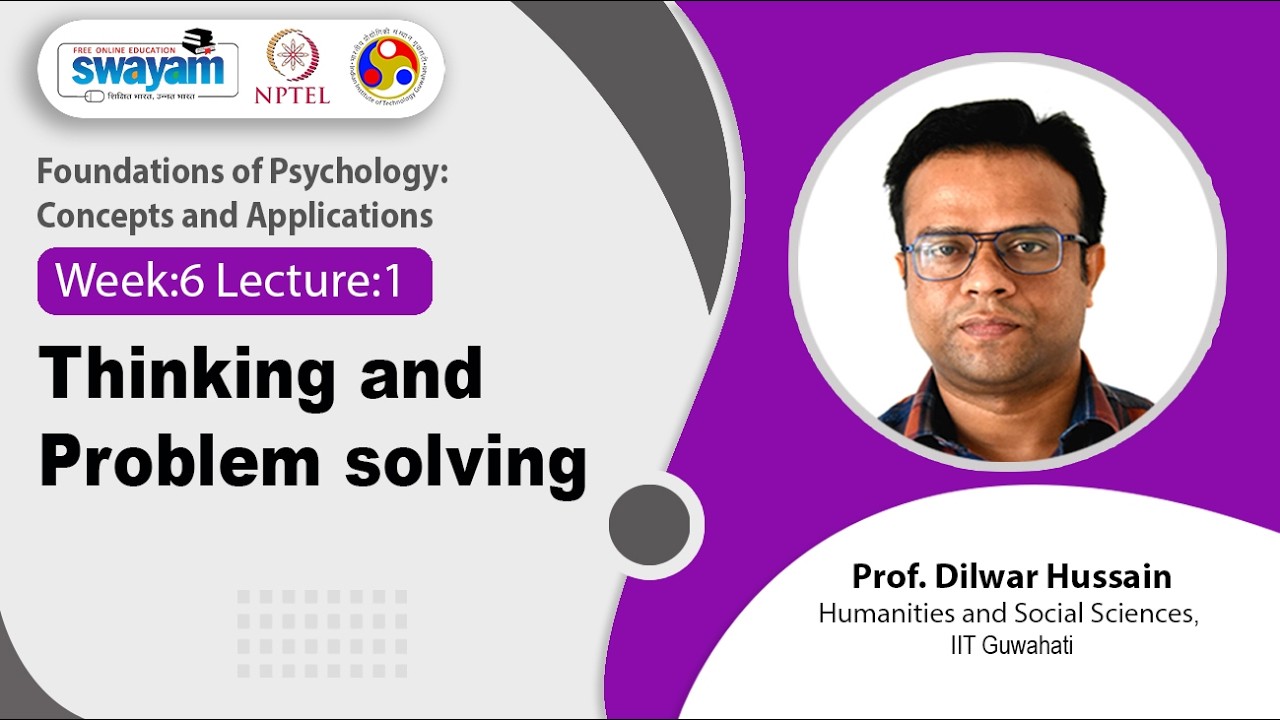
Lec 14: Thinking and Problem solving
Keywords
Summary
124 words
Critical Evaluation
The lecture provides a solid introduction to the cognitive psychology of thinking and problem solving. It clearly defines key concepts such as thinking, mental images, and concepts, and explains their roles in cognitive processes. The use of examples like Temple Grandin and Albert Einstein effectively illustrates the importance of mental imagery in creative thinking. The content is accurate and aligns with established psychological theories, though it lacks in-depth citations to specific research studies, which would enhance its scientific rigor. The argumentation is logical and well-structured, progressing from definitions to applications. The lecture is suitable for an introductory psychology course, but it does not delve deeply into the nuances of problem-solving strategies or creativity, which are mentioned but not fully explored. The title accurately reflects the content, and the lecture fulfills its educational purpose. Overall, it is a reliable and informative resource, though it could benefit from more empirical references and a deeper exploration of the topics.
156 words
Title / Content Match
The title accurately reflects the content, which covers thinking and problem-solving concepts.
Quality & Reliability
8/10
Lecture by a professor from IIT Guwahati, part of a structured NPTEL course. Content is based on established psychological theories and research, but lacks citations to specific studies beyond a few examples. The presentation is clear and educational.
Key Moments
Markers derived by PSI from the transcript: the creator did not define chapters.
- Introduction to module six on thinking and intelligence
- Recap of previous lecture on memory and forgetting
- Definition of thinking and its role in cognitive psychology
- Discussion on contents of thinking: mental images and concepts
- Examples of mental imagery: Temple Grandin and Albert Einstein
- Mental images behave like real objects; example of map of India
- Children rely more on visual imagery; adults use more language-based concepts
- Types of mental imagery: visual, auditory, tactile, etc.
- Role of mental imagery in creative thinking and problem solving
- Conclusion and preview of next lecture on types of thinking
Cited Sources
- NPTEL Course: Foundations of Psychology: Concepts and Applications — Course page for the lecture series
- Playlist: Foundations of Psychology — Playlist containing all lectures of the course
Concurring Sources
- Mental imagery - Wikipedia — Supports the concept of mental imagery and its characteristics.
- Cognitive psychology - Wikipedia — Provides background on the field of cognitive psychology.
Contribution & Novelties
This lecture provides a clear and accessible introduction to the concepts of thinking and problem solving, emphasizing the role of mental imagery. It offers a structured overview that is useful for students new to cognitive psychology. The lecture does not present original research but synthesizes existing knowledge in an educational format.
Pour aller plus loin :
- Mental imagery - Wikipedia — Provides an overview of mental imagery, its types, and research.
- Cognitive psychology - Wikipedia — Explains the field of cognitive psychology and its key topics.
- Problem solving - Wikipedia — Discusses problem-solving strategies and theories.
96 words
Radar Profile
The radar profile shows high scores in quantity and quality of information, indicating a well-structured and informative lecture. The technical level is moderate, suitable for introductory audiences. Reliability is high, reflecting the academic background of the instructor. The overall balance suggests a solid educational resource.
💬 No comments were provided for analysis.