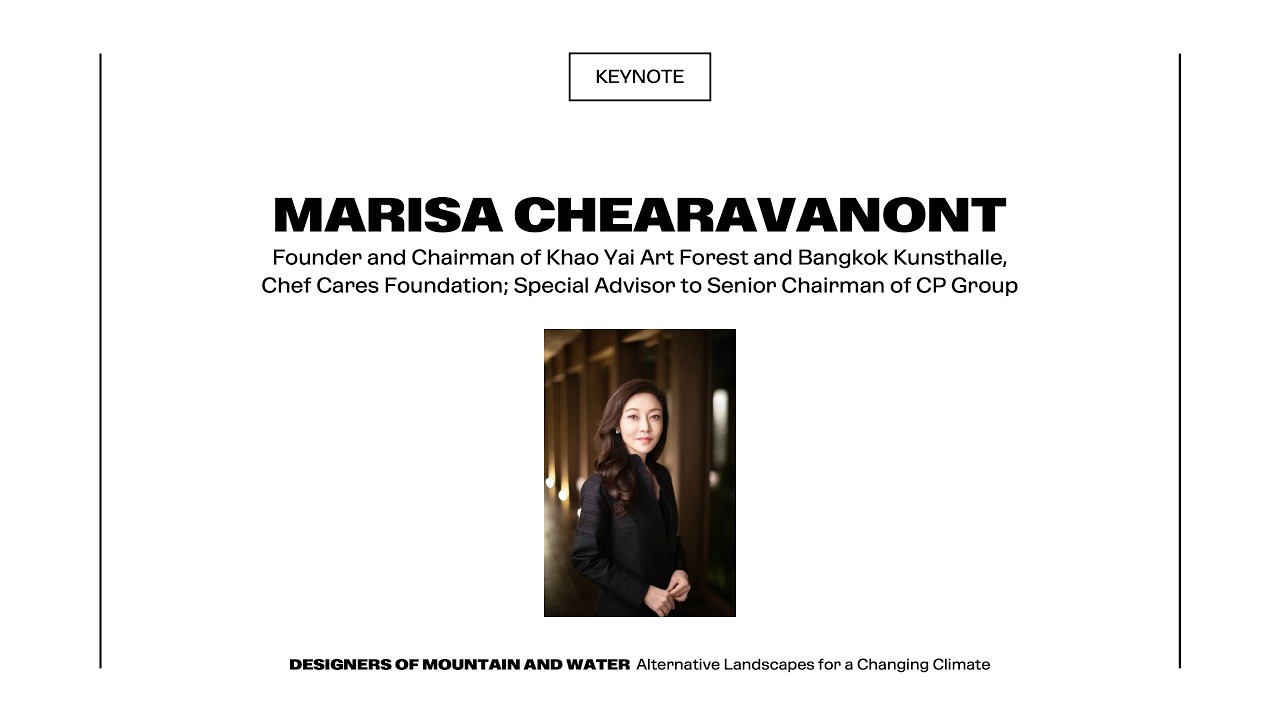
Designers of Mountain and Water: Alternative Landscapes for a Changing Climate | Marisa Chearavanont
Keywords
Summary
161 words
Critical Evaluation
Value of the Information & Strength of the Argument
The value of the information is high, as it presents a novel framework for understanding landscape architecture in Asia through bioregions rather than national boundaries. The argumentation is solid, grounded in the curatorial research and the speakers’ expertise. The keynote by Marisa Chearavanont offers a practical example of how art and landscape can be integrated for ecological and social benefit. The conference structure supports a coherent narrative, with each speaker building on the previous ones. The argumentation is persuasive, though it relies more on qualitative and cultural arguments than on quantitative data.
Scientific Rigor, Source Quality, Title Accuracy
The scientific rigor is moderate to high. The conference is hosted by Harvard GSD, a reputable institution, and features experts in the field. The sources cited are primarily the speakers’ own projects and publications, which are credible. The title accurately reflects the content, focusing on the concept of ‘mountain and water’ and its relevance to climate change. The exhibition and conference are well-documented, with clear references to specific projects and research. However, the keynote speaker is not a scientist but a philanthropist, which may affect the scientific depth. Overall, the sources are reliable and the title is appropriate.
205 words
Title / Content Match
The title accurately reflects the content, which focuses on landscape architecture in Asia, specifically the concept of 'mountain and water' and its relevance to climate change.
Quality & Reliability
8/10
The conference features established academics and practitioners from leading institutions, with a clear structure and curated content. The keynote speaker is a recognized philanthropist and cultural patron, though not a scientist, which slightly reduces the scientific rigor. The content is well-organized and presented, with a strong emphasis on design practice and cultural context.
Chapters
Cited Sources
- Khao Yai Art Forest — Mentioned by Marisa Chearavanont as her foundation and project.
- Bangkok Kunsthalle — Mentioned by Marisa Chearavanont as her initiative.
- Park Kim (firm) — Jungyoon Kim's practice, mentioned in her presentation.
Concurring Sources
- Alternative Nature — Book by Park Kim, referenced by Jungyoon Kim as a theoretical foundation.
Contribution & Novelties
The conference introduces a novel framework for understanding landscape architecture in Asia by using bioregions instead of national boundaries, which is a significant contribution to the field. It also highlights the concept of ‘mountain and water’ as a design strategy, offering a fresh perspective on traditional Asian landscape aesthetics. The exhibition and conference bring together diverse practices from across Asia, fostering cross-cultural exchange and knowledge sharing.
Pour aller plus loin :
- Bioregion — Provides background on the bioregional framework used in the exhibition.
- Landscape architecture — Overview of the discipline and its history.
- Climate change adaptation — Context for the conference’s focus on climate resilience.
105 words
Radar Profile
The radar profile shows high scores in quantity and quality of information, with a moderate level of technical depth. This indicates a well-structured and informative conference that is accessible to a broad audience while still offering substantive content for professionals.
💬 No comments were provided for analysis.