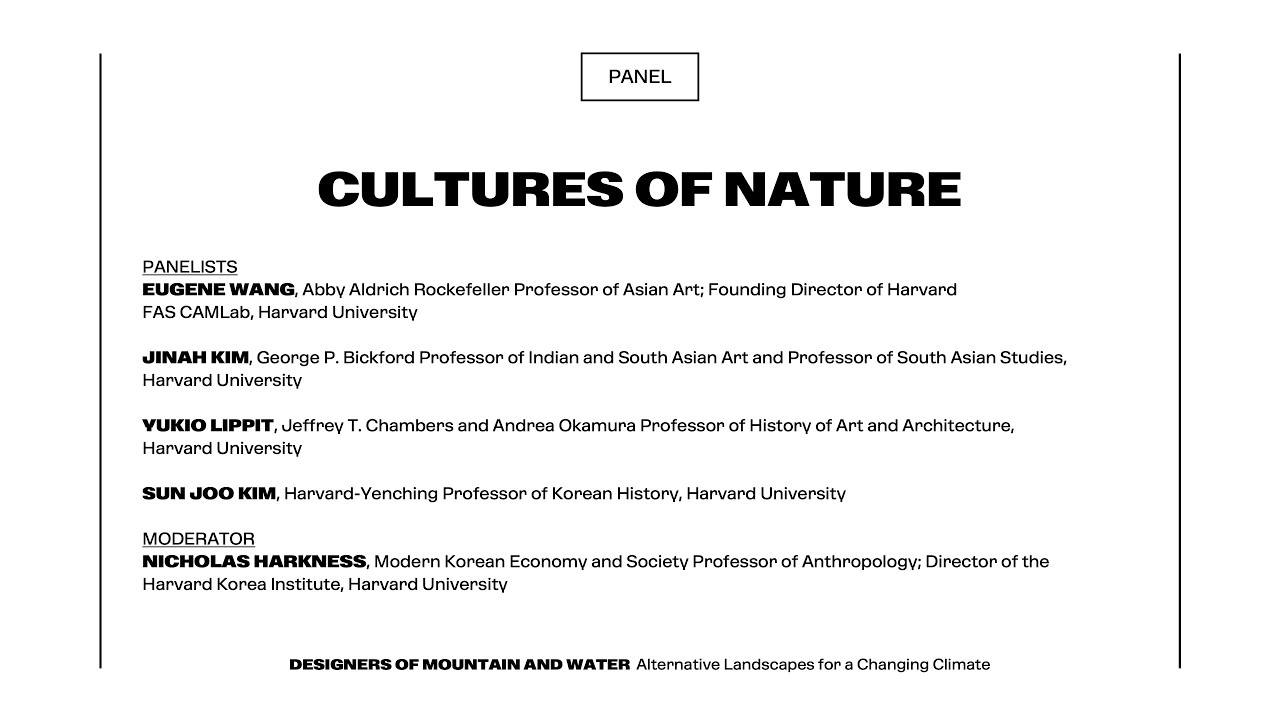
Designers of Mountain and Water: Alternative Landscapes for a Changing Climate | Panel 1
Keywords
Summary
201 words
Critical Evaluation
Value of the Information & Strength of the Argument
The panel provides valuable insights into how different Asian cultures have conceptualized nature and integrated it into art and architecture. Eugene Wang’s argument that traditional Chinese landscape painting was about circulation and the human body challenges common assumptions, offering a fresh perspective. His analysis of the Luce Chapel as a sustainable building that works with natural forces is compelling and well-argued. Jinah Kim’s focus on water and monsoon as a unifying theme in South and Southeast Asian art is insightful, and her examples of Kailasa Temple and Angkor Wat demonstrate sophisticated engineering and symbolic use of water. Yukio Lippit’s comparison of Western and East Asian landscape painting is thought-provoking, emphasizing the intersubjective nature of East Asian art. The arguments are well-supported with specific examples and historical context, though some claims could benefit from more detailed citations. The panel successfully bridges art history and contemporary sustainability concerns, offering a rich cultural perspective.
Scientific Rigor, Source Quality, Title Accuracy
The panelists are highly credible scholars from Harvard University, and their presentations are based on their research expertise. The sources cited are primarily artworks, monuments, and historical texts, which are appropriate for the topic. The title accurately reflects the content, focusing on cultural perspectives on nature. The panel is well-structured, with each speaker addressing a different aspect of the theme. The discussion is scholarly and rigorous, though it is a panel discussion rather than a peer-reviewed publication. The title’s mention of ‘Alternative Landscapes for a Changing Climate’ is addressed through the historical examples and their relevance to contemporary sustainability.
265 words
Title / Content Match
The title accurately reflects the panel's focus on cultural perspectives on nature in Asian art and architecture, though the subtitle 'Panel 1' is generic.
Quality & Reliability
8/10
The panel features four senior Harvard professors (art history, Korean history) with strong academic credentials. The content is scholarly, well-structured, and grounded in historical and art-historical evidence. However, it is a panel discussion, not peer-reviewed research, and some claims (e.g., about the Luce Chapel's engineering) are presented without detailed citations.
Chapters
Cited Sources
- Luce Chapel, Tunghai University — Eugene Wang discusses the Luce Chapel as an example of architecture embodying circulation and sustainability.
- Kailasa Temple, Ellora — Jinah Kim uses the Kailasa Temple as an example of rock-cut architecture representing Mount Kailasa and cosmic mountain.
- Angkor Wat — Jinah Kim discusses Angkor Wat as a cosmic mountain surrounded by a moat representing the cosmic ocean.
- Early Spring (Guo Xi) — Yukio Lippit references Guo Xi's painting to illustrate the intersubjective nature of East Asian landscape painting.
Concurring Sources
- Luce Chapel, Tunghai University — Wikipedia article provides details on the chapel's design and sustainability features, supporting Wang's claims.
- Angkor Wat — Wikipedia article confirms the monument's scale and symbolic layout, aligning with Kim's description.
Contribution & Novelties
The panel offers a novel perspective on sustainability by examining historical Asian concepts of nature as dynamic and interconnected, rather than static scenery. Eugene Wang’s reinterpretation of ‘shanshui’ as circulation and the human body provides a new lens for understanding traditional Chinese art and its relevance to modern design. Jinah Kim’s focus on water and monsoon as a unifying theme in South and Southeast Asian art highlights the importance of climatic context in architectural design. Yukio Lippit’s comparison of Western and East Asian landscape painting challenges the notion of a universal ’landscape’ and emphasizes the intersubjective nature of East Asian art. These insights can inform contemporary sustainable design by encouraging a more holistic and culturally aware approach.
Pour aller plus loin :
- Shanshui — Overview of the Chinese term for mountain-water painting.
- Feng shui — Traditional Chinese system of harmonizing with the environment, related to concepts of flow and circulation.
- Passive cooling — Techniques used in the Luce Chapel, relevant to sustainable architecture.
163 words
Radar Profile
The radar profile shows high scores in quantity and quality of information, reflecting the panel's rich content and scholarly depth. The technical level is moderate, suitable for an academic audience. The overall reliability is high due to the credibility of the speakers, though the format (panel discussion) limits the depth of citation.
💬 No comments were provided for analysis.