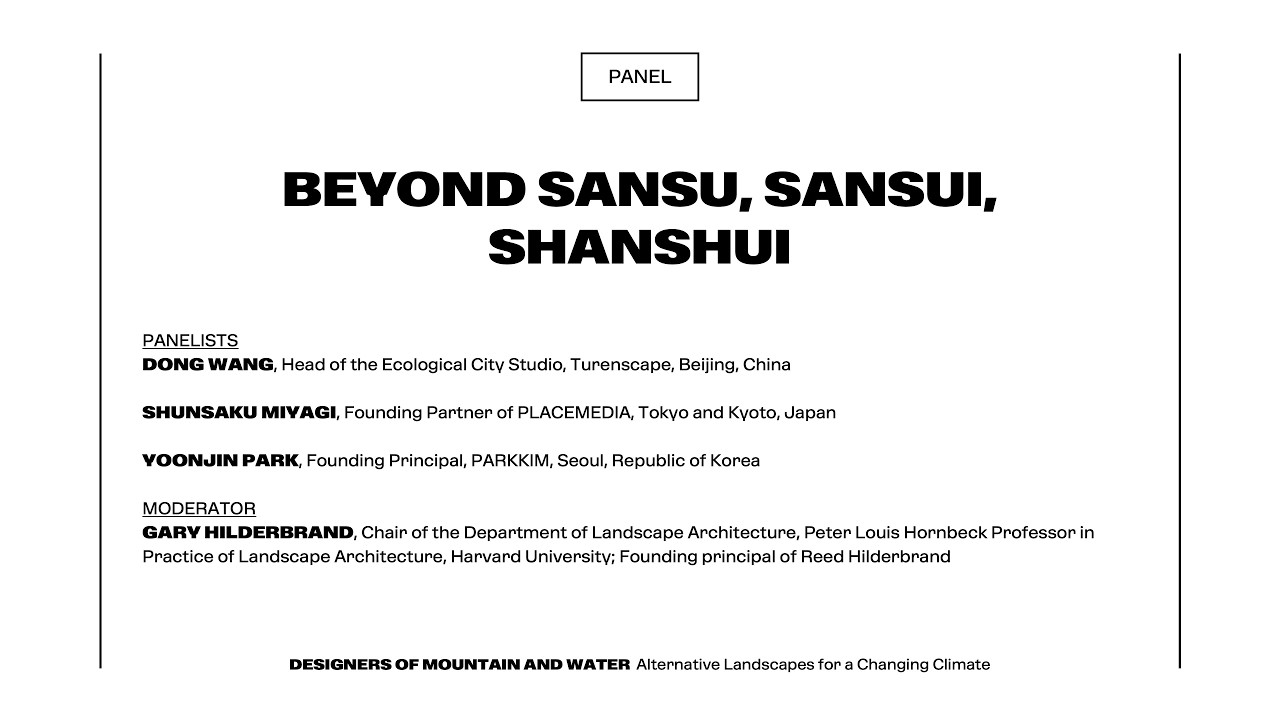
Designers of Mountain and Water: Alternative Landscapes for a Changing Climate | Panel 4
Keywords
Summary
186 words
Critical Evaluation
Value of the Information & Strength of the Argument
The panel provides valuable insights into contemporary landscape architecture practice, particularly the application of nature-based solutions for climate adaptation. Dong Wang’s presentation of the sponge city projects offers concrete examples of how ecological engineering can mitigate flooding and restore biodiversity, supported by data on flood storage capacity and post-event recovery. Shunsaku Miyagi’s discussion of the Kyoto garden demonstrates a sophisticated integration of traditional aesthetics with modern design, while his Krori project illustrates a scalable approach to sustainable community planning. The argumentation is generally solid, grounded in professional experience and project outcomes. However, some claims, such as the effectiveness of sponge city projects, could benefit from more rigorous scientific evidence. The panel also engages with the cultural and philosophical dimensions of landscape, enriching the discussion beyond purely technical aspects.
Scientific Rigor, Source Quality, Title Accuracy
The panel maintains a high level of scientific rigor, with speakers referencing specific projects, publications, and recognized frameworks like IUCN’s nature-based solutions. The tribute to Kongjian Yu and his work adds credibility, as his research is well-documented. The title accurately reflects the content, focusing on alternative landscapes for a changing climate within the Asian context. The sources cited are primarily the speakers’ own projects and publications, which are authoritative in the field. However, the discussion lacks formal citations to external scientific literature, which could enhance the rigor. The adequacy between title and content is strong, as the panel directly addresses the theme of reimagining shanshui for contemporary challenges.
251 words
Title / Content Match
The title accurately reflects the content, which explores contemporary landscape architecture responses to climate change in Asia, framed by the traditional concept of shanshui.
Quality & Reliability
8/10
The panel features established practitioners and academics from leading institutions (Harvard GSD, Turenscape, PLACEMEDIA, PARKKIM) presenting peer-recognized projects. The discussion is grounded in professional experience and references to specific projects and publications, though it lacks formal citations and peer-reviewed evidence for some claims.
Chapters
Cited Sources
- Turenscape — Dong Wang's firm, presented sponge city projects.
- PLACEMEDIA — Shunsaku Miyagi's firm, discussed projects in Kyoto and Krori.
- PARKKIM — Yoonjin Park's firm, mentioned in the introduction.
- Kongjian Yu's final paper in Nature Water — Referenced by Dong Wang as inspiration for sponge planet concept.
Concurring Sources
- IUCN Nature-based Solutions — Recognized as global best practice for the Bangkok project.
Contribution & Novelties
The panel contributes to the discourse on landscape architecture by showcasing innovative approaches that integrate ecological function with cultural heritage. The ‘sponge city’ concept, as applied by Turenscape, offers a replicable model for flood management and ecological restoration. The discussion also highlights the importance of reinterpreting traditional concepts like shanshui to address contemporary climate challenges. The panel provides a platform for cross-cultural exchange, presenting diverse perspectives from China, Japan, and Korea.
Pour aller plus loin :
- Sponge City concept — Overview of the sponge city approach in urban design.
- Nature-based Solutions — IUCN’s framework for nature-based solutions, referenced in the panel.
- Kongjian Yu’s work — Background on the influential landscape architect and his contributions.
114 words
Radar Profile
The radar profile shows high scores in information quantity, quality, and reliability, with a slightly lower technical level, reflecting the panel's focus on practical applications and professional experience rather than deep technical detail. The overall balance indicates a well-rounded, credible presentation.