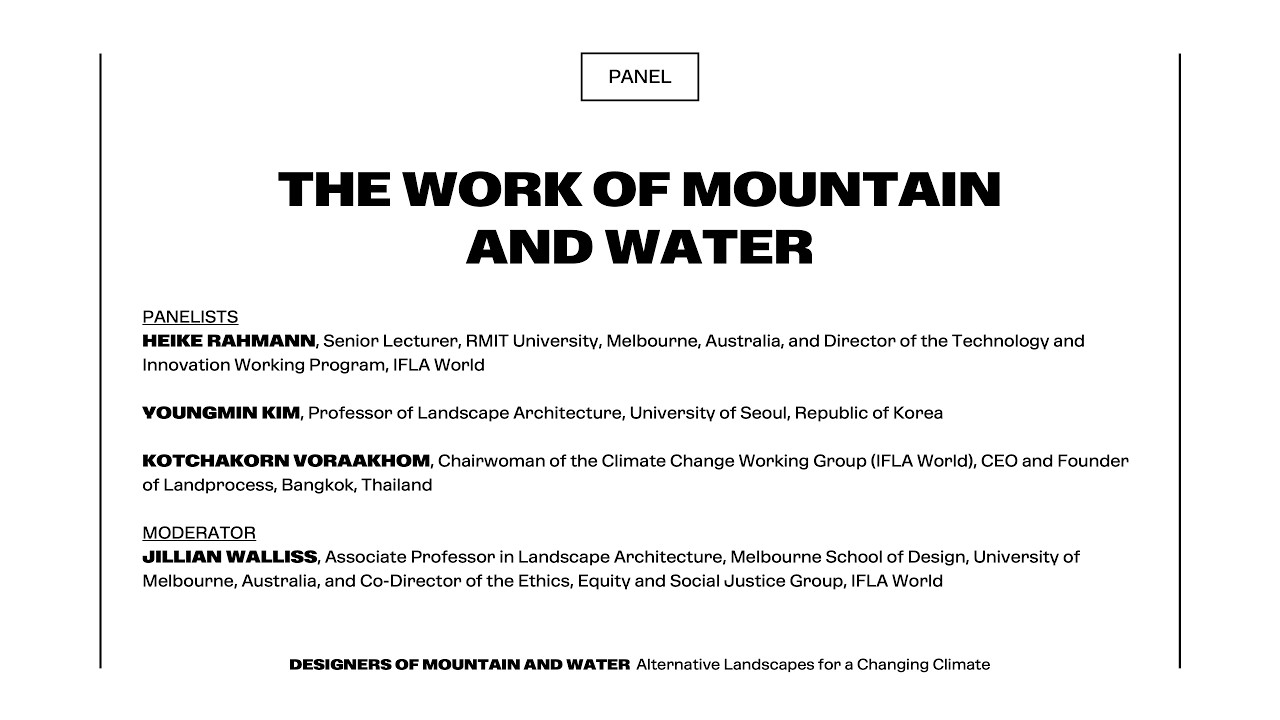
Designers of Mountain and Water: Alternative Landscapes for a Changing Climate | Panel 2
Keywords
Summary
149 words
Critical Evaluation
Value of the Information & Strength of the Argument
The panel provides valuable insights into the diverse approaches to landscape architecture in Asia, emphasizing the importance of cultural context and local knowledge. The speakers argue convincingly for the need to move beyond Western-centric frameworks and to embrace exchange and inter-referencing as methods for generating new knowledge. The argumentation is well-supported by specific examples from research and practice, such as the workshops and exhibitions described by Rahmann and the historical analysis of Korean landscape architecture by Kim. The discussion is nuanced and avoids oversimplification, acknowledging the complexities and contradictions within Asian contexts.
Scientific Rigor, Source Quality, Title Accuracy
The panel demonstrates scientific rigor through the expertise of the speakers and the depth of their presentations. While specific sources are not cited in the video, the speakers reference their own publications and projects, which are credible. The title accurately reflects the content, focusing on alternative landscapes for a changing climate. The discussion is well-structured and stays on topic, with a clear connection between the presentations and the overarching theme.
177 words
Title / Content Match
The title accurately reflects the panel's focus on alternative landscape design in Asia, with a strong emphasis on the cultural and environmental dimensions of 'mountain and water'.
Quality & Reliability
8/10
The panel features established academics and practitioners from leading institutions, providing expert perspectives grounded in research and practice. The discussion is well-structured and references specific projects and concepts, though it lacks formal citations and peer-reviewed sources.
Chapters
Contribution & Novelties
The panel offers a fresh perspective on landscape architecture in Asia, challenging dominant Western narratives and highlighting the importance of cultural exchange and inter-referencing. It provides a nuanced understanding of how traditional concepts like ‘mountain and water’ are being reinterpreted in contemporary practice to address climate change. The discussion also sheds light on the historical and political contexts that have shaped landscape architecture in different Asian countries.
Pour aller plus loin :
- Asia as Method — Concept by Yoshimi Takeuchi, central to the discussion on inter-referencing.
- Chulalongkorn Centenary Park — Key project by Kotchakorn Voraakhom, illustrating climate-adaptive design.
- Landscape Urbanism — Theoretical framework relevant to the discussion on contemporary landscape architecture.
111 words
Radar Profile
The radar profile shows high scores across all dimensions, indicating a well-rounded and informative panel. The strongest aspects are the quantity and quality of information, while the technical level is slightly lower, reflecting the broad audience. The overall reliability is high due to the expertise of the speakers.