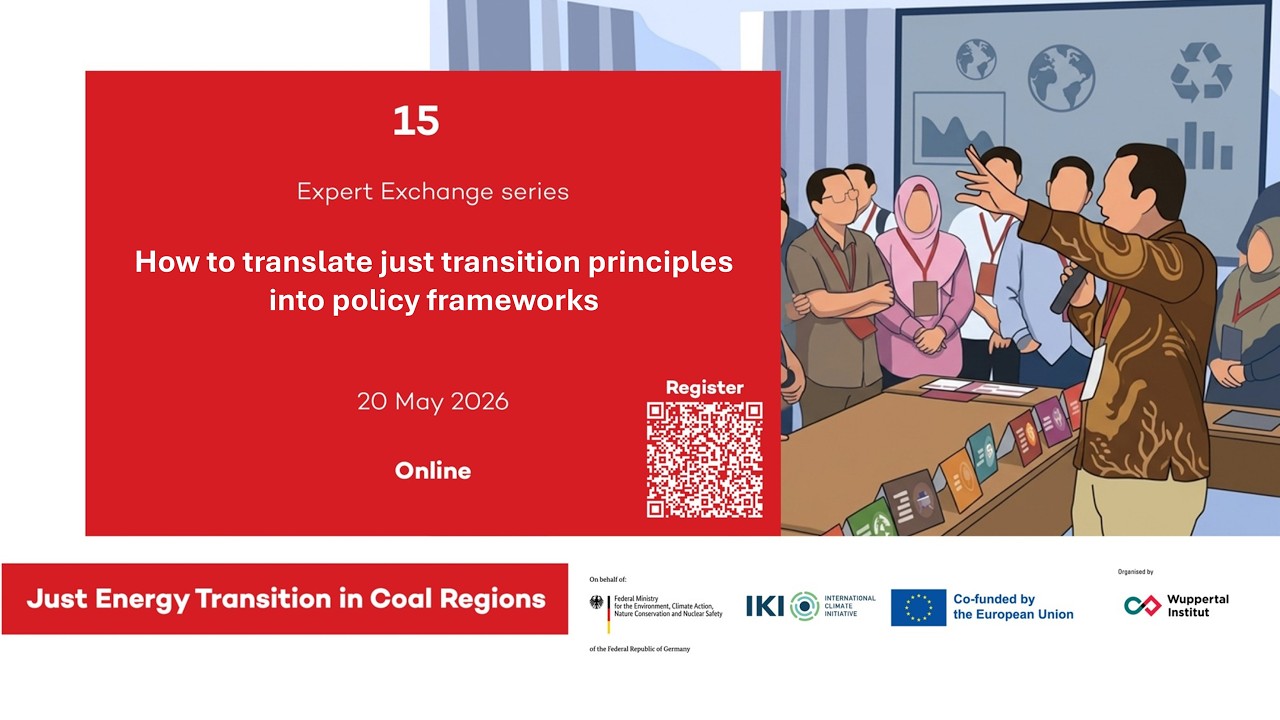
Expert Exchange: How to translate just transition principles into policy frameworks
Keywords
Summary
143 words
Critical Evaluation
Value of the Information & Strength of the Argument
The video provides valuable insights from practitioners directly involved in just transition policy development in different countries. The arguments are grounded in practical experience and highlight common challenges such as fragmented governance, lack of data, and financing gaps. The panelists offer concrete examples and lessons learned, making the content useful for policymakers and researchers. However, the discussion is largely anecdotal and lacks rigorous empirical evidence or comparative analysis. The argumentation is coherent but could benefit from more structured data and references to specific policies or studies.
Scientific Rigor, Source Quality, Title Accuracy
The video maintains a high level of scientific rigor by featuring experts from reputable institutions and referencing specific policy documents and projects. However, the sources cited are not explicitly listed or linked in the video description, and the discussion relies more on personal experience than on published research. The title accurately reflects the content, and the video stays on topic throughout. The absence of detailed citations and the reliance on anecdotal evidence slightly reduce the overall scientific quality.
179 words
Title / Content Match
The title accurately reflects the content, which focuses on translating just transition principles into policy frameworks through expert exchange.
Quality & Reliability
7/10
The video features expert panelists from research institutions and provides practical insights from country experiences, but lacks detailed citations and verifiable data.
Key Moments
Markers derived by PSI from the transcript: the creator did not define chapters.
- Introduction to the webinar and the IKI JET project.
- Presentation of the updated Just Transition Toolbox for Coal Regions.
- Discussion on governance coordination mechanisms for just transition.
- Panelist from Indonesia shares insights on just transition policy development.
- Panelist from Mongolia discusses challenges and lessons learned.
- Panelist from South Africa presents country-specific experiences.
- Open discussion on financing and fiscal frameworks for just transition.
- Q&A session with audience questions.
- Wrap-up and concluding remarks.
Cited Sources
- Just Transition Toolbox for Coal Regions — Mentioned as a flagship product of the Wuppertal Institute, updated in 2026.
- Comprehensive Investment and Policy Plan (CIPP) — Referenced as a key document for just transition in Indonesia.
- National Development Plan (RPJMN) — Mentioned as a policy anchor for just transition in Indonesia.
Concurring Sources
- Just Transition Research Collaborative — Provides academic research and resources on just transition.
- Climate Strategies: Just Transition — Offers policy briefs and analysis on just transition.
Dissenting Sources
- Critiques of Just Transition — Some scholars argue that just transition policies may not adequately address structural inequalities or may be co-opted by corporate interests.
Contribution & Novelties
The video provides a practical overview of just transition policy implementation challenges and lessons learned from multiple countries, particularly Indonesia, Mongolia, and South Africa. It highlights the importance of governance coordination, data availability, spatial planning, and innovative financing. The updated Just Transition Toolbox offers a comprehensive resource for policymakers.
Pour aller plus loin :
- Just Transition — Overview of the concept and its evolution.
- International Labour Organization (ILO) Guidelines for a just transition — Official guidelines for just transition policies.
- World Bank: Just Transition — Overview of World Bank initiatives on just transition.
93 words
Radar Profile
The radar profile shows a balanced performance across all dimensions, with slightly higher scores in information quantity and quality, reflecting the expert panel's depth. The lower technical level score indicates the content is accessible to a general audience, while the reliability score is moderate due to the lack of detailed citations.
💬 No comments were provided for analysis.