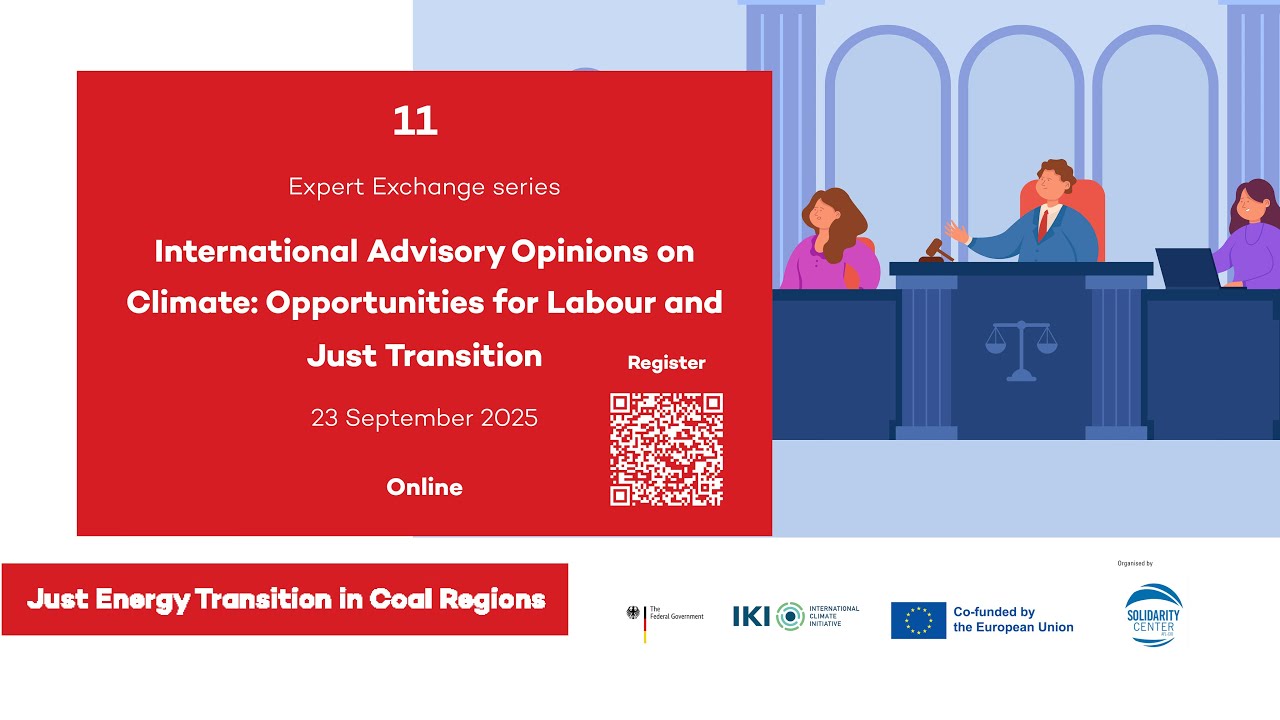
Expert Exchange - International climate advisories: Opportunities for labour and just transition
Keywords
Summary
190 words
Critical Evaluation
Value of the Information & Strength of the Argument
The webinar provides high-value information by synthesizing recent legal developments and connecting them to labour rights. The argumentation is solid, grounded in official reports and court opinions, and supported by expert testimony. The speakers effectively argue that human rights law provides a framework for just transition, emphasizing the obligations of states and the importance of worker participation. The discussion is nuanced, acknowledging challenges such as informality and lack of social protection, while highlighting opportunities for unions and workers.
Scientific Rigor, Source Quality, Title Accuracy
The scientific rigour is high, with references to the Inter-American Court’s Advisory Opinion 32, the ICJ’s advisory opinion, and the UN Secretary-General’s synthesis report. The sources are authoritative and directly relevant. The title accurately reflects the content, focusing on international climate advisories and their implications for labour and just transition. The webinar does not include a public Q&A, but the structured expert exchange ensures depth. No comments were provided for analysis.
164 words
Title / Content Match
The title accurately reflects the content: an expert exchange on international climate advisories and their implications for labour and just transition.
Quality & Reliability
8/10
The webinar features experts from UN OHCHR, ILAW, ITF, COSATU, and other organizations, discussing recent advisory opinions from the Inter-American Court and ICJ. The content is grounded in legal documents and reports, with high credibility. Minor limitations: no direct citations of specific articles, but references to official reports and court opinions.
Key Moments
Markers derived by PSI from the transcript: the creator did not define chapters.
- Introduction by Josyn Sotomayor, overview of webinar objectives and context.
- Presentation of Inter-American Court Advisory Opinion 32 and ICJ advisory opinion.
- Reena Kusipalo (OHCHR) discusses UN Secretary-General's synthesis report on human rights and just transition.
- Jeff Vote (Solidarity Center) analyzes the Inter-American Court's opinion, focusing on labour rights and just transition.
- Discussion on the role of unions and social dialogue in just transition, with examples from Colombia and South Africa.
- Q&A session with participants, addressing questions on implementation and opportunities.
- Concluding remarks and summary of key takeaways.
Cited Sources
- Inter-American Court of Human Rights Advisory Opinion 32 — Discussed as a landmark ruling on climate change and human rights obligations.
- International Court of Justice Advisory Opinion on Climate Change — Referenced as a recent opinion affirming state obligations to address climate change.
- UN Secretary-General's Synthesis Report on Human Rights and Just Transition — Presented by Reena Kusipalo as a key framework for human rights-based just transition.
Concurring Sources
- ILO Guidelines for a Just Transition — Referenced as the foundation of just transition concept.
- UN Guiding Principles on Business and Human Rights — Mentioned as providing responsibilities for businesses in the context of just transition.
Contribution & Novelties
The webinar provides a unique synthesis of recent international climate advisory opinions and their implications for labour rights, offering a legal analysis that is often missing in climate discussions. It highlights the explicit recognition of just transition in the Inter-American Court’s opinion, which is a novel development. The discussion bridges legal frameworks with on-the-ground experiences from Colombia and South Africa, providing practical insights for unions and workers.
Pour aller plus loin :
- ILO Guidelines for a Just Transition — Foundational document for just transition, referenced in the webinar.
- UN Guiding Principles on Business and Human Rights — Relevant for corporate responsibilities in climate action.
- Paris Agreement — Includes just transition in its preamble, as mentioned by Jeff Vote.
118 words
Radar Profile
The radar profile shows high scores in information quantity, quality, and reliability, with a slightly lower technical level, indicating a balanced and accessible expert discussion. The content is well-supported by legal documents and expert testimony, making it a valuable resource for understanding the intersection of climate law and labour rights.