2D Materials Conference 2024 | Lukas Lackner (Carl von Ossietzky University of Oldenburg, Germany)
Keywords
Summary
101 words
Critical Evaluation
Value of the Information & Strength of the Argument
The presentation provides valuable insights into experimental techniques for controlling excitons in 2D materials. The argumentation is solid, based on experimental data and comparisons with theoretical expectations. The speaker clearly explains the significance of each result, such as the observation of strong coupling and charge-tunable states. The use of open cavities is justified by their versatility and cost-effectiveness. The discussion of g-factors and correlated magnetism adds depth, though some claims could be further substantiated with more detailed data.
Scientific Rigor, Source Quality, Title Accuracy
The scientific rigor is high, with detailed experimental procedures and results. The speaker references collaborations with other researchers, but no external sources are cited in the description. The title accurately reflects the content, as the talk focuses on controlling excitons in van der Waals materials. The presentation is well-structured and clear, though the lack of citations limits the ability to verify claims independently.
156 words
Title / Content Match
The title accurately reflects the content: a conference talk on controlling excitons in van der Waals materials using open optical cavities.
Quality & Reliability
8/10
Presentation at a scientific conference by a researcher, with detailed experimental data and references to collaborations. However, no external sources are cited in the description, and the content is not peer-reviewed.
Key Moments
Markers derived by PSI from the transcript: the creator did not define chapters.
- Introduction and group overview
- Introduction to exciton-polaritons and cavity QED
- Open cavity design and advantages
- Cryogenic cavity setup with attocube
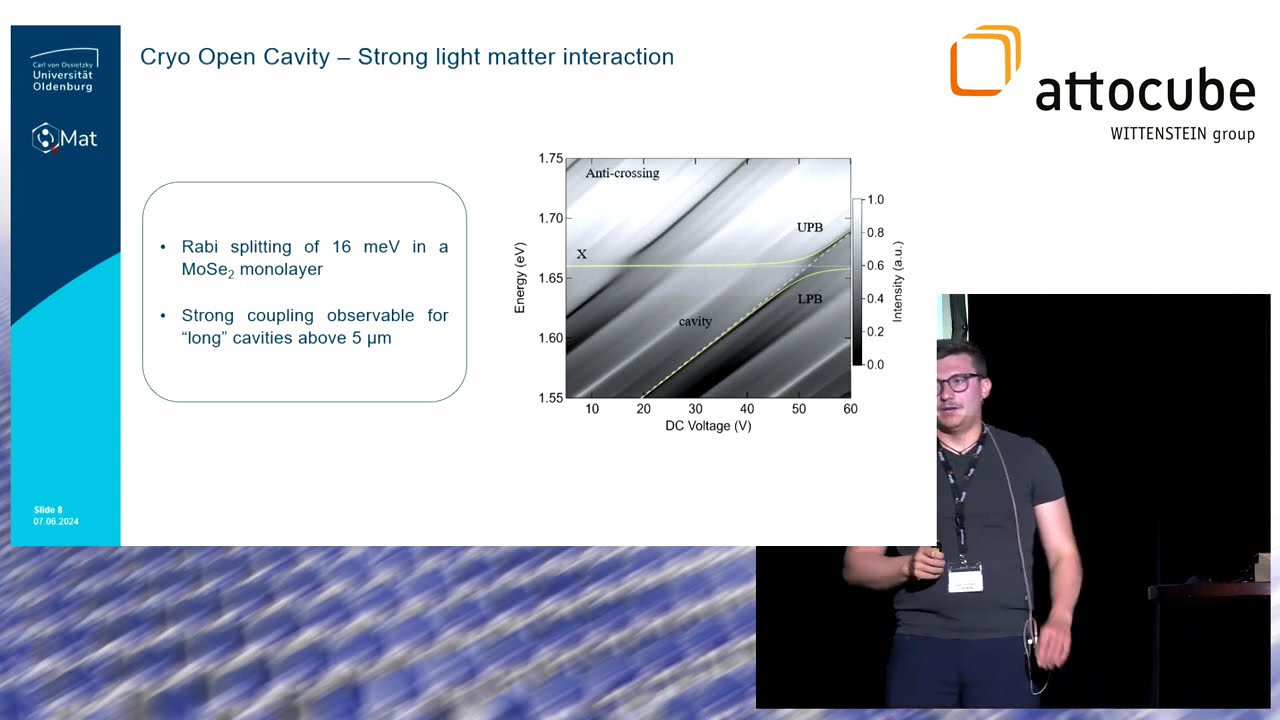
- Strong coupling with MoSe2 monolayers
- Charge tuning of TMD monolayers
- Moiré excitons in heterobilayers
- Magneto-optical response and g-factors
- Summary and conclusions
Contribution & Novelties
The talk presents novel experimental results on controlling excitons in van der Waals materials using open optical cavities, including strong coupling with monolayers and heterobilayers, charge tunability, and observation of large g-factors indicating correlated magnetic phases. The open cavity approach offers versatility and tunability, enabling studies at cryogenic temperatures.
Pour aller plus loin :
- Exciton-polaritons — Overview of exciton-polaritons and their properties.
- Van der Waals heterostructures — Background on 2D material stacks.
- Cavity quantum electrodynamics — Principles of cavity QED.
80 words
Radar Profile
The radar profile shows high scores in quantity and quality of information, with a strong technical level. The reliability is slightly lower due to the lack of cited sources. Overall, the talk is informative and technically sound.