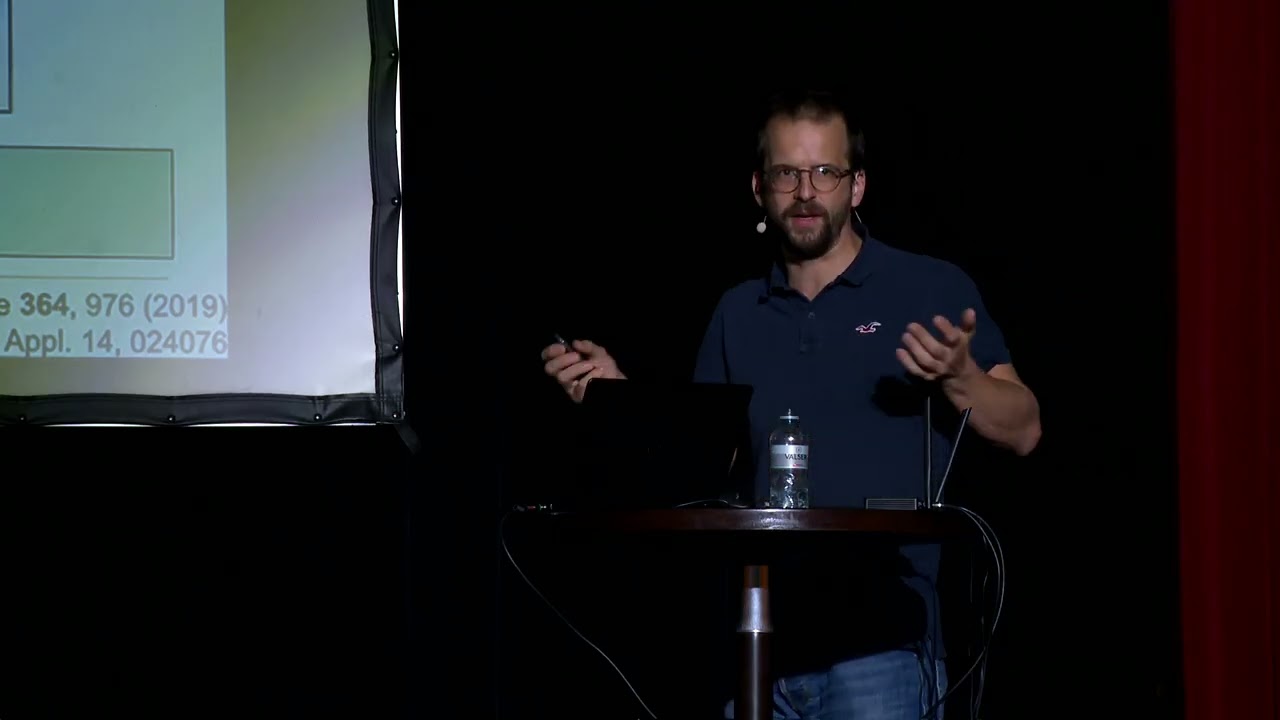
2D Materials Conference 2024 | Patrick Maletinsky (University of Basel, Switzerland)
Keywords
Summary
186 words
Critical Evaluation
Value of the Information & Strength of the Argument
The talk provides valuable insights into the application of NV magnetometry to 2D magnets, showcasing both established results and new developments. The argumentation is solid, based on experimental data and clear reasoning. The speaker effectively explains the principles of the technique and the significance of the findings. He also acknowledges limitations and open questions, which enhances credibility.
Scientific Rigor, Source Quality, Title Accuracy
The speaker references his own published work and collaborations, but does not provide specific citations during the talk. The description mentions the talk is part of a conference, and the title accurately reflects the content. The talk is scientifically rigorous, with a clear methodology and data presentation. The title is appropriate and does not overstate the content.
129 words
Title / Content Match
The title accurately reflects the content: a conference talk on quantum sensing of 2D magnets using single-spin microscopy.
Quality & Reliability
8/10
The talk is given by a leading researcher in the field of NV magnetometry, presenting original research results with a clear methodology and references to published work. The claims are supported by experimental data and collaborations with recognized groups. However, some results are preliminary and not yet peer-reviewed.
Key Moments
Markers derived by PSI from the transcript: the creator did not define chapters.
- Introduction and acknowledgments
- Motivation for 2D magnets and spin models
- Limitations of MOKE and introduction to NV magnetometry
- Principles of NV magnetometry and ODMR
- Technological advancements: integrated microwave delivery
- Results on CrI3: antiferromagnetic coupling and structural phase transition
- Introduction to CrSBr and its advantages
- Quantitative imaging of CrSBr magnetization and anisotropy
- Lateral exchange bias: concept and demonstration
- Preliminary results on domain wall structure and outlook
Cited Sources
- Quantum sensing of 2D magnets using single-spin microscopy — This is the video itself, which contains the talk.
Concurring Sources
- Scanning NV magnetometry — Background on the technique used in the talk.
Contribution & Novelties
The talk presents original research on quantum sensing of 2D magnets, particularly the novel concept of lateral exchange bias to control domain walls in CrSBr. This is a significant contribution to the field. The speaker also showcases technological advancements in NV magnetometry, such as integrated microwave delivery, which improve the technique’s practicality.
Pour aller plus loin :
- Nitrogen-vacancy center — Background on the NV center used in the technique.
- 2D materials — General context on two-dimensional materials.
- Magnetic domain — Relevant to the domain wall studies discussed.
87 words
Radar Profile
The radar profile shows high scores in all dimensions, indicating a well-rounded presentation with strong technical depth, reliable information, and good coverage. The talk is particularly strong in technical level and information quality, reflecting the speaker's expertise.
💬 No comments were provided for analysis.