2D Materials Conference 2024 | Dr. Samuel Mañas-Valero (University of Valencia, Spain)
Keywords
Summary
175 words
Critical Evaluation
Value of the Information & Strength of the Argument
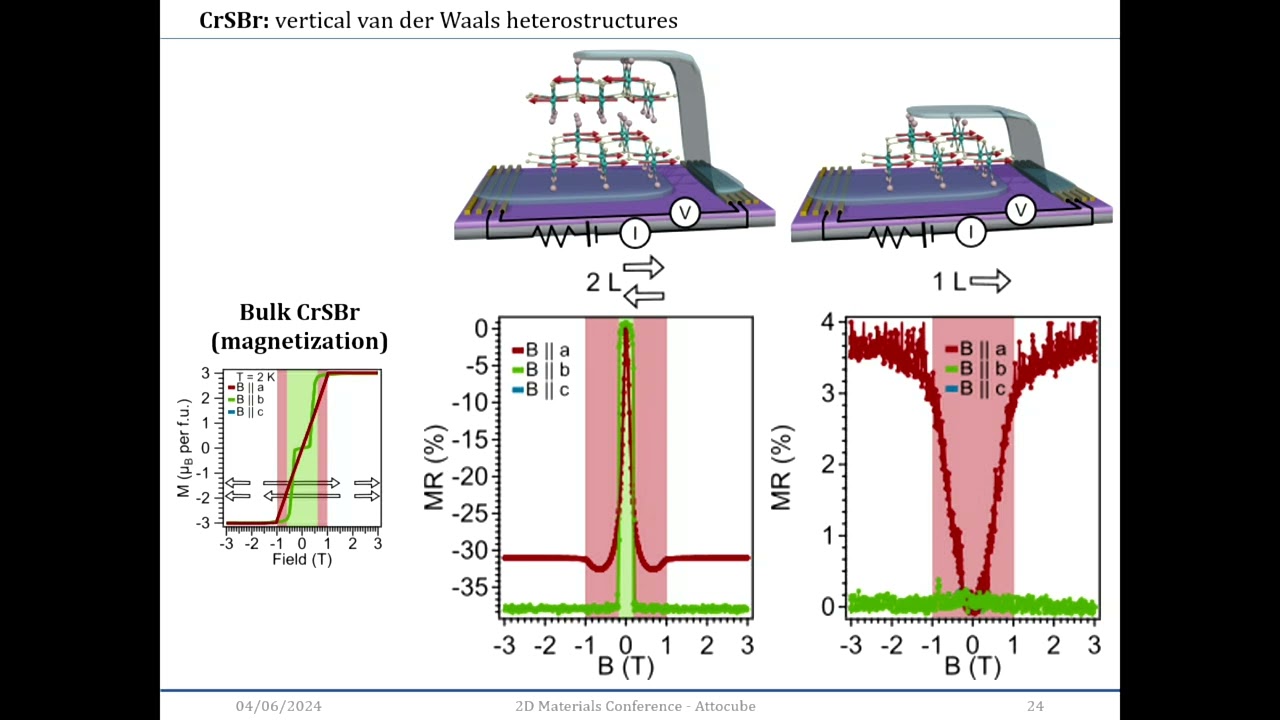
The talk provides valuable original data on twisted 2D magnets, a rapidly evolving field. The experimental results are clearly presented, with a logical progression from simple bilayer and monolayer devices to the more complex orthogonal twist. The argumentation is solid, as the observed magnetoresistance features are explained using established concepts of spin anisotropy and magnetic frustration. The speaker effectively connects the results to the broader context of 2D magnetism and twistronics, highlighting the potential for engineering artificial magnets. However, the talk is relatively short and some details, such as the exact device fabrication and measurement conditions, are not fully elaborated.
Scientific Rigor, Source Quality, Title Accuracy
The scientific rigor appears high, as the results are likely published in peer-reviewed journals, though specific references are not cited in the talk. The speaker mentions a review by ‘jonam’ (likely a mispronunciation of ‘J. M. D. Coey’ or similar) on magnetism in layered systems, but no explicit sources are given. The title accurately reflects the content, focusing on orthogonal twist in 2D magnets. The talk is well-structured and the speaker demonstrates expertise in the field. No comments were provided for analysis.
197 words
Title / Content Match
The title accurately reflects the content: a conference talk on twisted 2D magnets, specifically focusing on orthogonal twist in CrSBr.
Quality & Reliability
7/10
Presentation of original experimental results from a peer-reviewed research context, with clear methodology and data. However, the talk is concise and lacks detailed error analysis or full reproducibility details.
Key Moments
Markers derived by PSI from the transcript: the creator did not define chapters.
- Introduction and apology for being a 'big boss'
- Introduction to CrSBr and its properties
- Discussion of spin-flip and spin-orientation mechanisms in CrSBr
- Comparison of bilayer and monolayer magnetoresistance along different axes
- Temperature dependence and short-range correlations
- Introduction to orthogonal twist and frustrated system
- Butterfly-shaped magnetoresistance and multistep switching
- First-order reversal curves and magnetic domains
- Conclusion and key messages
Cited Sources
- No explicit sources cited in the talk — The speaker mentions a review on magnetism in layered systems but does not provide a specific reference.
Concurring Sources
- No concordant sources provided — No external sources were mentioned in the video description or transcription.
Dissenting Sources
- No discordant sources provided — No conflicting sources were mentioned.
Contribution & Novelties
The talk presents novel experimental results on orthogonally twisted CrSBr bilayers, demonstrating a butterfly-shaped magnetoresistance and multistep magnetization switching, which are attributed to spin anisotropy and magnetic frustration. This work extends the understanding of twisted 2D magnets beyond moiré effects, highlighting the role of spin anisotropy in designing artificial magnets.
Pour aller plus loin :
- Twistronics — Overview of twisting 2D materials to modify electronic properties.
- CrSBr — Basic properties of the material.
- Magnetoresistance — Phenomenon of resistance change in magnetic fields.
82 words
Radar Profile
The radar profile shows high scores in quality and technical level, with moderate scores in quantity and reliability. This indicates a technically detailed presentation with solid experimental data, though the limited duration and lack of explicit references slightly reduce the overall reliability score.