2D Materials Conference 2024 | Jian Shen (Fudan University, China)
Keywords
Summary
208 words
Critical Evaluation
Value of the Information & Strength of the Argument
The talk provides valuable insights into the physics of manganites and strategies to overcome limitations of CMR. The argumentation is solid, based on experimental observations and comparisons with theoretical models. The speaker systematically addresses the two main challenges (high field and low temperature) and proposes concrete solutions supported by data. The use of superlattices to control disorder is particularly innovative and well-argued.
Scientific Rigor, Source Quality, Title Accuracy
The talk demonstrates scientific rigor through careful experimental design and referencing of key historical papers (e.g., Lord Kelvin, Julliere, Fert, Grünberg). However, as a conference talk, it lacks detailed citations for all claims, and some results are preliminary. The title is somewhat generic but accurately reflects the content. No comments were provided for analysis.
131 words
Title / Content Match
The title is generic but accurate; the talk focuses on oxide materials for spintronics, as described.
Quality & Reliability
7/10
The talk presents original research results from a leading group, with clear methodology and references to established literature. However, it is a conference presentation without peer-reviewed details, and some claims are preliminary.
Key Moments
Markers derived by PSI from the transcript: the creator did not define chapters.
- Introduction and motivation: oxide materials for spintronics, focus on low-field high-temperature CMR.
- Historical overview of spintronics: AMR, TMR, GMR, and MRAM development.
- Introduction to CMR effect in manganites and electronic phase separation.
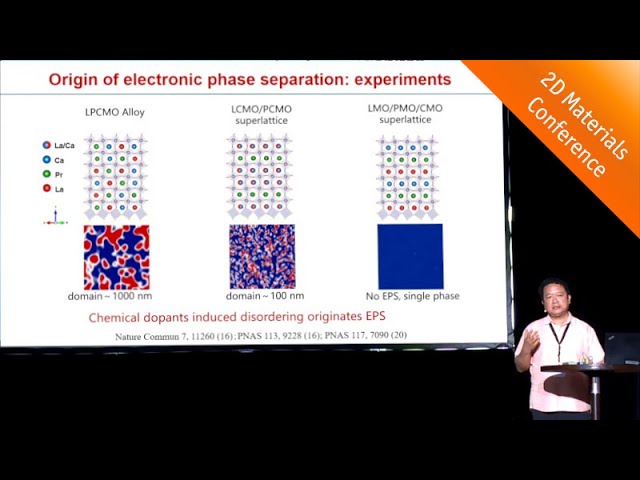
- Experimental evidence that chemical disorder induces electronic phase separation.
- Using magnetic nanodots to create nucleation sites and reduce required magnetic field.
- Increasing Curie temperature via tensile strain, achieving above room temperature.
- Roadmap for low-field high-temperature CMR and potential applications.
Cited Sources
- Lord Kelvin's observation of AMR — Historical reference to the discovery of anisotropic magnetoresistance in 1857.
- Julliere's TMR effect — 1975 report of tunneling magnetoresistance in magnetic tunnel junctions.
- Fert and Grünberg's GMR discovery — 1988 independent reports of giant magnetoresistance in magnetic multilayers.
- CMR in manganites — Reports in the 1990s of colossal magnetoresistance in manganite materials.
Concurring Sources
- Colossal magnetoresistance — General reference on CMR effect, consistent with the talk's focus.
- Spintronics — Background on spintronics, aligning with the talk's context.
Contribution & Novelties
The talk presents original experimental work on controlling electronic phase separation in manganites via chemical ordering and using magnetic nanodots to lower the switching field, potentially leading to practical low-field high-temperature CMR. This approach is novel and could enable spintronic applications.
Pour aller plus loin :
- Colossal magnetoresistance — Overview of CMR phenomenon and materials.
- Spintronics — General introduction to spintronics and its applications.
- Manganite — Information on manganite compounds and their properties.
73 words
Radar Profile
The radar profile shows high scores in quantity and quality of information, and technical level, with slightly lower reliability due to the preliminary nature of some results. This indicates a technically rich talk with solid content but requiring further validation.