2D Materials Conference 2024 | Vincent Jacques (University of Montpellier & CNRS, Franceattocube)
Keywords
Summary
168 words
Critical Evaluation
Value of the Information & Strength of the Argument
The talk provides valuable insights into the development of 2D quantum sensors, highlighting both the potential and the challenges. The argumentation is solid, based on experimental data and comparisons with theoretical calculations. The speaker clearly explains the limitations, such as the low quantum yield and the impact of pressure on the defect’s photophysics, which strengthens the credibility of the presented results.
Scientific Rigor, Source Quality, Title Accuracy
The presentation is scientifically rigorous, with clear methodology and acknowledgment of limitations. The speaker references his own work and that of colleagues, but specific citations are not provided in the video. The title accurately reflects the content, focusing on quantum sensing with spin defects in hBN. The talk is well-structured and the data presented are consistent with published literature.
135 words
Title / Content Match
The title accurately reflects the content: a conference talk on quantum sensing with spin defects in 2D materials.
Quality & Reliability
8/10
Presentation by a recognized expert in quantum sensing, based on peer-reviewed research, with clear methodology and data. Some limitations in depth due to conference format.
Key Moments
Markers derived by PSI from the transcript: the creator did not define chapters.
- Introduction to quantum sensing with NV centers in diamond and motivation for 2D sensors.
- Presentation of boron vacancy centers in hBN, including production and optical properties.
- Discussion of spin properties and ODMR spectroscopy of VB- centers.
- First magnetic imaging experiment using VB- centers on chromium telluride.
- Investigation of VB- centers in ultra-thin hBN layers and changes in spin properties.
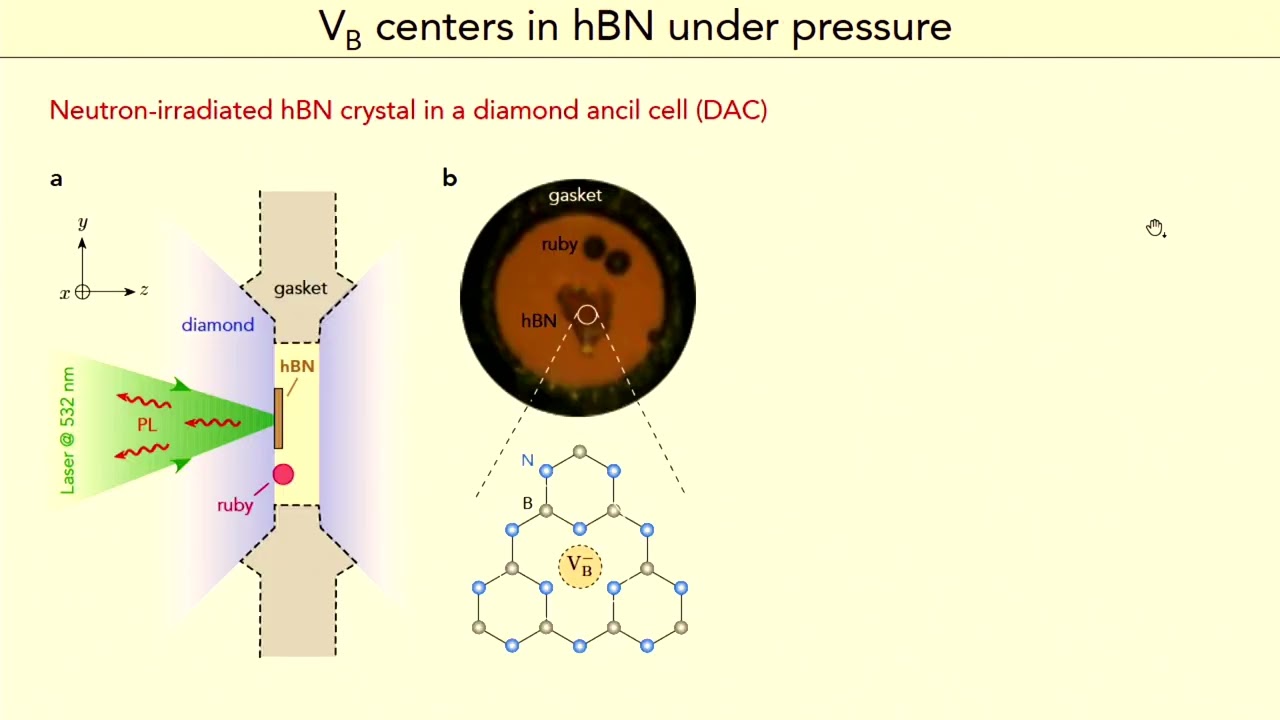
- Study of VB- centers under pressure using a diamond anvil cell.
- Magnetic imaging under pressure and observation of pressure-induced changes in chromium telluride.
Cited Sources
- No specific sources cited in the video — The speaker mentions his own work and that of colleagues but does not provide specific references.
Concurring Sources
- Quantum sensing with spin defects in hexagonal boron nitride — This paper likely covers similar results on VB- centers in hBN.
Dissenting Sources
- No discordant sources identified — The talk is consistent with current literature on VB- centers.
Contribution & Novelties
The talk presents original research on using boron vacancy centers in hBN for quantum sensing, particularly in ultra-thin layers and under pressure. The finding that the zero-field splitting parameter E vanishes in few-layer hBN is novel and important for understanding the defect’s environment. The demonstration of magnetic imaging under pressure opens new possibilities for studying phase transitions in 2D magnets.
Pour aller plus loin :
- Hexagonal boron nitride — Overview of hBN properties.
- Optically detected magnetic resonance — Technique used for spin readout.
- Diamond anvil cell — Equipment for high-pressure experiments.
91 words
Radar Profile
The radar profile shows high scores in quality and reliability, with moderate quantity and technical level, indicating a focused and expert presentation.