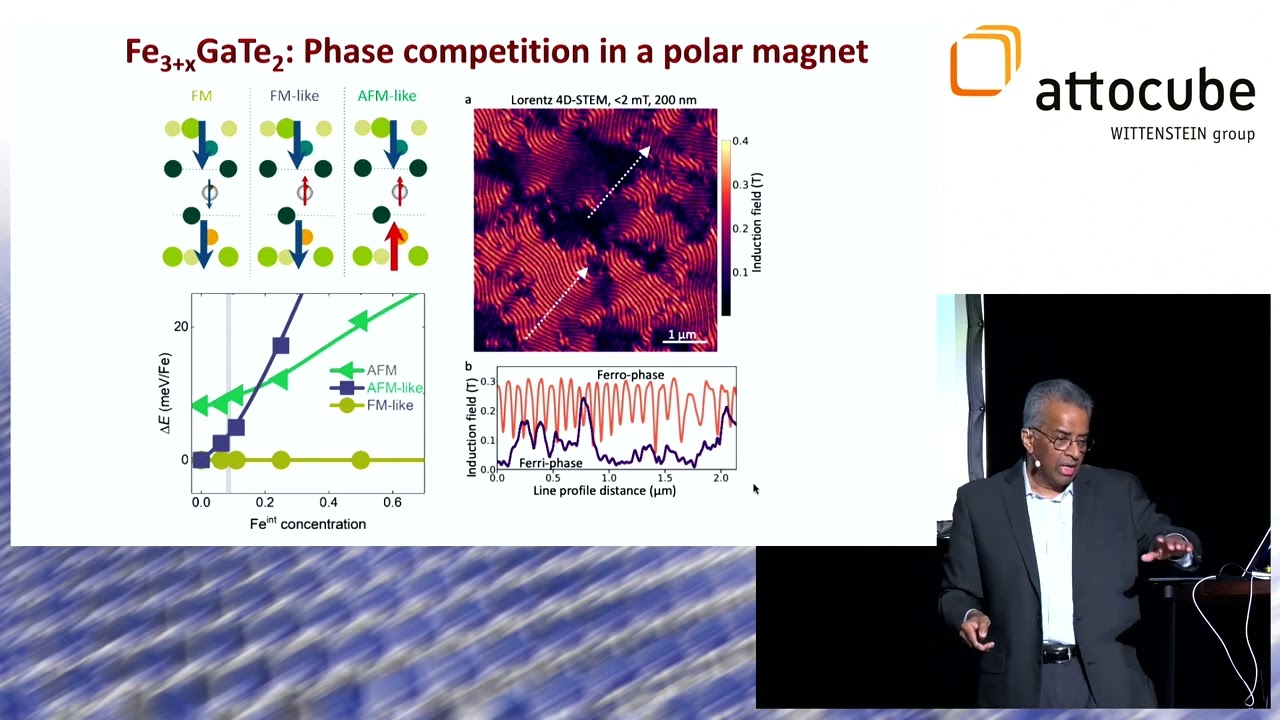
2D Materials Conference 2024 | Ramamoorthy Ramesh (Rice University, USA)
Keywords
Summary
147 words
Critical Evaluation
Value of the Information & Strength of the Argument
The talk provides a high-value overview of cutting-edge research in multiferroics, with a strong emphasis on experimental results and their implications for future computing technologies. The argumentation is solid, grounded in detailed experimental evidence and theoretical frameworks. Ramesh systematically builds the case for using multiferroics to overcome energy barriers in conventional electronics, presenting both successes and open challenges. The discussion of competing interactions and emergent textures is particularly insightful, offering a clear rationale for the observed phenomena.
Scientific Rigor, Source Quality, Title Accuracy
The scientific rigor is high, with references to multiple peer-reviewed publications and recent experimental data. The speaker acknowledges funding sources and collaborators, enhancing credibility. The title accurately reflects the content, focusing on multiferroics for energy-efficient computing. The talk is well-structured and technically detailed, though it assumes a specialist audience. The sources cited are relevant and authoritative, including works from leading groups in the field.
156 words
Title / Content Match
The title accurately reflects the content: a conference talk on multiferroics for energy-efficient computing, presented at a 2D materials conference.
Quality & Reliability
8/10
The talk is given by a leading expert in multiferroics and oxide electronics, with extensive references to peer-reviewed publications and recent experimental results. The content is technically rigorous and well-supported, though it is a conference presentation rather than a formal review.
Key Moments
Markers derived by PSI from the transcript: the creator did not define chapters.
- Introduction to the talk and acknowledgment of collaborators and funding.
- Discussion of iron-germanium-tellurium system and cobalt doping inducing inversion symmetry breaking.
- Formation of magnetic skyrmions and topological Hall effect in the doped system.
- Introduction to ferroelectric superlattices and polar vortices.
- Negative capacitance and chiral behavior in superlattices.
- Imaging spin cycloids in bismuth ferrite using NV-diamond magnetometry.
- Energy-efficient computing and the MESO device concept.
Cited Sources
- Review article on multiferroics (mentioned) — Ramesh mentions a review article he co-authored, but the URL is not provided.
- Nature paper on vortex collective oscillations (mentioned) — He references a Nature paper from Argonne on collective oscillations of vortices.
Concurring Sources
- Multiferroics: past, present, and future — A review article by Ramesh and Spaldin that covers the fundamentals of multiferroics.
- Electric-field control of magnetism — A paper discussing the electric-field control of magnetism in multiferroic heterostructures.
Contribution & Novelties
The talk provides a comprehensive overview of recent advances in multiferroics, emphasizing the role of epitaxial strain and competing interactions in creating emergent topological textures. It highlights the potential of these materials for energy-efficient computing, particularly through the MESO device concept. The use of advanced imaging techniques to visualize spin cycloids and polar vortices offers new insights into their behavior.
Pour aller plus loin :
- Multiferroics on Wikipedia — Provides background on multiferroic materials and their properties.
- Magnetoelectric effect on Wikipedia — Explains the coupling between electric and magnetic fields in materials.
- Skyrmion on Wikipedia — Overview of magnetic skyrmions and their potential applications.
- Spin cycloid on Wikipedia — Discusses spin spiral structures in magnetic materials.
- MESO device concept (Intel) — Information on the Magneto-Electric Spin-Orbit device proposed by Intel.
130 words
Radar Profile
The radar profile shows high scores in quality of information, technical level, and reliability, with a slightly lower score in quantity of information due to the focused nature of the talk. The overall profile indicates a highly specialized and credible presentation.
💬 No comments were provided for analysis.