2D Materials Conference 2024 | Markus Raschke (University of Colorado Boulder, USA)
Keywords
Summary
153 words
Critical Evaluation
Value of the Information & Strength of the Argument
The talk provides valuable insights into a cutting-edge technique for probing ultrafast phenomena at the nanoscale. The argumentation is solid, based on experimental results and supported by theoretical models. The speaker clearly explains the methodology and the physical mechanisms behind the observed coherence times. The comparison with other techniques and the discussion of limitations add to the credibility. The presentation is well-structured, moving from method development to applications, and includes a clear take-home message.
Scientific Rigor, Source Quality, Title Accuracy
The scientific rigor is high, with detailed descriptions of experimental setups and data analysis. The speaker references theoretical work (e.g., by Sake) and compares results with other experimental groups (e.g., Berlin group). The sources are not explicitly cited in the video, but the speaker mentions collaborations and prior work. The title accurately reflects the content, which is a focused presentation on ultrafast nano-imaging of quantum dynamics in 2D materials. The talk is a conference presentation, so it is not peer-reviewed, but the speaker is an established researcher in the field.
179 words
Title / Content Match
The title accurately reflects the content, which is a presentation on ultrafast nano-imaging of quantum dynamics in 2D materials.
Quality & Reliability
8/10
The talk presents original research from a leading group, with detailed methodology and comparison to theoretical models and other experimental results. The speaker is an expert in the field, and the content is consistent with known scientific principles. However, the presentation is a conference talk, not a peer-reviewed publication, and some details are summarized.
Key Moments
Markers derived by PSI from the transcript: the creator did not define chapters.
- Introduction and overview of the talk's focus on ultrafast nano-imaging.
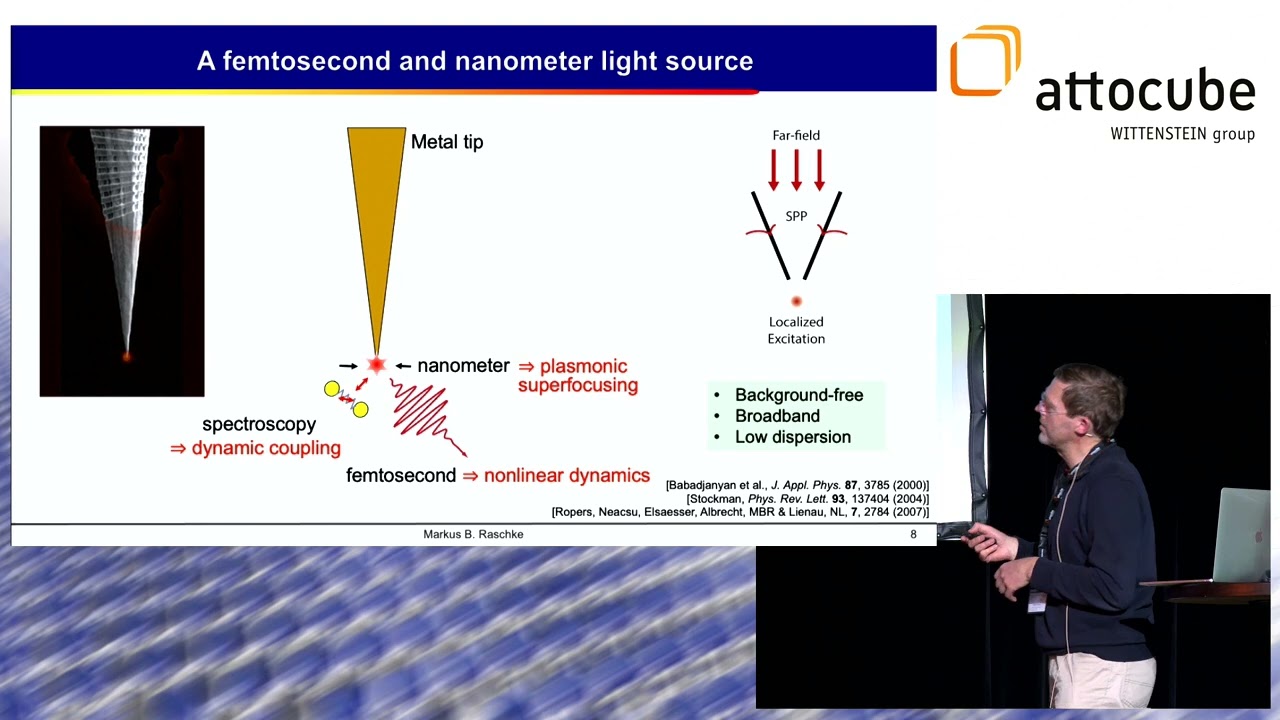
- Explanation of the nanolocalized light source using surface plasmon polaritons.
- Description of the four-wave mixing technique and its application to graphene.
- Results on exciton coherence in transition metal dichalcogenides, showing spatial heterogeneity.
- Application to heterostructures: distinguishing energy and charge transfer in WSe2/graphene.
- Summary and key take-home message about coherence and disorder.
- Q&A session discussing decoherence mechanisms and the role of the tip.
Cited Sources
- No explicit sources cited in the video — The speaker mentions collaborations and prior work but does not provide specific citations.
Concurring Sources
- No concordant sources provided — No external sources were provided in the video description.
Dissenting Sources
- No discordant sources provided — No external sources were provided in the video description.
Contribution & Novelties
The talk presents a novel approach to ultrafast nano-imaging that allows probing coherent quantum dynamics in 2D materials with nanoscale resolution. The technique enables the measurement of coherence times in graphene and TMDs, revealing spatial heterogeneity and distinguishing between energy and charge transfer mechanisms. This provides new insights into the fundamental physics of 2D materials and offers a powerful tool for future studies.
Pour aller plus loin :
- Ultrafast spectroscopy — Background on ultrafast techniques.
- Scanning probe microscopy — Overview of SPM methods.
- Exciton — Fundamental concept of excitons in semiconductors.
- Four-wave mixing — Nonlinear optical process used in the technique.
- Transition metal dichalcogenide monolayers — Relevant material class.
109 words
Radar Profile
The radar profile shows high scores in information quantity, quality, technical level, and reliability, indicating a highly informative and technically advanced presentation. The balance across these dimensions suggests a well-rounded scientific talk.