2D Materials Conference 2024 | Ajit Srivastava (Emory University, USA)
Keywords
Summary
124 words
Critical Evaluation
Value of the Information & Strength of the Argument
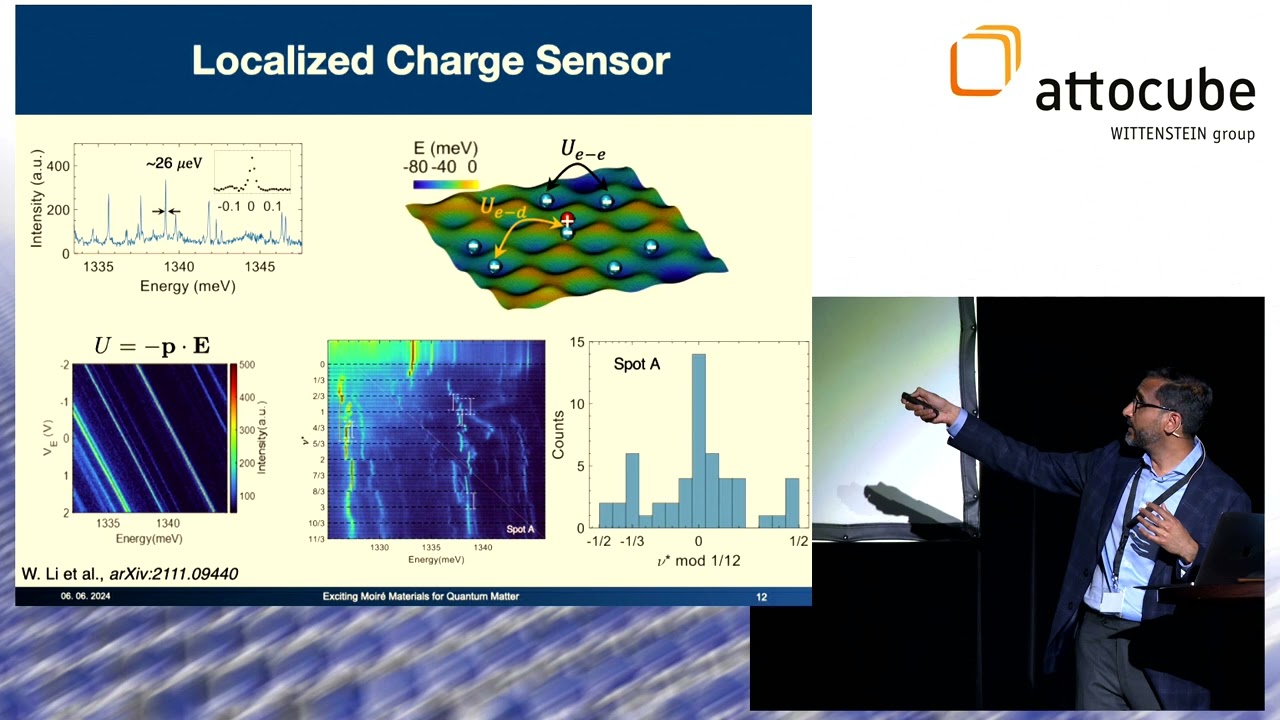
The talk provides valuable insights into the emerging field of many-body exciton physics in van der Waals heterostructures. The argumentation is solid, building from basic concepts of exciton interactions to a specific experimental observation. The speaker clearly explains the theoretical framework and supports it with experimental data and DFT calculations. The transition from quadrupolar to dipolar excitons is well-documented, and the evidence for antiferroelectric correlations is compelling. However, the talk is a brief conference presentation, so some details are omitted, and the claims are not yet published in a peer-reviewed journal.
Scientific Rigor, Source Quality, Title Accuracy
The scientific rigor is high: the speaker presents original data, uses appropriate theoretical models, and acknowledges limitations. The sources cited include relevant literature (e.g., Schindler’s paper on exciton phase space filling) and collaborations with theory groups. The title accurately reflects the content, and the talk is well-structured. The video description provides key aspects but no direct links to sources. The speaker mentions specific collaborators and institutions, which adds credibility.
175 words
Title / Content Match
The title accurately reflects the content: a talk on moiré materials for quantum matter, presented at a 2D materials conference.
Quality & Reliability
8/10
Presentation of original research with clear methodology, supported by DFT calculations and experimental data. The speaker acknowledges limitations and cites relevant literature. However, the video is a conference talk without peer review, and some claims are based on preliminary results.
Key Moments
Markers derived by PSI from the transcript: the creator did not define chapters.
- Introduction and acknowledgments
- Motivation: from excitons as sensors to excitons creating quantum phases
- Discussion of dipolar excitons and their advantages for interactions
- Exchange interaction and valley splitting experiment
- Introduction of trilayer heterostructure and quadrupolar excitons
- Experimental observation of quadrupolar to dipolar transition
- Theoretical model and simulation of antiferroelectric correlations
- Evidence for antiferroelectric correlations via exchange splitting
- Conclusions and future directions
Cited Sources
- DFT support from Angel Rubio's group — Mentioned as providing theoretical calculations for the hybridization and electronic structure.
- Samples from Jim Hone's group — Provided some of the samples used in the experiments.
- Boron nitride from Japan — Hexagonal boron nitride used as encapsulation layers.
- Schindler's paper on exciton phase space filling — Referenced to explain the blue shift and dehybridization due to phase space filling.
Concurring Sources
- Exciton sensing of fractionalized states in moiré materials — Earlier work mentioned in the talk where excitons are used as sensors.
- Unconventional superconductivity in twisted bilayer graphene — Mentioned as related work in the field.
Contribution & Novelties
This talk presents original research on many-body exciton interactions in trilayer van der Waals heterostructures, specifically the observation of a density-driven transition from quadrupolar to dipolar excitons. The work provides evidence for antiferroelectric correlations at zero electric field, which is a novel platform for studying quantum matter in driven-dissipative systems. The speaker also demonstrates the use of exchange interactions as a probe of internal exciton structure.
Pour aller plus loin :
- Moiré materials — Background on moiré patterns in stacked 2D materials.
- Exciton — Overview of excitons in semiconductors.
- Transition metal dichalcogenide monolayers — Properties of TMDs.
- Quantum phase transition — Concept of phase transitions driven by quantum fluctuations.
109 words
Radar Profile
The radar profile shows high scores across all dimensions, indicating a well-balanced presentation with strong technical depth, reliable information, and good overall quality. The talk is highly specialized, which may limit its accessibility to a broader audience.