2D Materials Conference 2024 | Abhay Pasupathy (Brookhaven National Laboratory, USA)
Keywords
Summary
138 words
Critical Evaluation
Value of the Information & Strength of the Argument
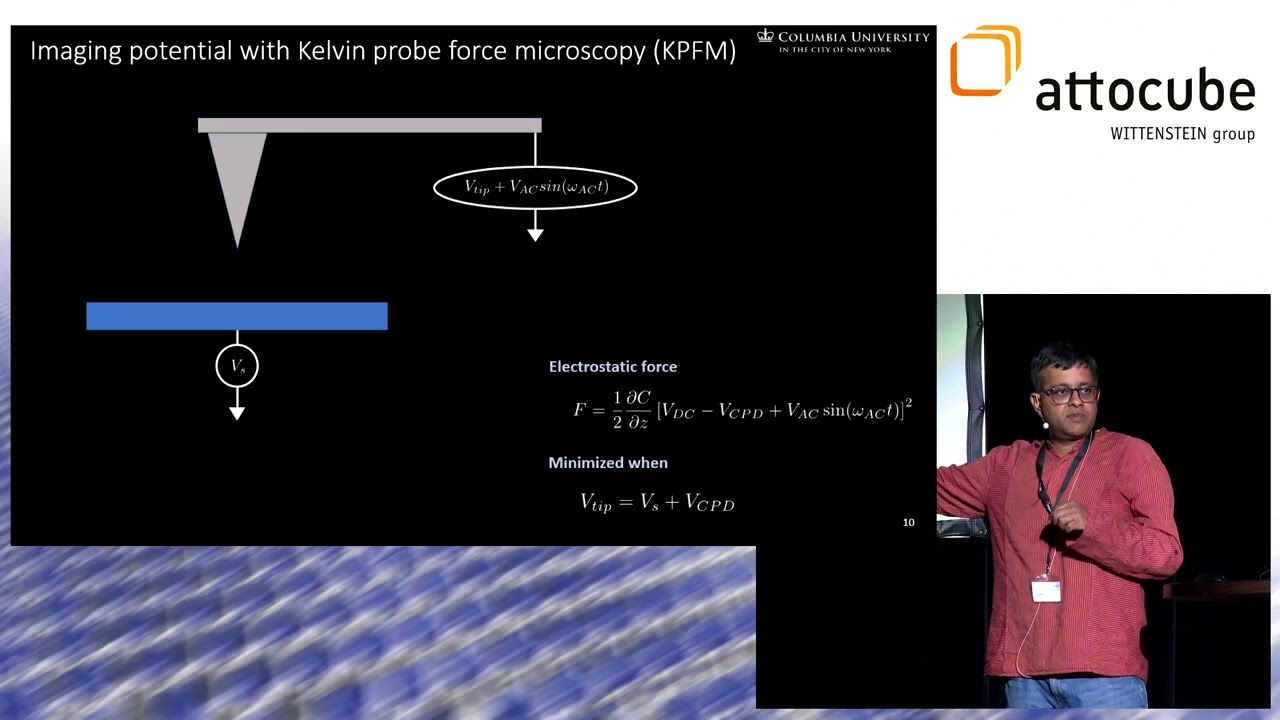
The value of the information is high, as it presents novel experimental observations of an electronic de Laval nozzle, a concept previously only theoretical. The argumentation is solid, building from the theoretical framework to the experimental setup and results. The speaker carefully explains the expected behavior and contrasts it with the observed data, providing multiple checks (gate voltage, magnetic field, geometry) to support the interpretation. The use of KPFM to directly image the potential profile is a significant methodological advance, providing spatial resolution that transport measurements lack.
Scientific Rigor, Source Quality, Title Accuracy
The scientific rigor is high, with clear methodology and careful analysis. The speaker references prior work, including a paper on arXiv (though not explicitly cited in the description) and mentions the theoretical framework. The title accurately reflects the content. The talk is a conference presentation, so the results are preliminary but well-supported. The speaker acknowledges limitations, such as the subtle difference between ohmic and hydrodynamic profiles and the need for further theoretical work.
175 words
Title / Content Match
The title accurately reflects the content, focusing on the electronic de Laval nozzle concept and its experimental realization.
Quality & Reliability
8/10
The talk presents original research with detailed experimental data, clear methodology, and references to prior work. The speaker is a recognized expert, and the results are consistent with theoretical predictions. However, the presentation is a conference talk and lacks peer-reviewed publication details.
Key Moments
Markers derived by PSI from the transcript: the creator did not define chapters.
- Introduction and acknowledgments
- Explanation of de Laval nozzle and its electronic analog
- Choice of material: boron-doped graphene
- Device fabrication and transport measurements
- Kelvin probe force microscopy technique
- Potential profiles at different currents
- Observation of nonlinear region and shock wave signature
- Spatial mapping of shock wave and comparison with transport
- Effect of gate voltage and magnetic field
- Q&A session
Cited Sources
- arXiv paper on electronic de Laval nozzle — Referenced as the theoretical proposal for the electronic de Laval nozzle, with one citation.
Concurring Sources
- Electron hydrodynamics in graphene — Prior work demonstrating hydrodynamic electron flow in graphene.
Contribution & Novelties
The talk presents the first experimental realization of an electronic de Laval nozzle, using scanning probe microscopy to directly image the potential profile and observe the shock wave. This provides direct spatial evidence for the phenomenon, complementing transport measurements. The work demonstrates the power of KPFM in studying electron hydrodynamics in 2D materials.
Pour aller plus loin :
- Electron hydrodynamics — Overview of the field.
- Kelvin probe force microscopy — Technique used in the experiment.
- de Laval nozzle — Classical fluid dynamics concept.
83 words
Radar Profile
The radar profile shows high scores in information quantity, quality, and reliability, with a slightly lower technical level, indicating a well-balanced presentation suitable for a specialized audience but not overly technical.
💬 No comments were provided for analysis.