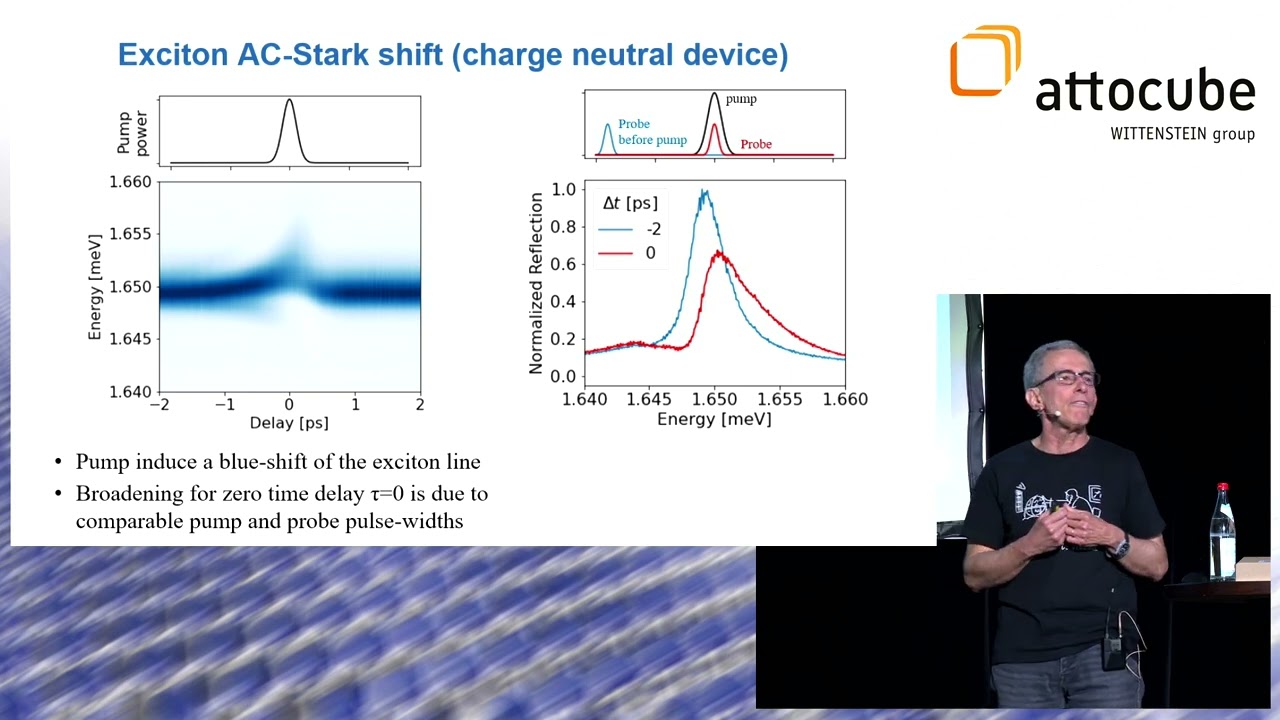
2D Materials Conference 2024 | Atac Imamoglu (ETH Zurich, Switzerland)
Keywords
Summary
143 words
Critical Evaluation
Value of the Information & Strength of the Argument
The talk provides valuable insights into the use of AC Stark spectroscopy to probe interactions in 2D materials. The argumentation is solid, building from fundamental principles to experimental results, and clearly explains the significance of each finding. The speaker carefully distinguishes between virtual and real excitations and addresses potential artifacts. The results are presented with appropriate caveats, and the interpretation is supported by theoretical models. The talk contributes original data on exciton and polaron interactions, which are crucial for future quantum technologies.
91 words
Title / Content Match
The title accurately reflects the content: a conference talk on quantum optical spectroscopy of 2D materials, specifically focusing on nonlinear pump-probe measurements in semiconductor moiré materials.
Quality & Reliability
8/10
The talk is given by a leading expert in quantum optics and 2D materials, presenting original experimental results with clear methodology and theoretical grounding. The content is consistent with established physics, and the speaker acknowledges limitations and open questions. However, the talk is a conference presentation without peer-reviewed publication details, and some claims are based on preliminary data.
Key Moments
Markers derived by PSI from the transcript: the creator did not define chapters.
- Introduction and acknowledgments
- Explanation of AC Stark effect in atoms
- AC Stark effect in semiconductors and exciton interactions
- Experimental setup for pump-probe spectroscopy
- Results on monolayer exciton interactions
- Attractive polaron interactions and enhancement
- Moiré excitons and biexciton states
- Conclusions and outlook
Cited Sources
- No specific sources cited in the talk — The speaker mentions prior work by Schmidt-Rink but does not provide specific references.
Concurring Sources
- Exciton-polarons in doped semiconductors — The concept of exciton-polarons is central to the talk's discussion of attractive polarons.
- Moiré materials — The talk focuses on moiré excitons, and this source provides background on moiré patterns.
Dissenting Sources
- No discordant sources found — The talk does not contradict established literature, but specific claims are not yet published in peer-reviewed journals.
Contribution & Novelties
The talk presents novel experimental results on measuring exciton and polaron interactions using AC Stark spectroscopy in 2D materials. The observation of enhanced interactions in attractive polarons and the discovery of biexciton states in moiré materials are significant contributions. The talk also highlights the density-independent behavior of moiré polarons, suggesting a different physical regime.
Pour aller plus loin :
- Exciton-polarons in doped semiconductors — Overview of exciton-polaron physics.
- Moiré materials — Introduction to moiré patterns and their role in 2D materials.
- AC Stark effect — Related to AC Stark effect and dressed states.
93 words
Radar Profile
The radar profile shows high scores in all dimensions, indicating a technically deep and reliable talk. The strongest aspects are the technical level and information quality, while the weakest is the lack of explicit citations, which slightly reduces the reliability score.