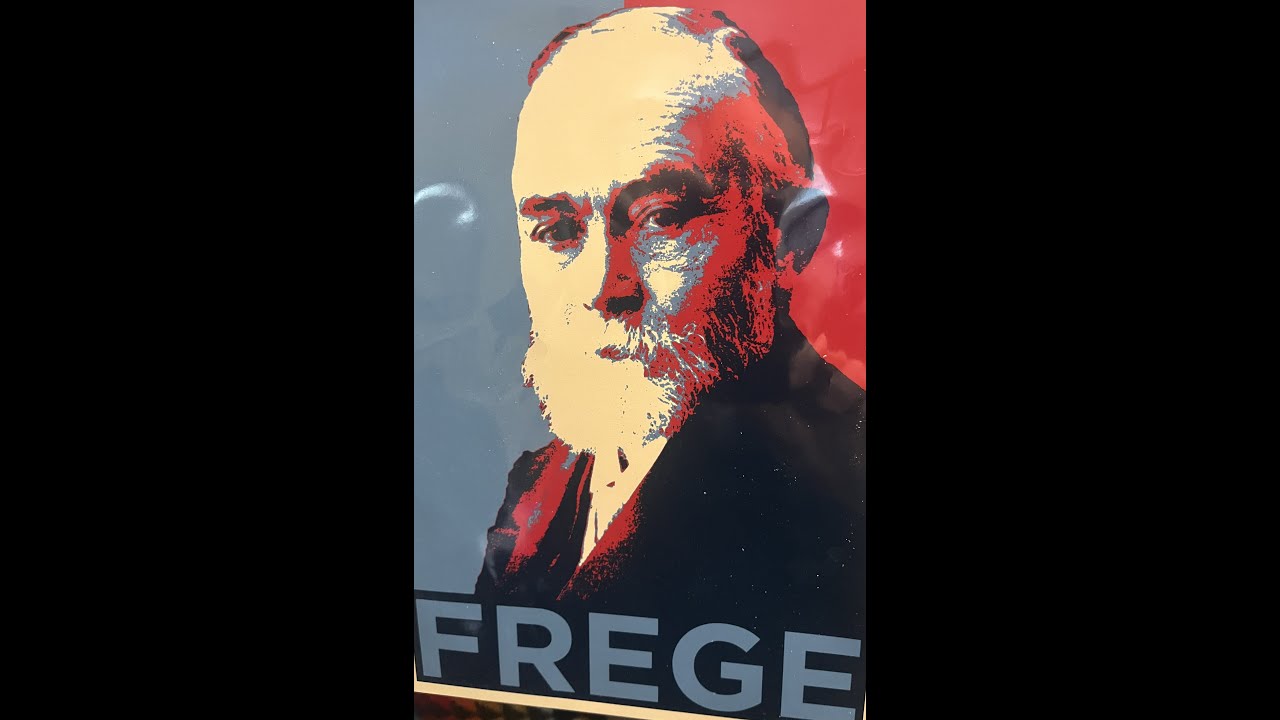
9. "Frege in Context" Brandom's 2025 Seminar Week 9: Late Philosophy of Logic, November 5, 2025.
Keywords
Summary
156 words
Critical Evaluation
Value of the Information & Strength of the Argument
The lecture offers a sophisticated and original interpretation of Frege’s late philosophy, connecting it to contemporary debates in semantics and pragmatics. Brandom’s argument for a global isomorphism between bilateral pragmatics and truthmaker semantics is novel and thought-provoking, providing a framework for understanding the relation between language use and truth. He supports his claims with close reading of Frege’s texts and engages with contemporary philosophers like Kit Fine and Gilbert Harman. The argumentation is rigorous and well-structured, though it assumes a high level of familiarity with the relevant philosophical literature.
Scientific Rigor, Source Quality, Title Accuracy
Brandom demonstrates a deep knowledge of Frege’s works and the secondary literature. He cites specific passages from Frege and engages with contemporary philosophers such as Kit Fine, Gilbert Harman, and Craig Restall. The course website provides access to materials, enhancing the reliability of the content. The title accurately reflects the seminar’s focus on Frege’s late philosophy of logic. No comments were provided for analysis.
168 words
Title / Content Match
The title accurately describes the content: it is the ninth meeting of Brandom's 2025 seminar on Frege, focusing on his late philosophy of logic.
Quality & Reliability
8/10
The video is a lecture by a leading philosopher (Robert Brandom) in a graduate seminar. It presents original interpretations and arguments, grounded in close reading of Frege's texts and contemporary debates. The content is high-level and philosophically rigorous, though it is not peer-reviewed and reflects the speaker's perspective.
Key Moments
Markers derived by PSI from the transcript: the creator did not define chapters.
- Recap of previous lecture on conceptual novelty and functional decomposition.
- Introduction to the focus on sense and reference, and the claim that sentences have truth values as their reference.
- Discussion of the introduction of truth values as logical objects and the connection to the inconsistency in Frege's system.
- Presentation of the basic discursive bipolarity: pragmatic (acceptance/rejection) and semantic (truth/falsity).
- Introduction of reason relations (implication and incompatibility) as more basic than logical notions.
- Explanation of the global isomorphism between bilateral pragmatics and truthmaker semantics.
- Discussion of the asymmetry between truth and falsity, and the privilege of truth as preserved by good implications.
- Connection to conceptual novelty and functional decomposition, with examples from Frege.
- Conclusion and preview of next lecture on thoughts.
Cited Sources
- Course Website — Provides all materials for the course, including handouts and readings.
- Course Website (Alternative) — Alternative access to course materials.
Concurring Sources
- Course Website — Provides materials that support the lecture's content.
Contribution & Novelties
Brandom offers a novel interpretation of Frege’s late philosophy of logic, emphasizing the importance of reason relations and the global isomorphism between pragmatics and truthmaker semantics. This provides a new framework for understanding the relation between language use and truth. The lecture also offers a fresh perspective on the origins of the inconsistency in Frege’s system, linking it to the introduction of truth values as logical objects.
Pour aller plus loin :
- Kit Fine’s Truthmaker Semantics — This entry provides an overview of truthmaker semantics, which is central to Brandom’s argument.
- Bilateralism in Logic — This entry discusses bilateralism, the view that assertion and denial are primitive speech acts, which is relevant to Brandom’s pragmatic account.
- Frege’s Philosophy of Logic — This entry provides an overview of Frege’s logic and its philosophical implications.
133 words
Radar Profile
The radar profile shows high scores in quality of information, technical level, and reliability, indicating a dense and rigorous philosophical lecture. The quantity of information is also high, but the accessibility is limited due to the advanced nature of the content.