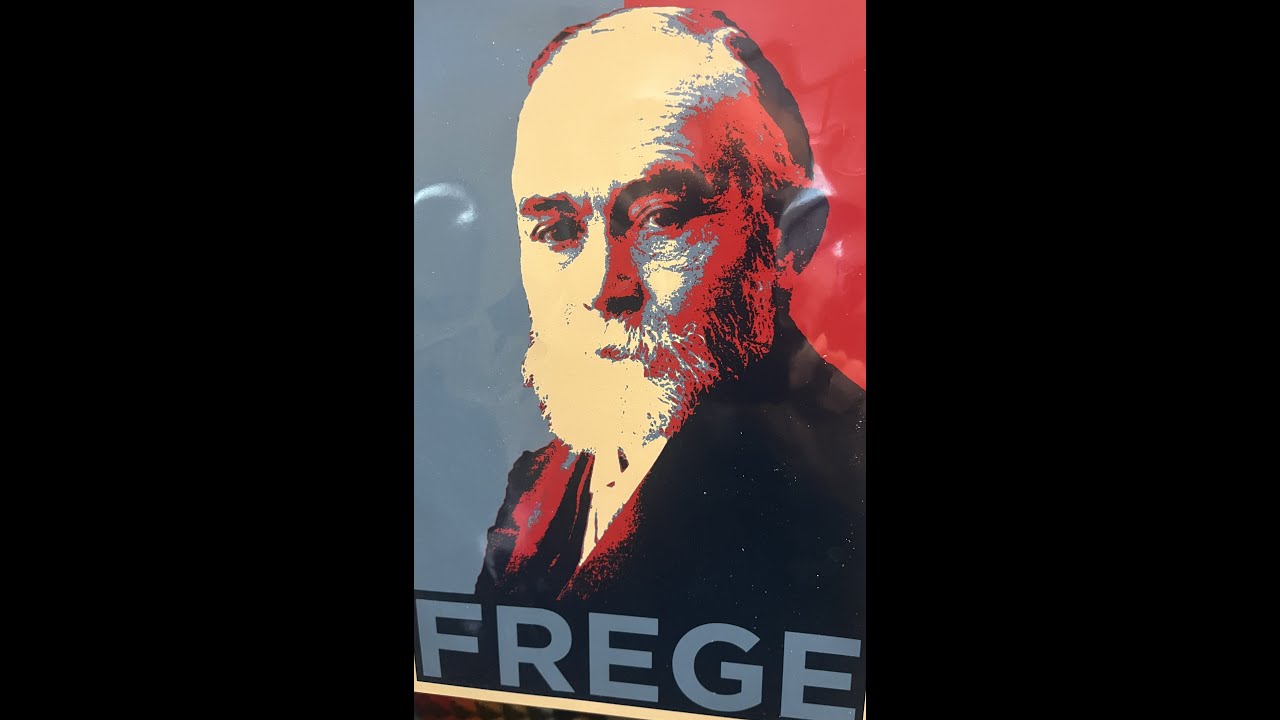
6. "Frege in Context" Brandom's 2025 Seminar Week 6: "Sinn und Bedeutung" (1892), October 15, 2025
Keywords
Summary
185 words
Critical Evaluation
Value of the Information & Strength of the Argument
The value of the information is high for an audience already familiar with Frege and analytic philosophy. Brandom offers a sophisticated interpretation of Frege’s distinctions, providing novel insights into the notion of complex predicates via substitutional equivalence classes. His argumentation is rigorous, building on textual evidence and engaging with secondary literature (Dummett, Tugendhat). He carefully distinguishes between different aspects of sense and reference, and addresses potential objections. The discussion is dense and assumes prior knowledge, but it is coherent and well-structured.
Scientific Rigor, Source Quality, Title Accuracy
The seminar demonstrates high scholarly rigor: Brandom refers directly to Frege’s texts and to key secondary sources (Dummett, Tugendhat, Putnam). He provides a course website with materials. The title accurately reflects the content. The discussion is historically informed and technically precise, though it is an interpretive lecture rather than a neutral exposition. No public comments were provided for analysis.
155 words
Title / Content Match
The title accurately describes the content: a seminar session focused on Frege's 'Sinn und Bedeutung' within a broader course on Frege.
Quality & Reliability
8/10
The seminar is led by a leading philosopher (Robert Brandom) and engages deeply with primary texts (Frege's 'Sinn und Bedeutung' and related essays). The discussion is rigorous, historically informed, and technically precise, though it reflects the instructor's interpretive perspective rather than a neutral survey.
Key Moments
Markers derived by PSI from the transcript: the creator did not define chapters.
- Introduction: Frege's mature view, distinctions between concept/object and sense/reference.
- Discussion of the concept horse paradox and the incompleteness of functions.
- Dummett's distinction between simple and complex predicates; complex predicates as patterns.
- Formalization of complex predicates via substitutional equivalence classes.
- Metaphysical implications: objects vs. functions, second-order quantification.
- Two aspects of reference: name-bearer relation and intersubstitutability salva veritate.
- Tugendhat's emphasis on intersubstitutability; two aspects of sense: cognitive value and mode of presentation.
- Discussion of Frege's notion of sense in the 1980s (Putnam) and its limitations.
- The role of courses of values and the delicate balance between sense and reference in logic.
- Concluding remarks and Q&A.
Cited Sources
- Course Website: Frege in Context — Course materials and handouts for the seminar.
- Course Website (alternative) — Alternative access to course materials.
Concurring Sources
- Frege: Sense and Reference — General overview of Frege's distinction, consistent with Brandom's presentation.
- Gottlob Frege (Stanford Encyclopedia of Philosophy) — Authoritative overview of Frege's philosophy, supporting the historical context.
Dissenting Sources
- Putnam's 'The Meaning of 'Meaning'' — Brandom critiques the 1980s interpretation of Fregean sense, which Putnam's work exemplifies.
Contribution & Novelties
Brandom offers a novel interpretation of Frege’s notion of complex predicates as substitutional equivalence classes, demystifying the idea of ‘incomplete’ expressions. He also clarifies the dual aspects of sense and reference, drawing on Tugendhat’s work. This provides a fresh perspective on Frege’s semantics that goes beyond standard readings.
Pour aller plus loin :
- Gottlob Frege — Stanford Encyclopedia of Philosophy entry on Frege, providing comprehensive background.
- Sense and Reference — Wikipedia article on Frege’s distinction.
- Michael Dummett — SEP entry on Dummett, whose work on Frege is central.
- Ernst Tugendhat — Wikipedia article on Tugendhat, who emphasized intersubstitutability.
- Hilary Putnam — SEP entry on Putnam, relevant to the 1980s interpretation of sense.
112 words
Radar Profile
The radar profile shows high scores in quality of information, technical level, and reliability, with slightly lower but still substantial quantity of information. This indicates a dense, expert-level lecture that is highly informative but may be less accessible to a general audience.