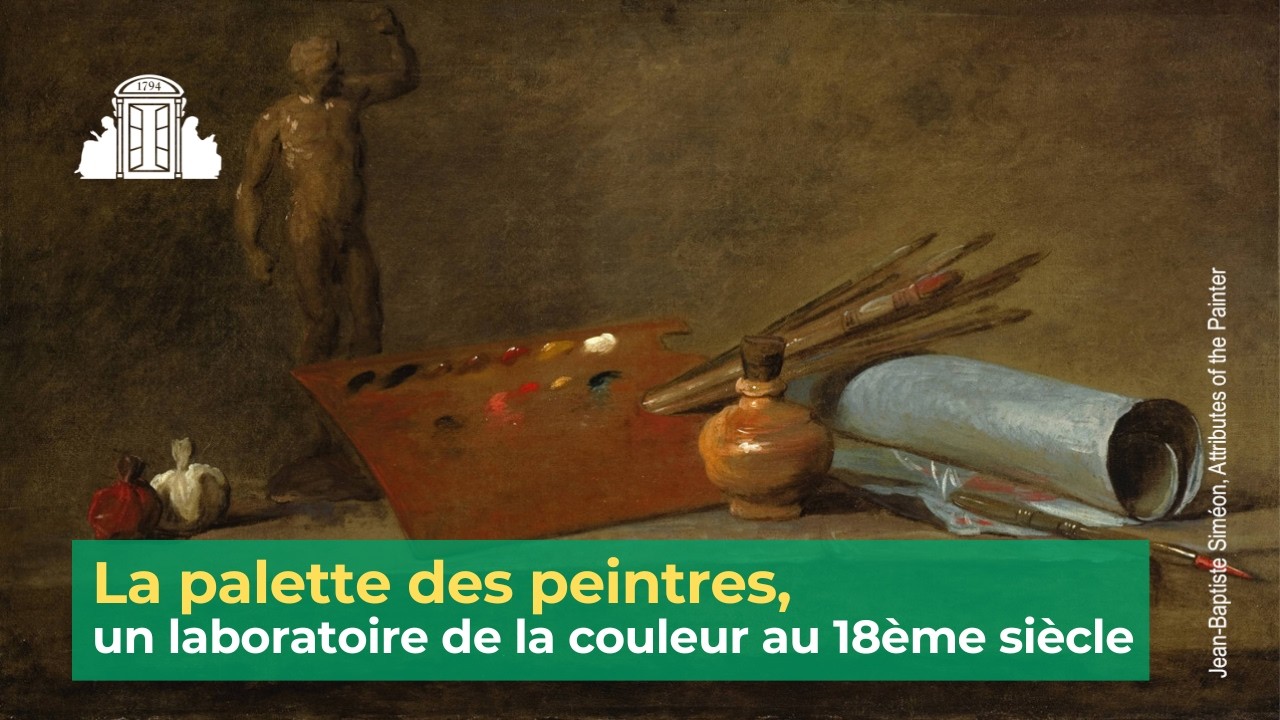
La palette des peintres, un laboratoire de la couleur au 18ème siècle | ENS-PSL
Keywords
Summary
210 words
Critical Evaluation
The lecture provides a nuanced and well-researched analysis of the intersection of art and science in 18th-century France. Guichard effectively uses a specific painting, Boucher’s ‘Le lever du soleil’, as a case study to illustrate broader trends in color theory and practice. Her argument is solidly grounded in historical sources, including the writings of Roger de Piles, the Dictionnaire des beaux-arts, and the works of Newton and his popularizers. She demonstrates a clear understanding of the scientific concepts involved, such as Newton’s theory of light and the chemistry of pigments, and she integrates them seamlessly into her art historical narrative. The lecture is well-structured, with a clear introduction, three main sections, and a conclusion that ties together the themes. One minor weakness is that the lecture is delivered in a conversational style, which may occasionally obscure the precision of the argument. Additionally, while she mentions the concept of ’trading zones’ and ‘reflexions opératoires’, she does not delve deeply into these theoretical frameworks, which could have enriched the analysis. The sources cited are appropriate and credible, though the lecture does not provide a formal bibliography. Overall, the lecture is a valuable contribution to the understanding of how painters engaged with scientific knowledge in the 18th century, and it successfully challenges the traditional view of Boucher as a purely decorative painter. The title accurately reflects the content, and the lecture is accessible to a general academic audience while maintaining scholarly rigor.
239 words
Title / Content Match
The title accurately reflects the content, which focuses on the palette of painters as a site of color experimentation in the 18th century.
Quality & Reliability
8/10
The speaker is a professor of art history at ENS, the content is based on scholarly research, and the lecture is part of an academic event. The argument is well-structured and references historical sources, but the presentation is a lecture rather than a peer-reviewed publication.
Key Moments
Markers derived by PSI from the transcript: the creator did not define chapters.
- Introduction and presentation of the painting 'Le lever du soleil' by François Boucher.
- Discussion of the critical reception of the painting and the debate over its colors.
- Introduction of Roger de Piles and the quarrel between drawing and color.
- Explanation of the concept of 'reflexions opératoires' from Michael Baxandall.
- Definition of color from the 1788 Dictionnaire des beaux-arts.
- Introduction of the three themes: Newtonian theories, modern colorism, and pigments.
- Discussion of Newton's Opticks and its reception in France.
- Mention of Voltaire's 'Elements of Newton's Philosophy' and Algarotti's 'Newtonianism for Ladies'.
- Explanation of the 'Newtonian painting' formula and the spectrum of colors.
- Transition to the second theme: the evolution of the art of color in modern painters.
Cited Sources
- Savoirs ENS platform — Platform hosting the lecture and other academic videos.
- Journée Georges Bram 2025 page — Page for the conference series where this lecture was given.
- ENS-PSL official website — Institutional website of the École normale supérieure - PSL.
- ENS-PSL LinkedIn — LinkedIn page of the institution.
- ENS-PSL YouTube channel — Official YouTube channel of the institution.
Concurring Sources
- Michael Baxandall, 'Shadows and Enlightenment' — Referenced in the lecture for the concept of 'reflexions opératoires'.
- Roger de Piles, 'Dialogue sur le coloris' — Mentioned as foundational for the debate on color.
- Isaac Newton, 'Opticks' — Discussed as a key influence on color theory.
Dissenting Sources
- Contemporary critics of Boucher — The lecture quotes a critic who disapproved of Boucher's use of color, representing a contrasting view.
Contribution & Novelties
The lecture offers a fresh perspective on 18th-century painting by framing the painter’s palette as a ’laboratory’ where scientific and artistic knowledge intersect. It highlights the active role of painters in scientific debates, challenging the view of them as mere recipients of scientific ideas. The concept of ’trading zones’ and ‘reflexions opératoires’ provides a useful framework for understanding these exchanges.
Pour aller plus loin :
- Michael Baxandall - Wikipedia — Relevant for his concept of ‘reflexions opératoires’ and his work on art and cognition.
- Opticks by Isaac Newton - Wikipedia — Primary source for Newton’s theories on light and color.
- Roger de Piles - Wikipedia — Key theorist of color in the 17th-18th centuries.
- François Boucher - Wikipedia — The painter discussed in the lecture.
- Color theory - Wikipedia — General background on color theory.
135 words
Radar Profile
The radar profile shows high scores in quantity and quality of information, with a strong technical level, indicating a well-researched and detailed lecture. The reliability is also high, reflecting the academic context and the speaker's expertise.