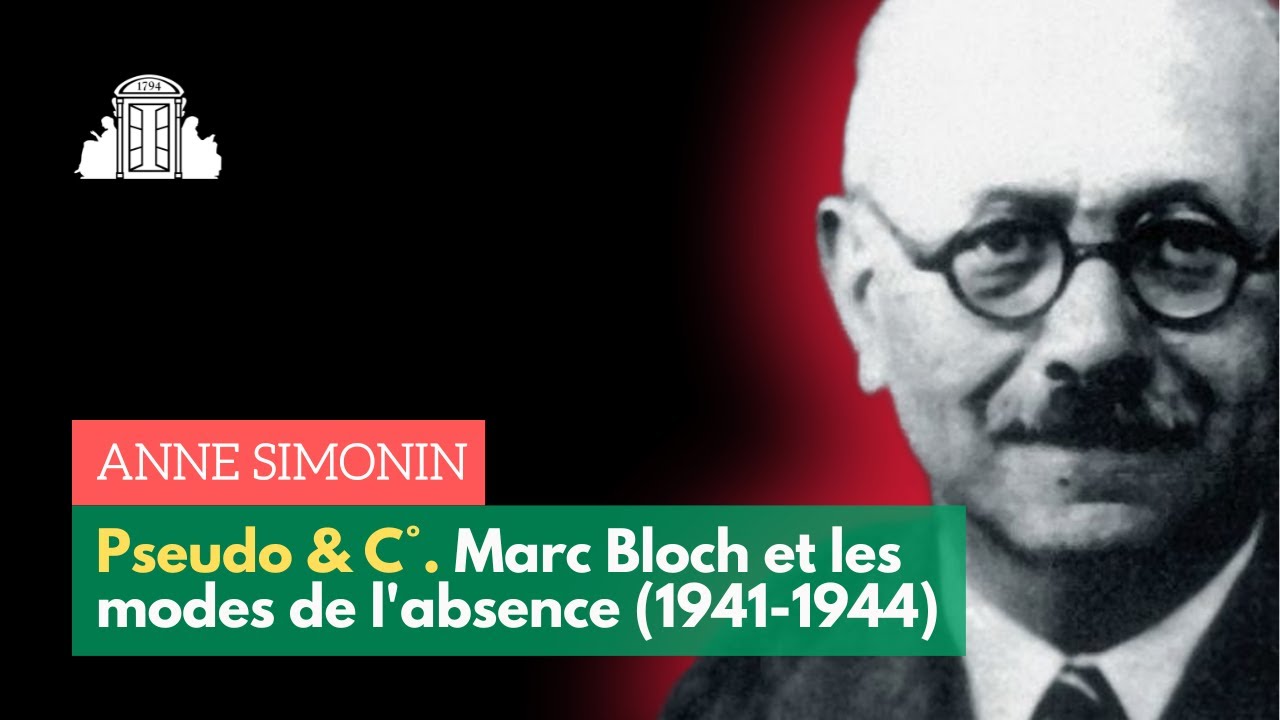
Pseudo & C°. Marc Bloch et les modes de l'absence (1941-1944) | ENS-PSL
Keywords
Summary
199 words
Critical Evaluation
Anne Simonin’s presentation offers a sophisticated and well-researched analysis of Marc Bloch’s situation during the Occupation, moving beyond simplistic narratives of collaboration or resistance. She effectively critiques the concept of ‘accommodation’ as a moralizing label, drawing on Sartre’s origins and its juridical underpinnings, and proposes alternative frameworks from Souriau’s philosophy—’trajectory’ and ‘intensity’—to capture the fluid and multi-faceted identities of intellectuals under Vichy. The argument is grounded in archival evidence, including correspondence and journal issues, and engages with existing scholarship (e.g., Peter Schöttler, Natalie Zemon Davis, Philippe Burrin). Simonin’s analysis of Febvre’s strategic maneuvers, such as renaming the journal and placing it under the Encyclopédie française, demonstrates a keen understanding of the institutional and legal constraints of the period. She also highlights the often-overlooked material aspects, like subscription logistics and censorship procedures, which add depth to the historical picture. The presentation is balanced, acknowledging both Febvre’s responsibility and his assumption of it, and Bloch’s acceptance of his removal. The use of Souriau’s concepts is insightful, though one might wish for a more explicit connection to Bloch’s own writings. The talk is dense and assumes prior knowledge of the Annales school and Vichy censorship, but it offers a valuable contribution to the historiography of intellectual life under occupation. The title accurately reflects the content, and the speaker’s expertise is evident throughout. Overall, this is a rigorous and thought-provoking lecture that enriches our understanding of a complex historical moment.
236 words
Title / Content Match
The title accurately reflects the content, focusing on Marc Bloch's modes of absence during 1941-1944.
Quality & Reliability
8/10
The speaker is a recognized historian, the content is based on archival sources and scholarly debates, and the presentation is nuanced and well-argued.
Key Moments
Markers derived by PSI from the transcript: the creator did not define chapters.
- Introduction by the session chair, presenting Anne Simonin and her topic on Marc Bloch.
- Simonin begins her talk, referencing the controversy over Bloch's name disappearing from the Annales.
- Discussion of the concept of 'accommodation' and its moral implications, citing Sartre and Talleyrand.
- Introduction of Étienne Souriau's 'modes of existence' and the notions of 'trajectory' and 'intensity'.
- Analysis of the journal's editorial changes, including Febvre becoming 'director responsible' and the disappearance of Bloch and other Jewish members.
- Explanation of the censorship system and the role of the commission including Marguerite Duras and Dionys Mascolo.
- Febvre's strategy to evade censorship by creating 'Mélanges d'histoire sociale' under the Encyclopédie française.
- Discussion of Bloch's article on Anatole de Monzie and his refusal to submit it to the Annales.
- Examination of the correspondence between Bloch and Febvre, showing their collaborative yet tense relationship.
- Conclusion summarizing the modes of absence and presence of Bloch during the Occupation.
Cited Sources
- Savoirs ENS — Platform hosting the video and related academic content.
- ENS-PSL official website — Institutional page of the École normale supérieure.
- ENS-PSL LinkedIn — Social media presence of the institution.
- ENS-PSL YouTube channel — Official YouTube channel of ENS-PSL.
Concurring Sources
- Marc Bloch - Wikipedia — General biographical information on Marc Bloch.
- Annales School - Wikipedia — Overview of the Annales school and its history.
Dissenting Sources
- Philippe Burrin - La France à l'heure allemande — Burrin's concept of 'accommodation' is critiqued by Simonin as moralizing and insufficient.
Contribution & Novelties
This presentation offers a fresh perspective on Marc Bloch’s wartime experience by applying Étienne Souriau’s philosophical concepts of ’trajectory’ and ‘intensity’ to historical analysis. It challenges the moralizing concept of ‘accommodation’ and provides a detailed account of the institutional and legal constraints faced by intellectuals under Vichy. The analysis of Febvre’s strategic use of the Encyclopédie française to bypass censorship is particularly insightful.
Pour aller plus loin :
- Marc Bloch on Wikipedia — Provides background on Bloch’s life and work.
- Annales School on Wikipedia — Context on the journal and its evolution.
- Étienne Souriau on Wikipedia — Information on the philosopher and his work ‘Les différents modes d’existence’.
- Vichy France on Wikipedia — Overview of the regime and its censorship policies.
121 words
Radar Profile
The radar profile shows high scores in information quality and reliability, reflecting the speaker's expertise and use of archival sources. The quantity of information is also substantial, though the technical level is moderate, making it accessible to a knowledgeable audience. Overall, the presentation is well-balanced and credible.