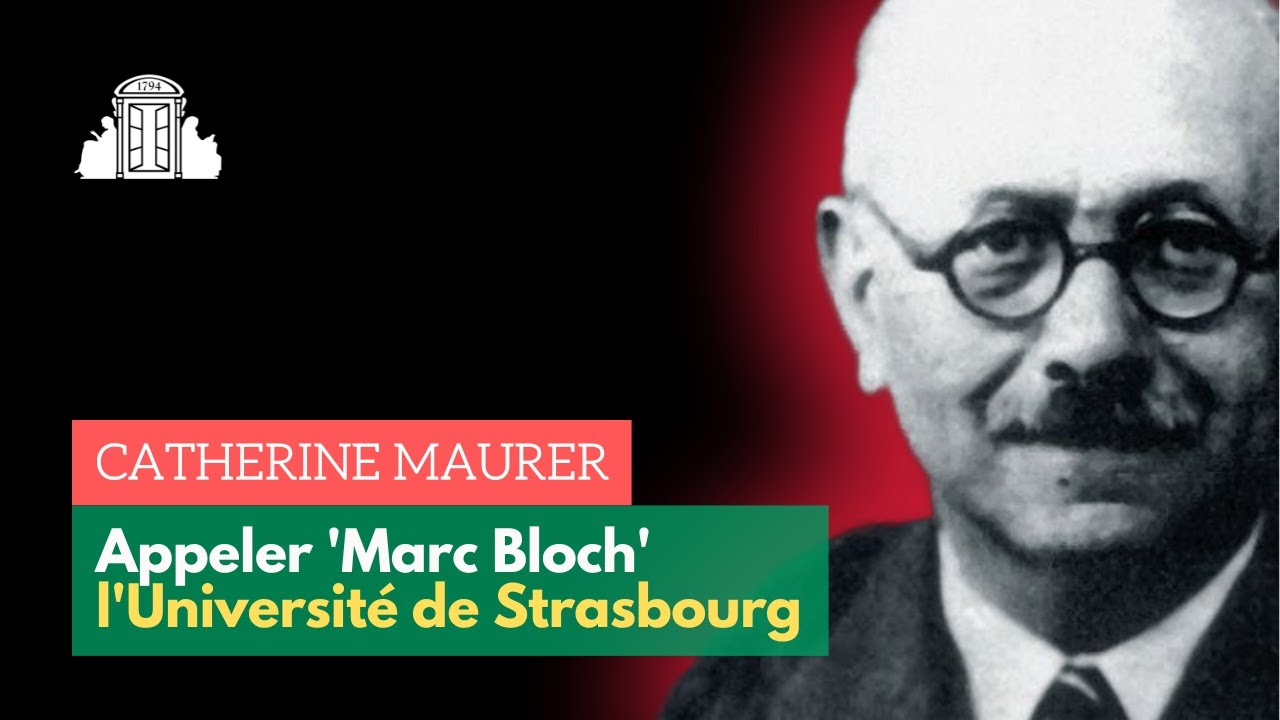
Appeler 'Marc Bloch' l’Université de Strasbourg | ENS-PSL
Keywords
Summary
221 words
Critical Evaluation
The presentation offers a valuable and nuanced historical analysis of a specific institutional naming controversy. Maurer demonstrates methodological rigor by combining archival sources (minutes of council meetings) with oral history interviews with key protagonists, notably Albert Hamm. This triangulation of sources strengthens the reliability of her account. She is transparent about the preliminary nature of her research, which is appropriate for a conference presentation. The argumentation is well-structured, moving from the memory of Bloch at the university to the detailed voting process and the eventual failure. She provides specific dates, vote counts, and quotes, which adds precision. However, the analysis could be deepened by exploring the broader political and social context of the 1990s, such as the rise of identity politics or the role of the university’s German heritage. The speaker also acknowledges the absence of overt antisemitism in the debates, but does not fully explore the potential for coded or implicit biases. The reliance on memory for some details, as she admits, introduces a degree of uncertainty. The talk is primarily descriptive rather than analytical, focusing on the sequence of events rather than interpreting their significance. Nevertheless, it contributes to the historiography of Marc Bloch’s memory and the politics of university naming. The title accurately reflects the content, and the presentation is well-suited for an academic audience. Overall, the information is reliable and the argumentation is sound, though it would benefit from further contextualization and theoretical framing.
238 words
Title / Content Match
The title accurately reflects the content, which focuses on the debate and failure to name the University of Strasbourg after Marc Bloch in the 1990s.
Quality & Reliability
8/10
The presentation is based on archival sources (minutes of council meetings) and interviews with key actors, providing a solid historical account. The speaker is a professor of contemporary history, lending expertise. However, the talk is described as a preliminary sketch, and some claims rely on memory, slightly reducing certainty.
Key Moments
Markers derived by PSI from the transcript: the creator did not define chapters.
- Introduction by the chair, presenting Catherine Maurer and the topic.
- Maurer begins her talk, referencing Olivier Dumoulin's book on Marc Bloch and the failure of the naming in 1994.
- Discussion of Bloch's memory at the University of Strasbourg, including his portrait by Lucien Febvre and memorial volumes.
- Maurer explains the creation of the three universities in Strasbourg in 1971 and the naming of Strasbourg 1 and 3.
- Details of the naming commission and the shortlist of five names in 1990.
- Description of the three votes in 1991, with Bloch gaining support but failing to achieve the required majority.
- The revival of the proposal in 1994 after the discovery of Bloch's archives, and the council meeting on 6 May 1994.
- Maurer reflects on the arguments against Bloch and the paradox that the failure boosted commemorations.
- Conclusion and thanks.
Cited Sources
- Savoirs ENS — Platform hosting the video and related academic content.
- ENS-PSL official website — Institutional site of the École normale supérieure - PSL.
Concurring Sources
- Olivier Dumoulin, 'Marc Bloch' (book) — Referenced in the talk as a key source on Bloch's memory and the naming failure.
External References
Contribution & Novelties
This presentation provides a detailed case study of the naming debate at the University of Strasbourg, shedding light on the complex memory of Marc Bloch and the dynamics of institutional identity. It offers new insights from archival sources and interviews, contributing to the historiography of Bloch’s posthumous reputation.
Pour aller plus loin :
- Marc Bloch - Wikipedia — Overview of Bloch’s life and work.
- Annales School - Wikipedia — Context on the historical movement Bloch co-founded.
- University of Strasbourg - Wikipedia — History of the university and its naming.
89 words
Radar Profile
The radar profile shows high scores in information quantity, quality, and reliability, with a moderate technical level. This indicates a well-researched and informative presentation that is accessible to a broad academic audience.