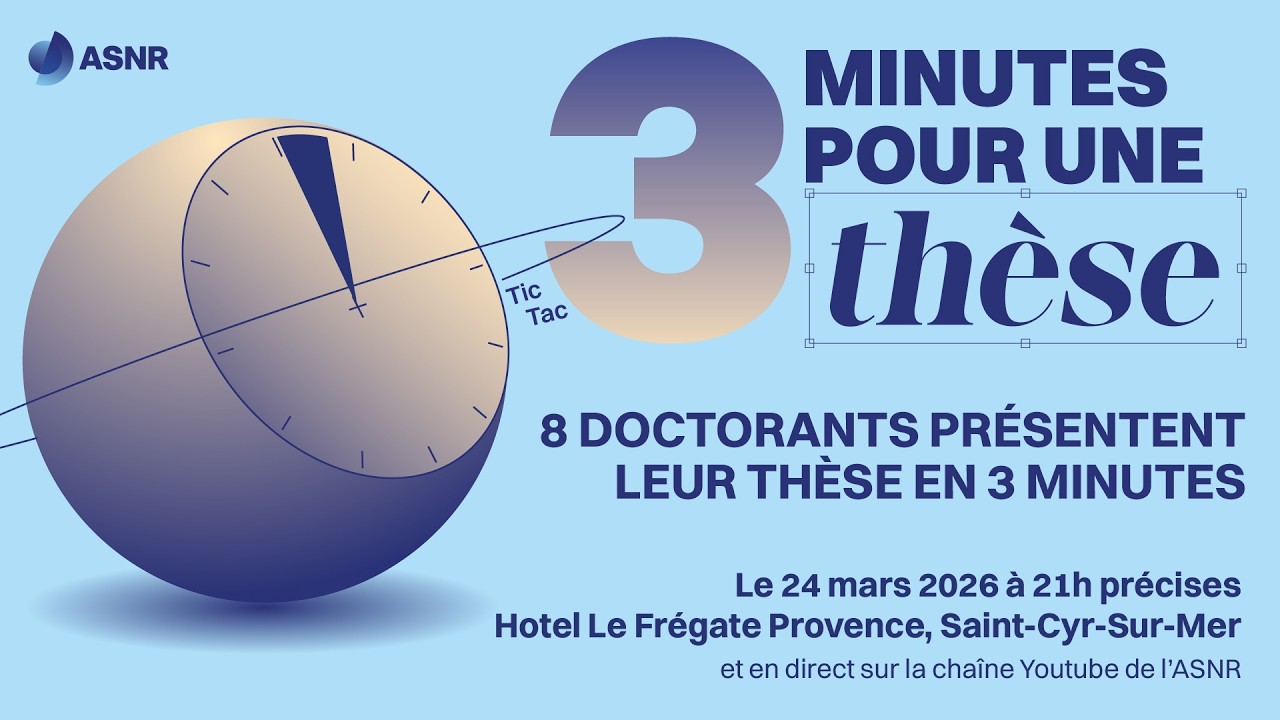
3 minutes pour une thèse 2026 - diffusion EN DIRECT le 24 Mars à 21h
Keywords
Summary
205 words
Critical Evaluation
Value of the Information & Strength of the Argument
The video offers valuable insights into current research in nuclear safety and radiation protection, presented in an engaging and accessible manner. Each doctoral student effectively communicates the significance of their work, often using analogies and metaphors to explain complex concepts. The argumentation is generally solid, with clear research objectives and methodologies. However, due to the time constraint, some presentations lack depth in explaining the scientific details and potential limitations. The overall value lies in showcasing the breadth of research and the importance of making science understandable to the public.
Scientific Rigor, Source Quality, Title Accuracy
The scientific rigor is evident in the presentations, as they are based on ongoing doctoral research conducted at ASNR and partner institutions. The sources cited are primarily the students’ own research and institutional knowledge. The title accurately reflects the content, as it is a live broadcast of the competition. The video does not include external references or citations, but the institutional context provides a level of credibility. The adequacy between title and content is high, as the video indeed shows the competition as advertised.
188 words
Title / Content Match
The title accurately reflects the content: a live broadcast of the '3 minutes pour une thèse' competition held on March 24, 2026.
Quality & Reliability
8/10
The video is a live broadcast of a doctoral competition by the French nuclear safety authority (ASNR). The presentations are based on ongoing research, with clear methodology and results. The content is scientifically grounded, though presented in a popularized format. The institutional source adds credibility.
Key Moments
Markers derived by PSI from the transcript: the creator did not define chapters.
- Introduction by the host, welcoming the audience and explaining the competition rules.
- First presentation by Fructueux Souhomé on the long-term behavior of cementitious materials for radioactive waste disposal.
- Second presentation by Léa Duf on the creep behavior of chromium-coated zirconium alloy cladding under temperature ramps.
- Third presentation by Jouant Sylva Filot on thermal-hydraulic conditions at and downstream of a quench front during loss-of-coolant accidents.
- Fourth presentation by Joao Bouchin on the behavior of chromium in the primary circuit during severe accidents, focusing on interactions with cesium and molybdenum.
- Fifth presentation by Adrien Bourgois on mechanisms for trapping radioactive noble gases in innovative porous materials.
- Sixth presentation by Myiam Brisset on in vitro and in vivo studies of actinide decorporation using bio-inspired hydroxamic acid sequestering agents.
- Seventh presentation by Taha Aheden on modeling suspended matter composition using neural networks, applied to the Rhône river.
- Eighth presentation by Hugo Duran on an interdisciplinary approach to post-accidental management of marine environments contaminated with radioactivity.
- Closing remarks and announcement of the winners.
Cited Sources
- ASNR official website — Institutional source for the nuclear safety authority in France.
Concurring Sources
- ASNR official website — The video is produced by ASNR, and the content aligns with their mission of nuclear safety and radiation protection.
Contribution & Novelties
The video provides a unique platform for doctoral students to present their research in a concise and accessible format, highlighting the diversity of topics within nuclear safety and radiation protection. It emphasizes the importance of science communication and public engagement. The presentations offer insights into ongoing research that may not yet be published, providing a glimpse into cutting-edge developments.
Pour aller plus loin :
- Nuclear safety in France — Overview of nuclear safety regulations and practices in France.
- Radioactive waste management — General information on radioactive waste and disposal methods.
- Loss-of-coolant accident — Explanation of this reactor accident scenario and its implications.
- Chromium coating for nuclear fuel cladding — Background on fuel cladding materials and potential coatings.
- Neural networks in environmental monitoring — Overview of neural networks and their applications.
130 words
Radar Profile
The radar profile shows high scores in quantity and quality of information, reflecting the rich content and scientific basis. The technical level is moderate, as the presentations are simplified for a general audience. The overall reliability is high due to the institutional source.
💬 No comments were provided for analysis.