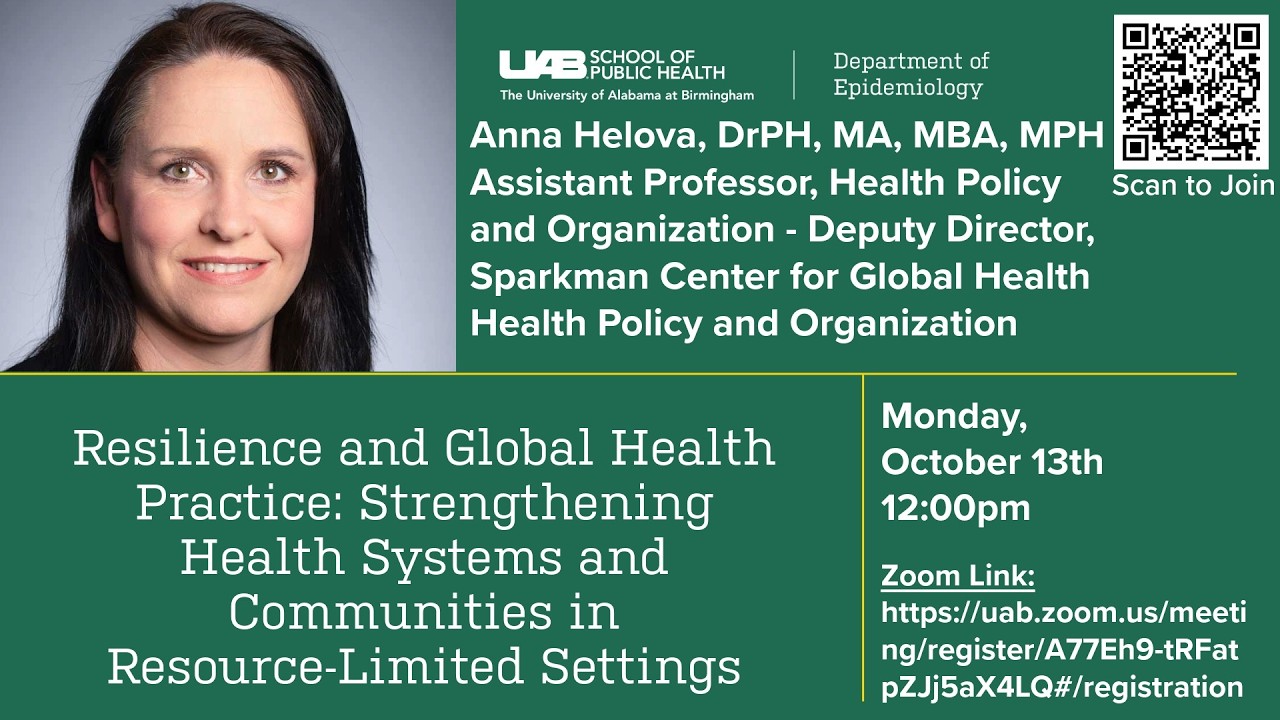
Resilience and Global Health Practice Strengthening Systems and Communities
Keywords
Summary
167 words
Critical Evaluation
Value of the Information & Strength of the Argument
The presentation provides valuable insights into the often-overlooked mental health challenges faced by health workers in resource-limited settings. The argumentation is supported by preliminary data from the REACH study, including quotes from participants that illustrate the severity of the issues. The speaker effectively argues for the need to strengthen health system resilience by investing in health worker well-being. However, the argumentation is somewhat limited by the preliminary nature of the data and the lack of published results. The speaker’s expertise and the alignment of the study with global health priorities add to the value of the information.
Scientific Rigor, Source Quality, Title Accuracy
The presentation demonstrates scientific rigor through a clear methodology, including the use of the ADAPT-ITT implementation framework and ethical approvals. The speaker cites recognized definitions of resilience and community resilience, though specific sources are not explicitly named. The title accurately reflects the content, focusing on resilience and global health practice. The presentation is based on the speaker’s own research, which is appropriate for a seminar. However, the lack of explicit citations and the preliminary nature of the results limit the overall rigor. The speaker does not provide a list of references, but the study is aligned with Kenyan and global health priorities.
214 words
Title / Content Match
The title accurately reflects the content, which focuses on resilience in global health practice, with a case study on health workers in Kenya.
Quality & Reliability
7/10
Presentation by an academic expert with 22 years of experience, based on a mixed-methods study with preliminary results. The methodology is described, but the study is ongoing and results are not yet published. The talk includes personal opinions and interpretations.
Key Moments
Markers derived by PSI from the transcript: the creator did not define chapters.
- Introduction and definitions of global health practice and resilience.
- Background on Kenya and HIV context, including 95-95-95 targets.
- Overview of the REACH study objectives and methodology.
- Presentation of preliminary results on mental health challenges among health workers.
- Discussion of preferred intervention components and delivery methods.
- Conclusions and key recommendations for strengthening health systems.
Cited Sources
- No explicit sources cited in the video — The speaker mentions definitions from recognized sources but does not name them.
Concurring Sources
- WHO Health Systems Resilience — Aligns with the presentation's focus on health system resilience.
Contribution & Novelties
The presentation offers an original contribution by focusing on the mental health of health workers in resource-limited settings, a topic that is often underexplored. The REACH study provides preliminary evidence from Kenya that can inform interventions to build resilience. The speaker emphasizes the need to address stigma and to include lay health workers in such interventions.
Pour aller plus loin :
- WHO Health Systems Resilience — Relevant to understanding health system resilience.
- Community Resilience: A Critical Review — Discusses community resilience concepts.
- Mental Health of Health Workers — WHO fact sheet on mental health at work.
96 words
Radar Profile
The profile shows a balanced presentation with moderate scores across all dimensions, indicating a solid but not exceptional seminar. The highest scores are in information quantity and quality, reflecting the detailed case study, while the technical level is slightly lower, making it accessible to a broad audience.
💬 No comments were provided for analysis.