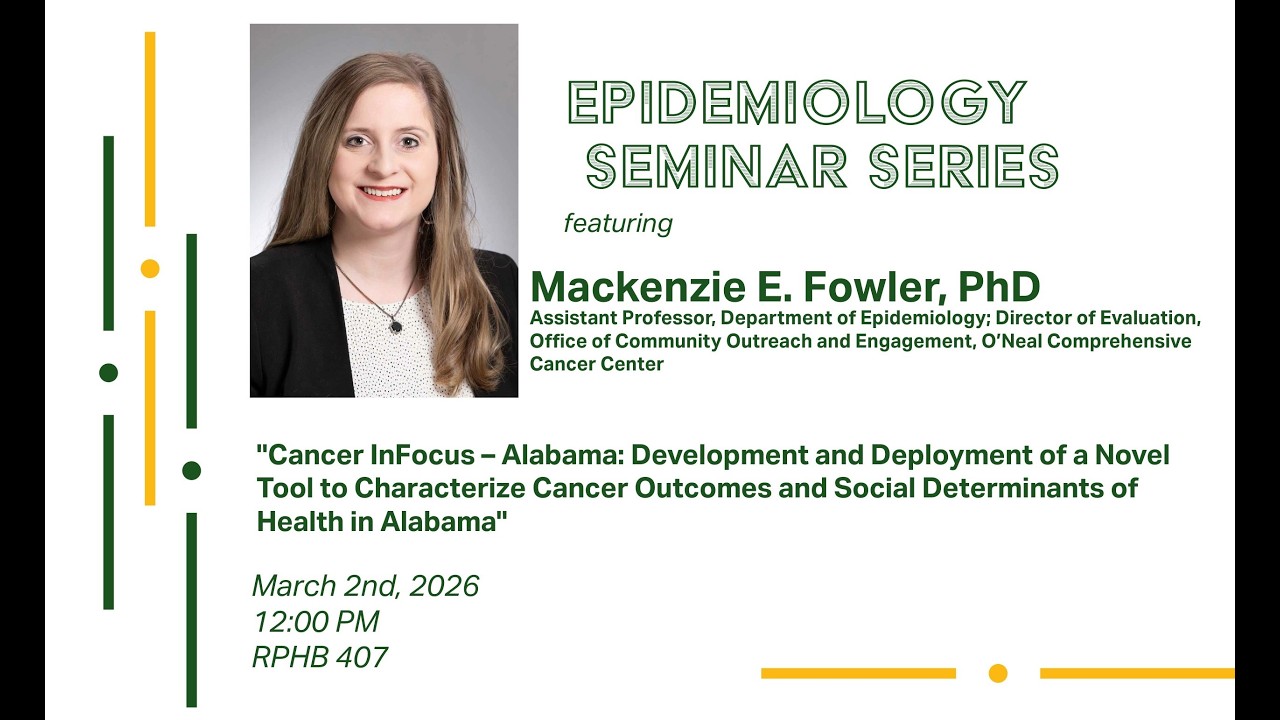
Cancer InFocus: Development & Deployment of a Novel SDoH Tool in Alabama
Keywords
Summary
148 words
Critical Evaluation
Value of the Information & Strength of the Argument
The presentation provides valuable insights into the development and utility of a practical tool for visualizing social determinants of health in relation to cancer outcomes. Fowler effectively argues for the importance of such tools in addressing disparities, using Alabama-specific data to illustrate the need. The argumentation is solid, grounded in established concepts like the cancer control continuum and supported by references to studies on poverty and neighborhood deprivation. However, the presentation is more of an overview and demonstration than a rigorous scientific argument, with limited critical analysis of the tool’s limitations or validation.
Scientific Rigor, Source Quality, Title Accuracy
The scientific rigor is moderate. Fowler cites several sources, including NCI, CDC, and a study from the American Journal of Epidemiology, but does not provide specific citations for all claims. The tool itself is based on publicly available data, which enhances reliability, but its validation is not discussed in detail. The title accurately reflects the content, focusing on the tool’s development and deployment. The presentation is well-structured and informative, but lacks depth in methodological details and critical evaluation.
186 words
Title / Content Match
The title accurately reflects the content, which focuses on the development and deployment of the Cancer InFocus tool in Alabama.
Quality & Reliability
7/10
The presentation is based on publicly available data and the speaker's expertise, but lacks detailed methodological transparency and peer-reviewed citations for the tool's validation.
Key Moments
Markers derived by PSI from the transcript: the creator did not define chapters.
- Introduction and speaker background
- Career trajectory and motivation
- Cancer statistics in Alabama
- Social determinants of health overview
- Impact of SDoH on cancer outcomes
- Role of NCI-designated cancer centers
- Introduction to Cancer InFocus tool
- Live demonstration of the tool
- Demonstration of dashboards and features
- Discussion of updates and future plans
Cited Sources
- NCI Cancer Control Continuum — Referenced to explain the cancer control continuum and its stages.
- CDC Social Vulnerability Index — Mentioned as a measure of neighborhood vulnerability.
- American Journal of Epidemiology study on neighborhood deprivation — Cited for the association between neighborhood deprivation and cancer mortality.
Concurring Sources
- CDC Social Vulnerability Index — Supports the use of SVI as a measure of community vulnerability.
- NCI Cancer Control Continuum — Provides a framework for understanding cancer prevention and control.
Contribution & Novelties
The presentation introduces Cancer InFocus, a novel tool that integrates multiple public data sources into an interactive platform for visualizing social determinants of health and cancer outcomes at the county level. This tool is particularly valuable for public health practitioners and researchers in Alabama, as it provides a user-friendly interface to explore disparities and inform interventions. The live demonstration highlights its practical utility.
Pour aller plus loin :
- Social determinants of health - Wikipedia — Provides a comprehensive overview of SDoH concepts.
- CDC PLACES — A similar tool for local health data.
- National Cancer Institute - Cancer Disparities — Discusses cancer disparities and related factors.
105 words
Radar Profile
The radar profile shows a balanced distribution across scores, with slightly higher scores in information quantity and quality, indicating a well-rounded presentation. The technical level is moderate, suitable for a professional audience, and the overall reliability is good, though not exceptional.
💬 No comments were provided for analysis.