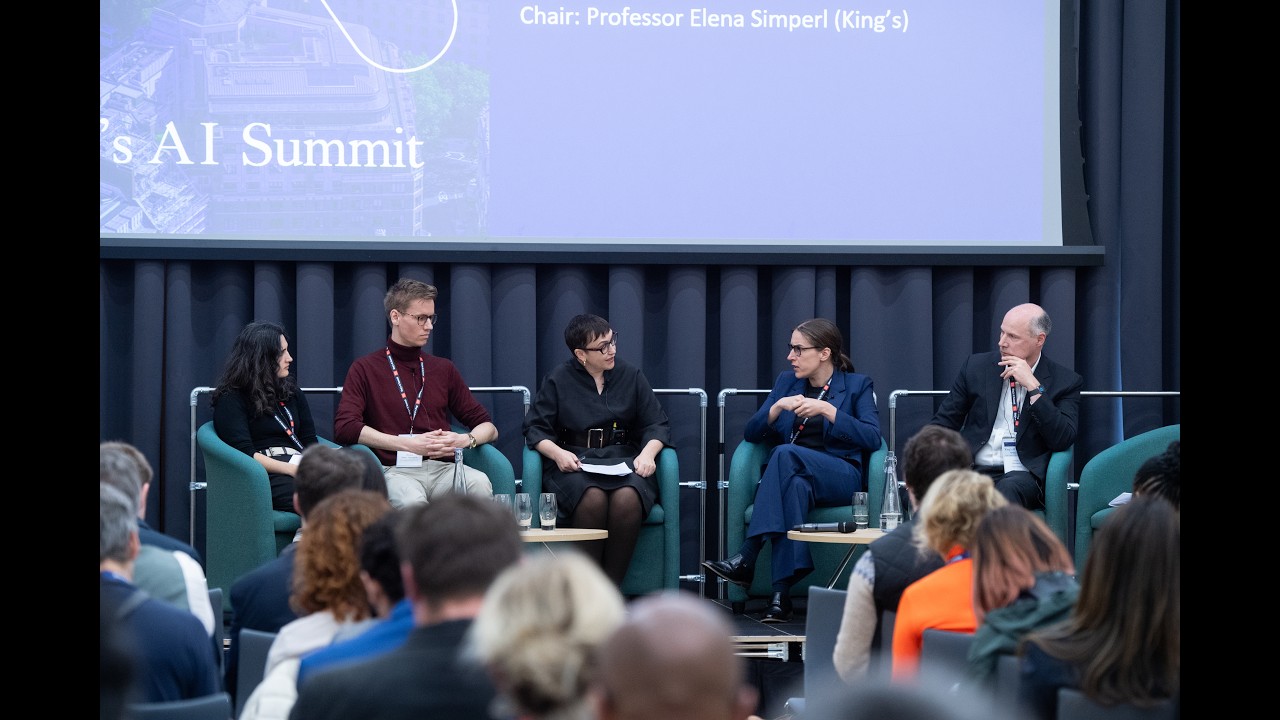
What Is Happening to Jobs? | King's AI Summit
Keywords
Summary
124 words
Critical Evaluation
Value of the Information & Strength of the Argument
The panel provides valuable insights from multiple perspectives: industry (Fitch Group), tech (Google), academia (KCL, UCL), and policy. The argumentation is solid, grounded in empirical research and historical analogies. They critically evaluate existing evidence, such as the McKinsey study on personal computing, and discuss the limitations of current measures of AI exposure. The discussion on uncertainty vs. automation is particularly insightful, supported by cross-country evidence on hiring declines. The panel also addresses the importance of firm-level data and the need for better research methods. Overall, the value is high, offering a nuanced and evidence-based view of the complex dynamics between AI and employment.
Scientific Rigor, Source Quality, Title Accuracy
The panel demonstrates scientific rigor by referencing specific studies and data, such as the McKinsey report, randomized control trials, and cross-country analyses. However, some claims are based on ongoing or unpublished research, and the discussion is more qualitative than quantitative. The title accurately reflects the content, and the panelists are credible experts. The sources cited are primarily from the description, including the King’s AI Summit website and related programs. The discussion is well-structured and avoids overgeneralization, acknowledging the limitations of current data. Overall, the scientific rigor is high, though the format limits the depth of evidence presented.
215 words
Title / Content Match
The title accurately reflects the central question addressed by the panel.
Quality & Reliability
8/10
Panel of experts from academia, industry, and policy, discussing evidence-based research on AI and labor markets. The discussion is nuanced, acknowledges uncertainty, and avoids overclaiming. However, it is a debate format with limited peer-reviewed evidence presented, and some claims are based on ongoing research.
Key Moments
Markers derived by PSI from the transcript: the creator did not define chapters.
- Introduction by Elena Simperl, setting the context for the panel.
- Andy Jackson (Fitch Group) discusses AI adoption principles: augmentation over replacement, disciplined adoption, and workforce investment.
- Zanna Iscenko (Google) presents historical lessons from personal computing and the jobs lost/gained/changed framework.
- Bouke Klein Teeselink (KCL) presents research on declining job openings in AI-exposed occupations, attributing it to uncertainty rather than automation.
- Maria del Rio-Chanona (UCL) discusses short-term effects on low vs. high-skilled workers and long-term adaptability.
- Panel discusses what evidence would be needed to attribute job changes to AI, including adoption rates and job description changes.
- Discussion on the need for firm-level data and better measurement of AI exposure.
- Concluding remarks on the importance of monitoring and policy action.
Cited Sources
- King's AI Summit — Official summit website with more information.
- AI and Workforce Futures programme — King's College London research programme related to the panel.
- King's AI Summit playlist — Playlist of other summit videos.
Concurring Sources
- McKinsey Global Institute — Research on automation and job displacement aligns with the panel's discussion.
- OECD Employment Outlook — Provides data on labor market trends and AI adoption.
Dissenting Sources
- Some studies suggest AI is a great equalizer — While the panel notes this, they also highlight that benefits may be limited to simple tasks, and more complex tasks favor experienced workers.
Contribution & Novelties
The panel provides a balanced, multi-stakeholder perspective on AI and jobs, emphasizing the distinction between automation and uncertainty effects. It highlights the need for better data and measurement, and calls for deliberate policy action. The discussion on self-fulfilling prophecies and the importance of adaptability adds depth.
Pour aller plus loin :
- General purpose technologies — Foundational concept for understanding AI’s potential impact.
- Task-based approach to labor markets — Framework for analyzing how technology affects jobs.
- McKinsey report on automation — Reference for historical job creation and displacement data.
88 words
Radar Profile
The radar profile shows high scores in information quality and reliability, reflecting the expert panel and evidence-based discussion. The technical level is moderate, making it accessible to a broad audience. The overall balance suggests a well-rounded and credible presentation.
💬 No comments were provided for analysis.