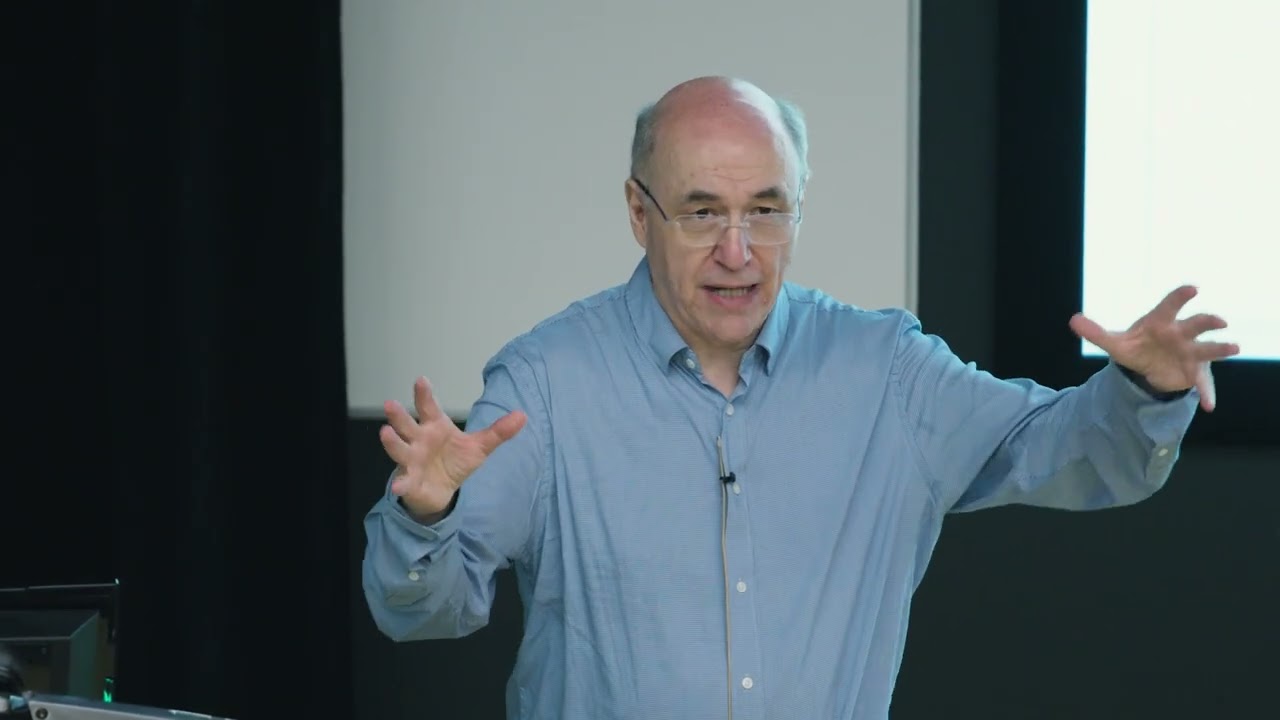
Computation and the Foundations of Physics, Mathematics and AI
Keywords
Summary
131 words
Critical Evaluation
Value of the Information & Strength of the Argument
The talk offers a high value in terms of presenting a unified and original perspective on fundamental science. Wolfram’s argumentation is logically structured, building from simple computational systems to complex physical theories. He provides concrete examples and visualizations, making the concepts accessible. However, the argumentation relies heavily on his own research program, and many claims are speculative without experimental validation. The strength of the argumentation lies in its internal consistency and the breadth of connections made, but it may not convince those outside his framework.
Scientific Rigor, Source Quality, Title Accuracy
The talk demonstrates scientific rigor in the sense that Wolfram carefully explains his reasoning and provides visual evidence. However, the sources cited are primarily his own work and the institutional links provided in the description (King’s College) are not directly related to the content. The title accurately reflects the content, which is a broad overview of his computational paradigm. The talk does not engage with alternative viewpoints or potential criticisms, which limits its scientific rigor.
175 words
Title / Content Match
The title accurately reflects the content, which covers computational foundations across physics, mathematics, and AI.
Quality & Reliability
8/10
The talk is given by Stephen Wolfram, a recognized expert in computation and physics, and presents a coherent theoretical framework. However, many claims are speculative and not yet peer-reviewed, and the talk is a presentation of his own research program.
Key Moments
Markers derived by PSI from the transcript: the creator did not define chapters.
- Introduction by the head of mathematics department, mentioning the collaboration with King's Institute for AI.
- Stephen Wolfram begins his talk, introducing the question of how complexity arises in nature.
- Discussion of cellular automata and rule 30, demonstrating simple rules producing complex behavior.
- Introduction of computational irreducibility and the principle of computational equivalence.
- Application of computational irreducibility to explain the second law of thermodynamics.
- Proposal that space is a discrete hypergraph, and that its evolution follows simple rules.
- Derivation of Einstein's equations from the hypergraph model, and discussion of dimension fluctuations.
- Speculation that dark matter is a manifestation of the microscopic dynamics of space.
- Discussion of the implications for AI and mathematics, suggesting that computation is fundamental.
- Q&A session begins, with questions from the audience.
Cited Sources
- King's Institute for Artificial Intelligence — Co-host of the event, mentioned in the introduction.
- Department of Mathematics at King's College London — Co-host of the event, mentioned in the introduction.
Concurring Sources
- Wolfram Physics Project — Official website presenting the hypergraph model and related papers.
Dissenting Sources
- Critique of Wolfram's physics project — Some physicists have expressed skepticism about the lack of experimental predictions and the speculative nature of the claims.
Contribution & Novelties
The talk presents a novel and ambitious framework that unifies physics, mathematics, and AI through the concept of computation. Wolfram’s key contributions include the notion of computational irreducibility, the hypergraph model of space, and the idea that the second law of thermodynamics arises from observer limitations. These ideas challenge traditional approaches and offer a new perspective on fundamental questions.
Pour aller plus loin :
- Cellular automaton — Foundational concept for Wolfram’s work.
- Computational irreducibility — Key concept introduced by Wolfram.
- Wolfram Physics Project — Official site for the hypergraph model of physics.
92 words
Radar Profile
The radar profile shows high scores in quantity of information and technical level, reflecting the dense and advanced content. The quality of information is also high, but the global reliability is lower due to the speculative nature of many claims. This suggests a talk that is intellectually stimulating but should be consumed with a critical eye.
💬 Sur les 0 commentaires analysés, aucune tendance n'est disponible.