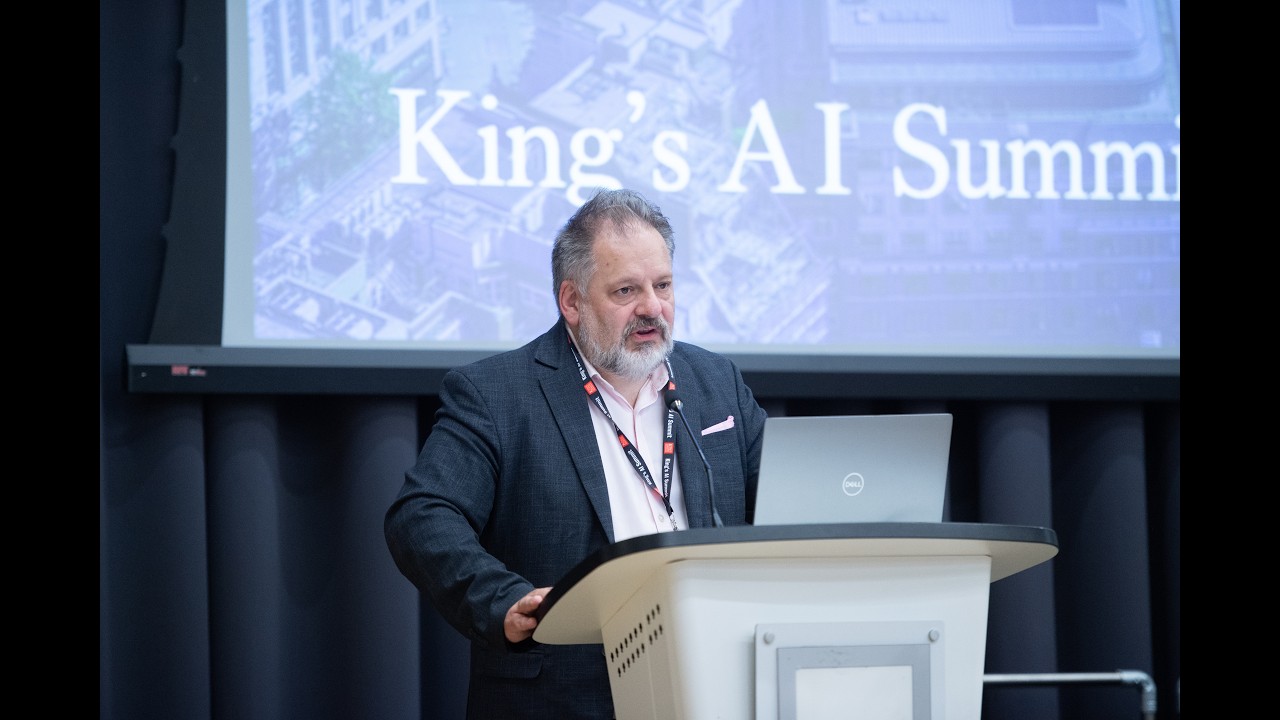
Howard Dawber OBE at the King's AI Summit
Keywords
Summary
175 words
Critical Evaluation
Value of the Information & Strength of the Argument
The speech provides valuable insights into the policy perspective on AI’s impact on the workforce, particularly from a city government viewpoint. It offers concrete examples of London’s AI ecosystem and policy responses. The argumentation is persuasive, using personal anecdotes and references to data to support the need for proactive measures. However, it lacks detailed evidence and relies on general claims, such as the number of affected workers, without citing specific studies. The call for ‘AI realism’ is a compelling framework, but the speech is more motivational than analytical.
Scientific Rigor, Source Quality, Title Accuracy
The speech is scientifically light, as it is a policy address rather than a research presentation. It references reports from McKinsey, Stanford, and Goldman Sachs, but without specific citations. The title accurately reflects the content. The speaker’s authority as Deputy Mayor adds credibility, but the lack of detailed sourcing limits the scientific rigor. The description provides links to the summit and related programs, which are relevant but not directly cited in the speech.
176 words
Title / Content Match
The title accurately describes the content: a keynote speech by Howard Dawber at the King's AI Summit.
Quality & Reliability
7/10
The speaker is a senior government official (Deputy Mayor of London) providing an informed policy perspective. The content is largely opinion and policy advocacy, with some references to data and reports (McKinsey, Stanford, Goldman Sachs) but without detailed citations. The speech is coherent and grounded in the context of London's AI ecosystem, but lacks rigorous scientific sourcing.
Key Moments
Markers derived by PSI from the transcript: the creator did not define chapters.
- Introduction and personal anecdote about daughter using ChatGPT.
- Comparison to historical breakthroughs (Rosalind Franklin, Maxwell).
- Advocacy for 'AI realism' and the mayor's approach.
- London's strengths as AI hub, mention of DeepMind, Turing Institute, and investments.
- Discussion of impact on jobs, example of Uber drivers, and statistics.
- Outline of the AI and Jobs Taskforce and three action areas.
- Mention of Community Union charter and ethical guardrails.
- Closing remarks and call to action.
Cited Sources
- King's AI Summit — Official summit website, mentioned in description.
- AI and Workforce Futures programme — Programme related to the summit, mentioned in description.
- Summit playlist — Playlist of summit videos, mentioned in description.
Concurring Sources
- McKinsey report on automation — Referenced in speech regarding timeline for autonomous vehicles, but no specific URL given.
Contribution & Novelties
This speech offers a unique perspective from a city government leader on AI and workforce policy, emphasizing the need for proactive governance. It introduces the concept of ‘AI realism’ as a balanced approach. The speech is valuable for understanding how local governments are preparing for AI’s impact.
Pour aller plus loin :
- AI and Workforce Futures — Programme at King’s College London addressing AI’s impact on work.
- Alan Turing Institute — UK’s national institute for data science and AI, mentioned as a key London institution.
- DeepMind — Leading AI research lab based in London, mentioned in the speech.
- Mayor of London’s AI and Jobs Taskforce — Official page for the taskforce, though specific URL not provided; concept is central to the speech.
122 words
Radar Profile
The radar profile shows high scores in quantity and quality of information, reflecting the speech's informative content. The technical level is moderate, as it is accessible to a general audience. The overall reliability is moderate, given the lack of detailed citations.