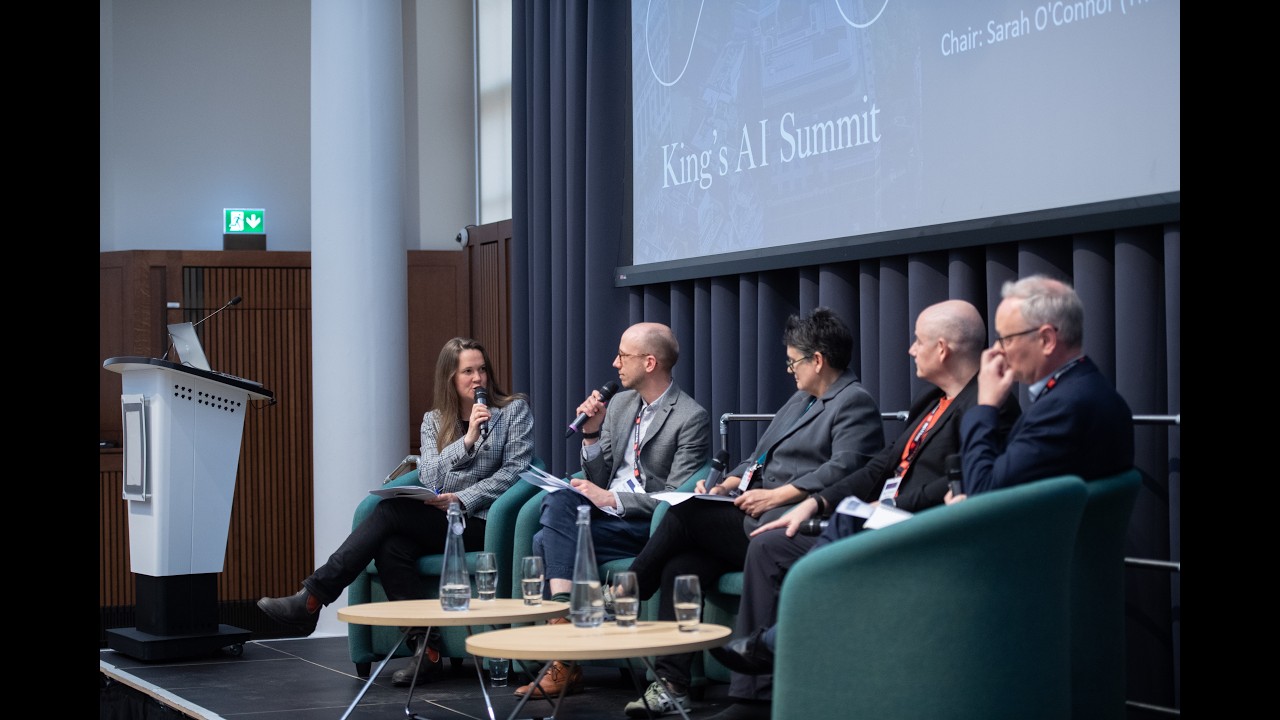
From Lecture Hall to Labour Market: The Role of Universities in the AI Age | King's AI Summit
Keywords
Summary
187 words
Critical Evaluation
Value of the Information & Strength of the Argument
The panel provides valuable insights into the intersection of AI, education, and the labor market. The discussion is well-argued, with panelists drawing on their diverse expertise: Diane Coyle offers a policy perspective, Antonio Mele brings evidence from educational experiments, Jack Snape outlines government initiatives, and Graham Wynn shares practical experience from university leadership. The argumentation is solid, with concrete examples such as the LSE’s AI tutor experiments and the UK’s AI Skills Boost program. The panel effectively addresses the complexity of the issue, acknowledging the uncertainties and trade-offs involved. The value of the information is high, as it synthesizes current research and policy developments, offering actionable insights for educators, policymakers, and students.
Scientific Rigor, Source Quality, Title Accuracy
The discussion is scientifically rigorous, with panelists referencing specific programs and research, such as the AI and Workforce Futures programme at King’s and the AI economics institute announced by the Chancellor. The sources cited are credible, including government departments and academic institutions. The title accurately reflects the content, focusing on the role of universities in the AI age. The panel maintains a high level of intellectual honesty, acknowledging limitations and uncertainties. The discussion is well-moderated, keeping the focus on the key questions. Overall, the rigor and source quality are strong, with no obvious biases or misinformation.
223 words
Title / Content Match
The title accurately reflects the panel discussion on the role of universities in the AI age, focusing on the transition from education to employment.
Quality & Reliability
8/10
Panel of experts from academia, government, and journalism discussing the role of universities in preparing students for an AI-shaped labor market. The discussion is grounded in current research and policy initiatives, with balanced perspectives and no obvious misinformation.
Key Moments
Markers derived by PSI from the transcript: the creator did not define chapters.
- Introduction by moderator Sarah O'Connor, setting the stage for the panel on universities and AI.
- Panelists introduce themselves: Jack Snape (DSIT), Diane Coyle (Cambridge), Antonio Mele (LSE), Graham Wynn (King's).
- Discussion on who is responsible for preparing young people for an AI-shaped job market, with Jack Snape outlining government's role.
- Diane Coyle discusses the need for universities to engage with policymakers and the challenges of academic incentives.
- Graham Wynn answers whether an 18-year-old should go to university, emphasizing the value of expertise and human capabilities.
- Antonio Mele discusses using AI as a tutor to enhance learning, citing experiments at LSE.
- Graham Wynn elaborates on rebalancing education towards human skills and the evolution of assessment methods.
- Jack Snape discusses lifelong learning and government initiatives like AI Skills Boost.
- Diane Coyle and Sarah O'Connor discuss the importance of job quality and the Swedish example of lifelong learning.
- Panelists offer concluding thoughts on the role of universities in the AI age.
Cited Sources
- King's AI Summit — Official summit website, providing context for the event.
- AI and Workforce Futures programme — King's College London research programme related to the panel topic.
- King's AI Summit playlist — Playlist of other summit videos, providing additional context.
Concurring Sources
- King's AI Summit — Official summit website, aligning with the panel's themes.
- AI and Workforce Futures programme — Research programme that supports the discussion's focus on AI and work.
Contribution & Novelties
The panel offers a nuanced perspective on the role of universities in the AI age, emphasizing that AI acts as a ‘force multiplier’ on expertise, making deep knowledge and critical thinking more valuable. It highlights the need for universities to rebalance education towards human capabilities like judgment, creativity, and ethical reasoning, and to use AI to enhance learning rather than bypass it. The discussion also underscores the importance of lifelong learning and collaboration between universities, government, and employers.
Pour aller plus loin :
- AI and Workforce Futures programme — Relevant research initiative at King’s College London.
- Department for Science, Innovation and Technology — UK government department responsible for AI policy.
- LSE Department of Economics — Antonio Mele’s institution, relevant for educational experiments.
122 words
Radar Profile
The radar profile shows high scores in information quantity, quality, and reliability, with a moderate technical level. This indicates a well-rounded discussion that is accessible yet substantive, suitable for a broad audience interested in the societal implications of AI.