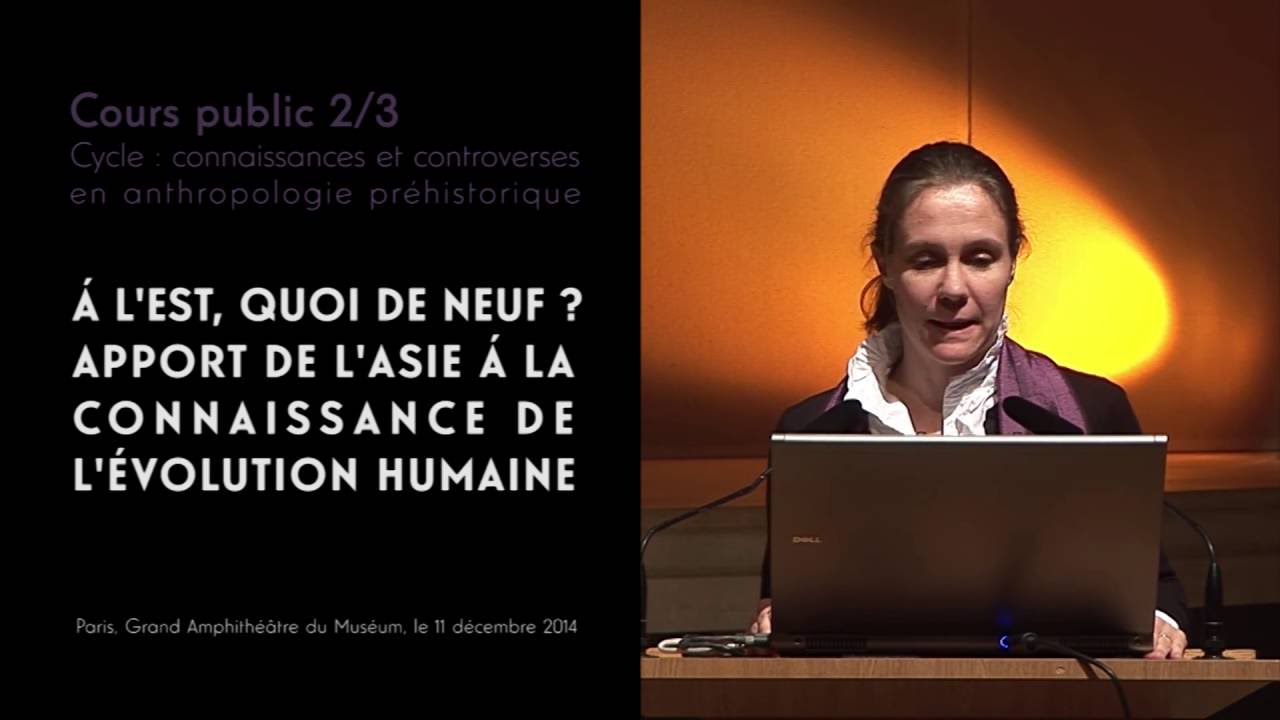
A l'est, quoi de neuf ? Apport de l'Asie à la connaissance de l'évolution humaine (2/3)
To the East, what's new? Contribution of Asia to the knowledge of human evolution (2/3)
Keywords
Summary
157 words
Critical Evaluation
Value of the Information & Strength of the Argument
The lecture provides valuable information on the history of paleoanthropology in Asia, correcting the common Eurocentric or Afrocentric bias by showcasing the rich fossil record from China. Vialet presents a well-structured argument, moving from historical context to specific case studies, and supports her claims with references to dating methods, morphological analyses, and comparative studies. She also addresses controversies, such as the interpretation of fire use at Zhoukoudian and the reconstruction of the Nanjing skull, demonstrating a balanced scientific approach. The argumentation is solid, though some points could benefit from more detailed evidence, but overall it is convincing and informative.
Scientific Rigor, Source Quality, Title Accuracy
The lecture demonstrates high scientific rigor, with clear references to specific sites, dating techniques (e.g., paleomagnetism, U-Th), and comparative morphological analyses. Vialet cites her own research and that of colleagues, and the content aligns with current scientific knowledge. The title accurately reflects the content, which is a detailed overview of Asian contributions to human evolution. The lecture is well-sourced, though it lacks explicit citations to publications, but the speaker’s expertise and the institutional context (Muséum national d’Histoire naturelle) lend credibility. The title is appropriate and not misleading.
201 words
Title / Content Match
The title accurately reflects the content, which focuses on the contribution of Asian discoveries to understanding human evolution.
Quality & Reliability
8/10
The lecture is given by a specialist (Amélie Vialet, paleoanthropologist at MNHN) and presents well-documented scientific findings, including references to specific sites, dating methods, and comparative analyses. The content is rigorous and up-to-date, though it is a conference rather than a peer-reviewed publication.
Key Moments
Markers derived by PSI from the transcript: the creator did not define chapters.
- Introduction to the importance of Asia in paleoanthropology, referencing the 'East' and the history of discoveries.
- Discussion of early pioneers like Teilhard de Chardin and the role of Jesuit missionaries in China.
- Overview of the Zhoukoudian site and the discovery of Homo erectus fossils.
- Description of the Nanjing skull and its significance, including dating and morphology.
- Presentation of the Yunxian site and its contribution to understanding Homo erectus variability.
- Discussion of the role of carnivores in fossil accumulation and implications for early human behavior.
- Conclusion summarizing the importance of Asian discoveries and future research directions.
Cited Sources
- Muséum national d'Histoire naturelle — Institution of the speaker and host of the lecture.
Concurring Sources
- Homo erectus — General information on Homo erectus, consistent with the lecture's content.
Contribution & Novelties
This lecture provides a comprehensive overview of Asian contributions to paleoanthropology, highlighting recent discoveries and ongoing research. It emphasizes the importance of Asia in the human evolutionary story, often overshadowed by African discoveries. The speaker presents new data from sites like Nanjing and Yunxian, offering fresh insights into Homo erectus variability and behavior. The lecture also discusses methodological advances, such as multidisciplinary approaches and international collaborations, which are crucial for future research.
Pour aller plus loin :
- Homo erectus — Overview of the species and its significance.
- Zhoukoudian — The famous Peking Man site.
- Paleoanthropology — The scientific study of human evolution.
102 words
Radar Profile
The radar profile shows high scores in information quantity and quality, reflecting the lecture's comprehensive and well-structured content. The technical level is also high, indicating a specialized audience. The overall reliability is strong, given the speaker's expertise and the institutional backing.
💬 Sur les 0 commentaires analysés, aucune tendance n'est disponible.