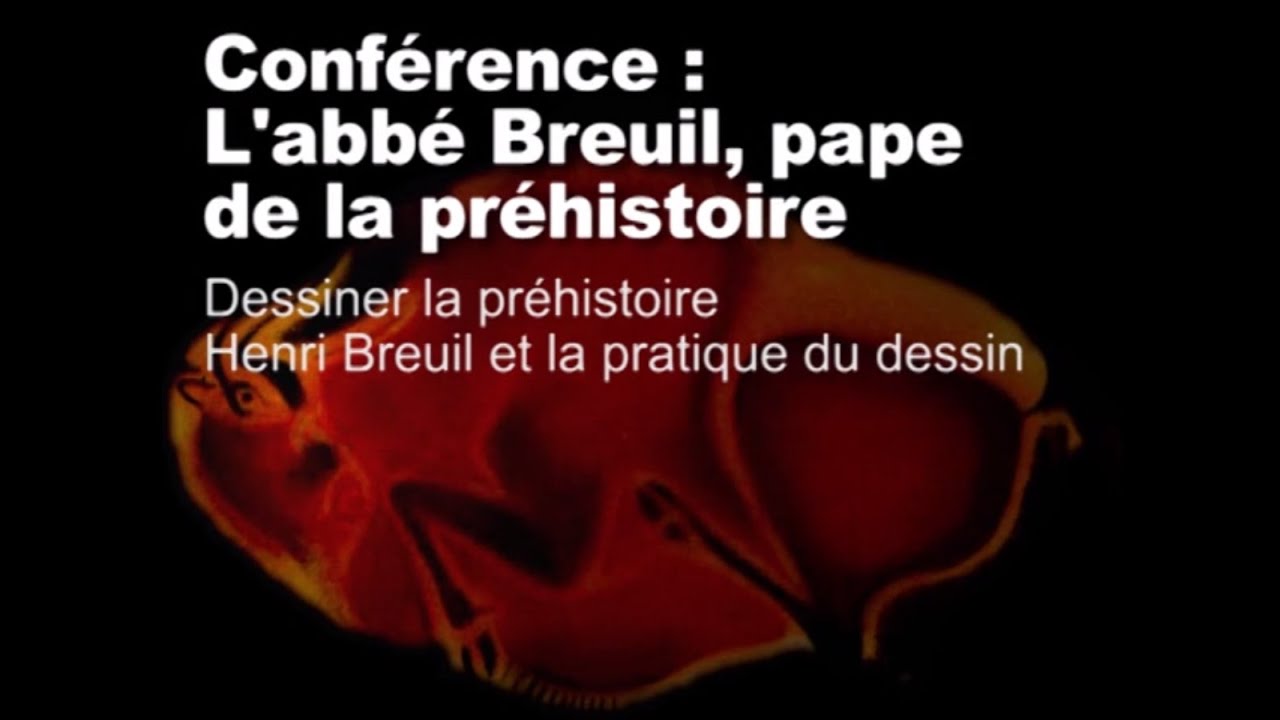
Dessiner la Préhistoire (L’abbé Breuil, "pape" de la Préhistoire 2/11)
Drawing Prehistory (Abbé Breuil, "Pope" of Prehistory 2/11)
Keywords
Summary
192 words
Critical Evaluation
Value of the Information & Strength of the Argument
The value of this presentation lies in its original perspective on Breuil’s work, focusing on his practice of drawing rather than his theoretical interpretations. Coye uses archival sources, including letters and manuscripts, to support his arguments. He presents a coherent thesis that Breuil’s drawing was not merely a technical skill but a fundamental aspect of his scientific approach, aimed at conveying the essence of the artworks. The argumentation is well-structured, moving from Breuil’s early life to his major works, and it successfully demonstrates the continuity in his practice. However, some claims, such as the interpretation of Breuil’s intentions, are speculative and based on limited evidence, but they are presented as such.
Scientific Rigor, Source Quality, Title Accuracy
The presentation demonstrates strong scientific rigor, drawing on primary sources such as Breuil’s autobiography, letters, and manuscripts. Coye, as a heritage curator, is well-positioned to analyze these materials. The sources are cited appropriately, and the speaker acknowledges the limitations of certain documents, such as the autobiography’s retrospective nature. The title accurately reflects the content, which is a focused analysis of Breuil’s drawing practice. The talk does not rely on external sources but rather on the speaker’s expertise and archival research, which is appropriate for this type of conference presentation.
215 words
Title / Content Match
The title accurately reflects the content, which focuses on Abbé Breuil's drawing practice and its role in his scientific work.
Quality & Reliability
8/10
The talk is given by a heritage curator and historian, based on archival research and primary sources (letters, autobiography, manuscripts). The speaker is an expert in the field, and the content is well-documented, though it represents an interpretive analysis rather than a systematic review.
Key Moments
Markers derived by PSI from the transcript: the creator did not define chapters.
- Introduction: presentation of the topic and the three key elements: travel, collection, and drawing.
- Discussion of Breuil's travels and his work on collections, emphasizing his role in transferring collections to public institutions.
- Introduction of the central role of drawing, with a quote from a letter to Joseph Déchelette.
- Breuil's early drawing practice and its continuity with his scientific work.
- Breuil's first major work on collections: inventory of Bronze Age objects in the Somme and his work on Piette's collection.
- Breuil's first cave art tracings at Altamira and his techniques.
- Discussion of Breuil's techniques for tracing cave art, including direct tracing and color rendering.
- Breuil's dissatisfaction with his reproductions and his later revisions, focusing on conveying the impression of the artworks.
- Analysis of Breuil's children's book 'Beyond the Bounds of History' and its significance.
- Conclusion: Breuil's drawing practice as a coherent whole, integrating intuition and scientific method.
Cited Sources
- Beyond the Bounds of History — Breuil's 1949 book, discussed as a marginal but essential work that synthesizes his career.
- Autobiography of Abbé Breuil — Breuil's autobiographical writings, used to understand his self-perception and the continuity of his practice.
- Lettre de Breuil à Joseph Déchelette, 15 août 1906 — A letter quoted to illustrate Breuil's drawing activities during his missions.
- Note manuscrite 'Comment j'ai appris à dessiner' (vers 1958) — A manuscript note where Breuil discusses his drawing techniques and influences.
Concurring Sources
- Breuil, H. (1952). Quatre cents siècles d'art pariétal. — Breuil's major work on cave art, which aligns with his approach to drawing and interpretation.
Dissenting Sources
- Critiques of Breuil's tracings by later prehistorians — Some later researchers have criticized Breuil's tracings for being subjective and not faithful to the original artworks, which contrasts with his own stated goals.
Contribution & Novelties
The presentation offers a novel approach by analyzing Breuil’s drawing practice as a coherent whole, linking his early naturalist drawings, his collection drawings, and his cave art tracings. It highlights the importance of drawing in Breuil’s scientific method and his deliberate choice to prioritize authenticity over fidelity. The analysis of ‘Beyond the Bounds of History’ as a key to understanding Breuil’s vision is particularly insightful.
Pour aller plus loin :
- Abbé Breuil — Biographical context and overview of his work.
- Art pariétal — General information on cave art and its study.
- Altamira — Specific site discussed in the talk, with details on its art and history.
106 words
Radar Profile
The radar profile shows high scores in information quantity, quality, and technical level, reflecting a dense and well-supported presentation. The global reliability is also high, indicating a trustworthy source. The overall score of 4 stars is justified by the depth and originality of the analysis.